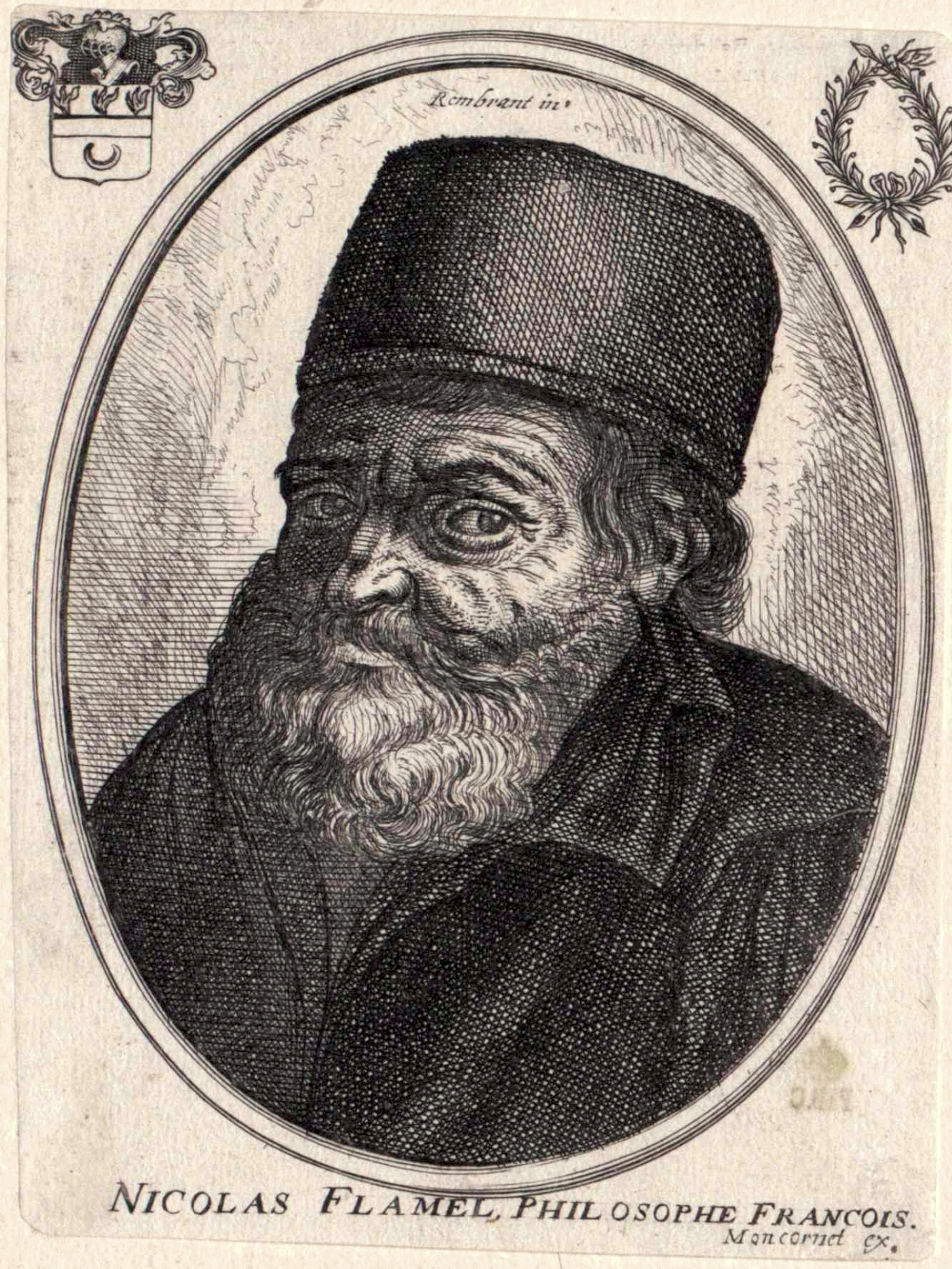
Nicolas Flamel was a real French scribe who lived in Paris during the fourteenth century. Long after his death, he became a famous figure in alchemical legend, said to have created the philosopher's stone and achieved immortality.
- Flamel was a real French scribe who lived in Paris from c. 1340 to 1418.
- He married Perenelle, who brought wealth from previous husbands.
- The legend of his alchemy appeared nearly 200 years after his death.
- He is said to have created the philosopher's stone and achieved immortality.
- Modern historians confirm he was a document draftsman, not an alchemist.
What it is
Nicolas Flamel is a historical person who has been transformed into a legendary magical figure. He was originally a French scribe and document draftsman who lived in Paris in the late fourteenth and early fifteenth centuries. His life is well documented through surviving contracts and property records. However, long after his death, he developed a reputation as an alchemist. People believe he discovered the philosopher's stone and used it to achieve immortality. These stories are not based on his actual life but were invented in the seventeenth century. Today, he is best known as a fictional character in modern fantasy literature and film.
Where it comes from
The legend of Nicolas Flamel began nearly two hundred years after his death in 1418. The primary source for these claims is the Livre des figures hiéroglyphiques, published in 1612. This text attributes alchemical secrets to him. According to the story, Flamel bought a mysterious book in 1357. He traveled to Spain to find help translating it. There, he met a Jewish scholar who helped him decode the text. The couple allegedly used this knowledge to create the philosopher's stone. They produced silver in 1382 and gold shortly after. Scholars later questioned the validity of these accounts, suggesting the publisher fabricated the narrative to sell books.
How it is done
The legendary method involves the creation of the philosopher's stone. Alchemists believe this substance can turn base metals into gold. It is also said to grant eternal life through the Elixir of Life. The process begins with a mysterious manuscript purchased by Flamel. A sage helps translate the hidden meanings. The couple then follows the recipe within the text. They successfully replicate the transmutation of metals. This success allows them to live forever. The real Flamel left no such instructions. His will shows he was generous but did not possess extraordinary wealth. Historical research confirms he was a scribe, not a practitioner of alchemy.
Tools and materials
The central tool in the legend is a mysterious twenty-one-page book. Flamel is said to have purchased this codex in 1357 for two florins. The text contains hieroglyphic figures and alchemical symbols. A Jewish converso provides the key to understanding these images. The translation reveals the recipe for the philosopher's stone. In reality, Flamel used quills and parchment to draft public documents. He ran a school to teach writing skills. He owned property and commissioned religious sculptures. There is no evidence he used alchemical equipment or studied Hebrew texts.
Nicolas Flamel, drawn and placed
- Living
- Revived
- Fading
- Historical
- Legendary
- Performed
- Lineage
- Western alchemy
What it is for
In legend, the purpose of Flamel's work is to gain unlimited wealth and eternal life. The philosopher's stone transforms lead into gold. The elixir stops aging and prevents death. These goals define the highest aims of Western alchemy. In fiction, characters seek Flamel's secrets to achieve similar power. Modern readers are drawn to the idea of an immortal master alchemist. Historically, Flamel used his skills to earn a living. He drafted contracts and managed properties. He contributed to churches and supported the poor. His actual purpose was practical administration, not magical transformation.
Who does it
Nicolas Flamel himself was a scribe, not an alchemist. He worked as an écrivain public in Paris. This role involved drafting legal documents for others. Few people could read or write at that time. He and his wife Perenelle ran a school for this trade. She brought wealth from previous marriages. They became noted for their philanthropy. Flamel designed his own tombstone before dying in 1418. The legend portrays him as a master adept. Fictional versions often depict him as a powerful wizard. Scholars study his historical documents to separate fact from fiction.
Peoples and places
The legend is primarily French, rooted in Parisian history. Flamel lived and died in France. His house still stands in the city today. The street named after him intersects with one named for his wife. The story spread through European alchemical circles in the seventeenth century. Isaac Newton referenced Flamel in his journals. Victor Hugo included him in literary works. The legend gained global fame through modern popular culture. Books and films have adapted the character for international audiences. The core identity remains tied to medieval France.
At a glance: who, where and when
Peoples


What people believe
Alchemical belief holds that matter can be perfected. The philosopher's stone represents the ultimate achievement of this art. It bridges the gap between the physical and spiritual worlds. Immortality is seen as a reward for mastering nature. Flamel is viewed as a successful initiator who crossed this threshold. The legend suggests that hidden knowledge exists in ancient texts. Decoding these symbols leads to divine power. Skeptics view the story as a fabrication. They argue it was created to promote alchemical sales. The belief in Flamel's immortality persists in fiction rather than serious practice.
When it is done
There are no specific festivals or calendar days associated with Nicolas Flamel. The legend does not tie his achievements to seasonal cycles or holy days. His historical life followed the standard rhythms of medieval Paris. He worked as a scribe year-round. He contributed to church projects when funds allowed. He died in March 1418. His tombstone was carved in 1410. The legend emerged in the seventeenth century without a fixed date. Modern adaptations do not observe any special rituals or commemorations for him.
How scholars and sceptics see it
Historians distinguish clearly between the real Flamel and the legend. Research by M. and R. Rouse shows he was a scribe, not a book seller. Documents calling him a copyist are mistaken or forged. Etienne Villain first questioned the alchemical claims in 1761. He identified the publisher as the likely author of the myth. Scholars agree that Flamel had no involvement in pharmacy or medicine. His will proves he lacked the vast wealth described in legends. Academic consensus treats the alchemical stories as seventeenth-century inventions. They reflect the interests of later writers, not the reality of the fourteenth century.
Cautions and what is closed
The legend of Nicolas Flamel is purely fictional. No historical evidence supports his alchemical achievements. Claims of immortality are scientifically impossible. Modern fraudsters sometimes use his name to sell fake remedies. Consumers should be wary of products claiming alchemical origins. The real Flamel was a legitimate professional. His legacy is preserved in historical archives and architecture. Fictional portrayals vary widely in accuracy. Some depict him as a villain, others as a wise mentor. Readers should understand these are creative interpretations, not historical facts.
Compare and confuse
Nicolas Flamel is often confused with other alchemical figures. He shares traits with Hermes Trismegistus, the mythical founder of alchemy. Unlike Hermes, Flamel is a documented historical person. He is also compared to Paracelsus, a famous Renaissance alchemist. Flamel's legend is unique in its focus on a scribe becoming a master. Other traditions have similar immortal figures, but none match his specific story. The name appears in many different fictional universes. Each adaptation changes his role and powers. The core element of the philosopher's stone remains constant across comparisons.
Law and persecution
There are no laws specifically regulating Nicolas Flamel. He is a public domain historical figure. His image and name can be used freely in creative works. Copyright does not protect his historical identity. Some fictional adaptations may have their own intellectual property rights. Governments do not recognize alchemical claims as valid. Transactions involving philosopher's stones are not legally binding. Fraudulent sales of alchemical goods are subject to consumer protection laws. The historical site of his house is protected as heritage. Visitors can see the inscription on the wall. Legal status is neutral regarding the legend.
Questions people ask about Nicolas Flamel
Who was Nicolas Flamel?
Nicolas Flamel was a real French scribe who lived in Paris during the fourteenth and fifteenth centuries. He drafted public documents and ran a school for writing. He is not historically known as an alchemist, though legends claim otherwise.
Did Nicolas Flamel really discover the philosopher's stone?
No, there is no historical evidence that he discovered the philosopher's stone. The story originated in the seventeenth century, long after his death. Scholars consider these accounts to be fictional inventions designed to promote alchemical ideas.
Where did the legend of Nicolas Flamel come from?
The legend comes from the Livre des figures hiéroglyphiques, published in 1612. This book attributed alchemical secrets to him. It claimed he decoded a mysterious manuscript with help from a Jewish scholar in Spain.
Is Nicolas Flamel immortal?
According to legend, yes. Stories say he and his wife Perenelle achieved immortality using the Elixir of Life. Historically, he died in 1418 and was buried in Paris. His immortality is a fictional trope used in modern fantasy.
What is Nicolas Flamel known for today?
He is best known as a fictional character in popular culture. He appears in novels like Harry Potter and films like Fantastic Beasts. These works use his legendary status as an immortal alchemist for entertainment purposes.
Good reading and sources
- Nicolas Flamel on WikipediaEncyclopedia
- More photos on Wikimedia CommonsPhotos and video
- Wikidata recordOpen data
The facts on this page come from the Wikipedia article "Nicolas Flamel", written by its contributors and used under the CC BY-SA 4.0 licence, and from its Wikidata record (CC0). EveryJaadu rewrote the text in its own words, with AI assistance, and compares every page with the article to make sure no passage is copied. It may be reused under the same CC BY-SA 4.0 licence with a link back.
It may contain mistakes. Names and customs differ from one community to the next, and some knowledge is closed to outsiders and left out here. This page describes belief and practice. It does not say that any of it works, it is not a how-to, and it is not medical advice. If something is wrong, tell us. Last refreshed 2026-10-05.
More from France
All the entries from France 🇬🇧 United Kingdom and 2 moreKing ArthurBrenin Arthur
A legendary British king and folk hero of medieval literature and Welsh mythologyFigure · Power and authority · Wonder and entertainment Legendary
🇬🇧 United Kingdom and 2 moreKing ArthurBrenin Arthur
A legendary British king and folk hero of medieval literature and Welsh mythologyFigure · Power and authority · Wonder and entertainment Legendary
 🇫🇷 France and 5 moreWerewolf
A mythical shapeshifter that turns into a wolf, central to European witch-hunts and Gothic horror.Being · Cursing and harm · Wonder and entertainment Legendary
🇫🇷 France and 5 moreWerewolf
A mythical shapeshifter that turns into a wolf, central to European witch-hunts and Gothic horror.Being · Cursing and harm · Wonder and entertainment Legendary
 🇫🇷 FranceHoly GrailSaint Graal
A cup or stone from Arthurian tales that grants healing and eternal lifeFigure · Healing · Luck and prosperity Legendary
🇬🇧 United Kingdom and 1 moreBugbear
A medieval English creature used to frighten children into obedienceFigure · Cursing and harm Legendary
🇫🇷 FranceHoly GrailSaint Graal
A cup or stone from Arthurian tales that grants healing and eternal lifeFigure · Healing · Luck and prosperity Legendary
🇬🇧 United Kingdom and 1 moreBugbear
A medieval English creature used to frighten children into obedienceFigure · Cursing and harm Legendary
Related elsewhere
All figure 🇪🇬 Egypt and 1 moreSphinx
A mythical hybrid with a human head and lion body, serving as guardian or riddler in Egyptian and Greek traditions.Being · Protection · Wonder and entertainment Legendary
🇺🇸 United States and 1 moreHorace Goldin
A stage magician known for his fast style and the sawing illusion.Illusion · Wonder and entertainment Historical
🇪🇬 Egypt and 1 moreSphinx
A mythical hybrid with a human head and lion body, serving as guardian or riddler in Egyptian and Greek traditions.Being · Protection · Wonder and entertainment Legendary
🇺🇸 United States and 1 moreHorace Goldin
A stage magician known for his fast style and the sawing illusion.Illusion · Wonder and entertainment Historical
 🇨🇳 ChinaLan Caihe藍采和
An ambiguous Taoist immortal known for a flower basket and wandering songsBeing · Wonder and entertainment Legendary
🇪🇬 EgyptDjedi
A fictional magician from the Westcar Papyrus who resurrects animals and foretells a king's lineage.Figure · Seeing and foretelling · Wonder and entertainment Legendary
🇨🇳 ChinaLan Caihe藍采和
An ambiguous Taoist immortal known for a flower basket and wandering songsBeing · Wonder and entertainment Legendary
🇪🇬 EgyptDjedi
A fictional magician from the Westcar Papyrus who resurrects animals and foretells a king's lineage.Figure · Seeing and foretelling · Wonder and entertainment Legendary