
Maat
In its own language: mꜣꜥt
from Egyptian mꜣꜥt; cuneiform texts point to a New Kingdom pronunciation like /múʔʕa/, and Coptic ⲙⲉⲉ carries the sense
An Egyptian idea of truth, law and balance, and the goddess who stands for it
Maat is an ancient Egyptian word for truth, balance, law and justice, and the name of the goddess who stands for it. She is said to keep the stars and seasons in order, and her feather was the measure used when the dead were judged.
- Her ostrich feather was weighed against the heart of a dead person
- The Pyramid Texts of Unas, around 2375 to 2345 BCE, hold the oldest substantial records
- From the Eighteenth Dynasty she was called a daughter of Ra
- Judges in later periods wore images of Maat
- Scribal schools taught sacred writing and arithmetic from the Middle Kingdom
What it is
Maat is at once an idea and a figure in ancient Egyptian religion. As an idea it names truth, balance, law, morality and justice. As a figure it is a goddess, drawn as a young woman, sometimes with a wing on each arm and an ostrich feather on her head. She is said to have set the stars and the seasons and to govern what people and gods do. Her opposite is Isfet, a word for chaos, injustice, violence and wrong doing. The order she stands for is held to have been fixed at creation, and keeping it there was a task shared by the king and by ordinary people.
Where it comes from
The oldest substantial records of Maat come from the Old Kingdom, chiefly the Pyramid Texts of Unas, dated around 2375 and 2345 BCE. Pictures of her as a goddess begin in the middle of the Old Kingdom, roughly 2680 to 2190 BCE. In Egyptian accounts of creation, Ra is said to have emerged only once she had been put in the place of chaos. From the Eighteenth Dynasty, about 1550 to 1295 BC, she was called a daughter of Ra, which let kings claim they ruled by her warrant. Accounts differ over her partner: Thoth often stands as her male counterpart because their qualities overlap, while other versions pair Thoth with Seshat and make Shu her brother.
How it is done
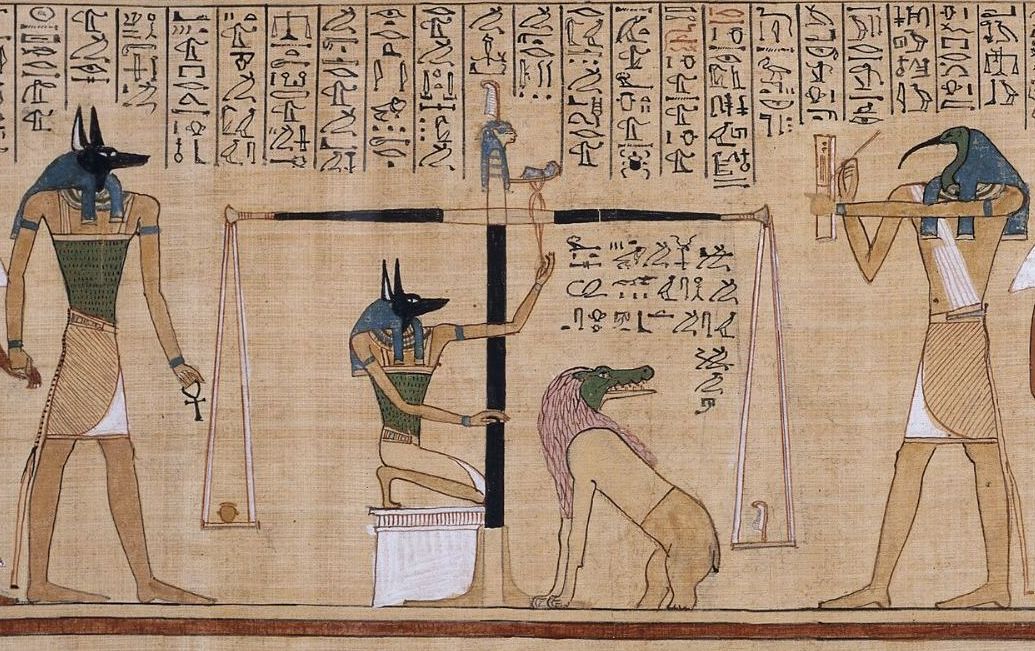
The best known setting for Maat is the judgement of the dead, the Weighing of the Heart, which takes place in the Duat, the Egyptian realm of the dead. A person's heart is set against her feather, and the balance is believed to decide whether that soul reaches the paradise of the afterlife. In daily life the working of Maat was a matter of conduct rather than a spell: public and ritual life, correctly carried out, was held to keep the world in order, and the king was charged with holding her in place. Judges in later periods wore her image while hearing cases.
Tools and materials
Her sign is the ostrich feather, worn on her head and used as the weight in the judgement of the dead. She is also linked with the balance that holds feather and heart, and with scales more generally. Nobody is sure what the feather meant to the Egyptians; the god Shu, in some stories her brother, wears the same emblem. Kings were shown with her symbols to make plain their duty of upholding law and right conduct, and from later periods judges carried pictures of her.
Maat, drawn and placed
- Living
- Revived
- Fading
- Historical
- Legendary
- Performed
- Lineage
- ancient Egyptian religion and mythology
- Timing
- in everyday conduct, and at the judgement of the dead
What it is for
Maat was the standard against which daily conduct was measured. People were expected to deal honestly with family, community, the state, the land and the gods. The concept served the needs of a growing Egyptian state made up of peoples with different interests, and it became the ground of Egyptian law, holding disorder back. It also asked something of the powerful: the rich were urged to help those with less, a duty echoed in tomb inscriptions about feeding the hungry, clothing the naked and caring for widows and orphans. In the afterlife it decided who reached paradise.
Who does it
Priests were the ritual specialists, and from the Fifth Dynasty, around 2510 to 2370 BCE, the vizier who oversaw justice bore the title Priest of Maat. Judges at later dates wore her image. Much of the everyday work of Maat fell to the sesh, a word for scribes, bureaucrats and educated men who drafted, read and kept records. Scribal schools began in the Middle Kingdom, around 2060 to 1700 BCE, and their teachers were priests. Pupils were picked by date of birth, most of them boys though some privileged girls attended; they could board or live at home, and learned sacred writing alongside practical arithmetic.
Peoples and places
Maat belongs to ancient Egypt, and no single cult centre is given for her: all Egyptian cities are named instead. The principle is described as a response to a state that drew together peoples of differing interests. Scribes wrote and read letters aloud for people who could not read, so the idea reached past the literate elite, and complaints from the poor were carried upward through them. Through the Greek period Egyptian law ran beside Greek law, and Egyptian practice let women act on their own and hold substantial property, which in time affected the tighter customs of the Greeks and Romans.
At a glance: who, where and when
Who does it
Peoples
Belief worlds
Occasions



What people believe
Behind Maat lies a conviction that the world holds together as one holy order. Correct public and ritual life is held to keep that harmony, and any break in it is thought to reach both the individual and the state: an impious king could be blamed for famine, and blasphemy was said to bring blindness. Isfet, meaning chaos, lies and violence, is the opposing force. The creator is quoted in a Middle Kingdom text, from roughly 2062 to 1664 BCE, saying he made every person like his fellow. Maat was thought to join the cosmos, the living world, the kingdom and the single person into one whole.
Compare and confuse
Maat is most often set against Isfet, its named opposite, a word covering injustice, chaos, violence and evil doing. The Coptic descendants of the Egyptian word, ⲙⲉⲉ and ⲙⲉ, carry the sense of truth and justice. Thoth, god of writing and reckoning, shares several of her qualities and appears as her male partner in some accounts, while in others he is paired with Seshat and Maat is linked to Shu as a sibling.
Law and persecution
Maat was applied as a spirit rather than a written code, and little survives describing how Egyptian courts actually worked. From the Fifth Dynasty the chief judge, the vizier, held the title Priest of Maat, and later judges wore her picture. Wisdom texts known as Sebayt offered case by case advice on settling disputes in her spirit, so few general rules can be drawn from them. Under Greek rule two legal systems ran side by side; the Egyptian one let women own property and act alone, and it later shaped Greek and Roman practice. Roman control replaced this with the empire's own law.
Questions people ask about Maat
What is Maat?
Maat is an ancient Egyptian word for truth, balance, law, morality and justice, and the name of the goddess who embodies it. She is shown as a young woman with an ostrich feather, and her opposite is Isfet, the word for chaos and wrong doing.
Where does Maat come from?
The oldest substantial records are in the Pyramid Texts of Unas, from around 2375 to 2345 BCE, in Old Kingdom Egypt. Depictions of her as a goddess appear from roughly 2680 to 2190 BCE, and in the Eighteenth Dynasty she was called a daughter of Ra.
What was the Weighing of the Heart?
It is the judgement of the dead, set in the Duat, the Egyptian realm of the dead. The person's heart is placed against Maat's feather, and the balance is believed to decide whether that soul reaches the paradise of the afterlife.
Was Maat a goddess or an idea?
Both. The word covers a principle of order, truth and justice that people were expected to follow in daily life, and it is also the name of the goddess who personifies that principle and keeps the stars and seasons in their course.
Good reading and sources
- Maat on WikipediaEncyclopedia
- More photos on Wikimedia CommonsPhotos and video
- Wikidata recordOpen data
The facts on this page come from the Wikipedia article "Maat", written by its contributors and used under the CC BY-SA 4.0 licence, and from its Wikidata record (CC0). EveryJaadu rewrote the text in its own words, with AI assistance, and compares every page with the article to make sure no passage is copied. It may be reused under the same CC BY-SA 4.0 licence with a link back.
It may contain mistakes. Names and customs differ from one community to the next, and some knowledge is closed to outsiders and left out here. This page describes belief and practice. It does not say that any of it works, it is not a how-to, and it is not medical advice. If something is wrong, tell us. Last refreshed 2026-10-21.
More from Egypt
All the entries from Egypt 🇪🇬 Egypt and 1 moreLilithלִילִית
A feminine figure from Mesopotamian and Jewish mythology, often depicted as a night demon or spirit.Being · Cursing and harm Legendary
 🇪🇬 EgyptCurse
A spoken wish for harm, often backed by ritual or divine authorityBelief · Cursing and harm · Protection Historical
 🇪🇬 EgyptAnubis𓇋𓈖𓊪𓃣
The jackal-headed god who guides souls and oversees mummification in ancient Egypt.Being · Protection · Speaking with spirits and the dead Historical
🇪🇬 EgyptAncient Egyptian afterlife beliefs
A system of rituals and texts guiding the soul through the underworld to eternal rebirthTradition · Protection · Speaking with spirits and the dead Historical
Related elsewhere
All belief 🇮🇶 Iraq and 4 moreAstrology
A system of divination that links human affairs to the positions of celestial bodiesTradition · Seeing and foretelling · Luck and prosperity Living
 🇫🇷 France and 2 moreKing ArthurBrenin Arthur
A legendary British king and folk hero of medieval literature and Welsh mythologyFigure · Power and authority · Wonder and entertainment Legendary
 🇺🇸 United States and 5 moreSatanism
A modern set of beliefs using the figure of Satan as a symbol or deity.Tradition · Power and authority · Cursing and harm Living
 🇲🇾 Malaysia and 1 morePawang
A shaman from Indonesia and Malaysia who commands spirits, weather, and wild animals.Being · Protection · Cursing and harm Living