
Iravan
In its own language: அரவான்
from Sanskrit Irā, meaning possessing food or provisions
A Hindu deity worshipped as a severed head for healing and protection
Iravan is a figure from the Mahabharata epic who became a major folk deity in South India. He is worshipped as his own severed head to cure illness and help childless women conceive.
- Worshipped as a severed head in South India
- Son of Arjuna and Naga princess Ulupi
- Believed to cure disease and induce pregnancy
- Central deity in the Kuttantavar cult
- Known as Irawan in Indonesian Wayang Kulit
What it is
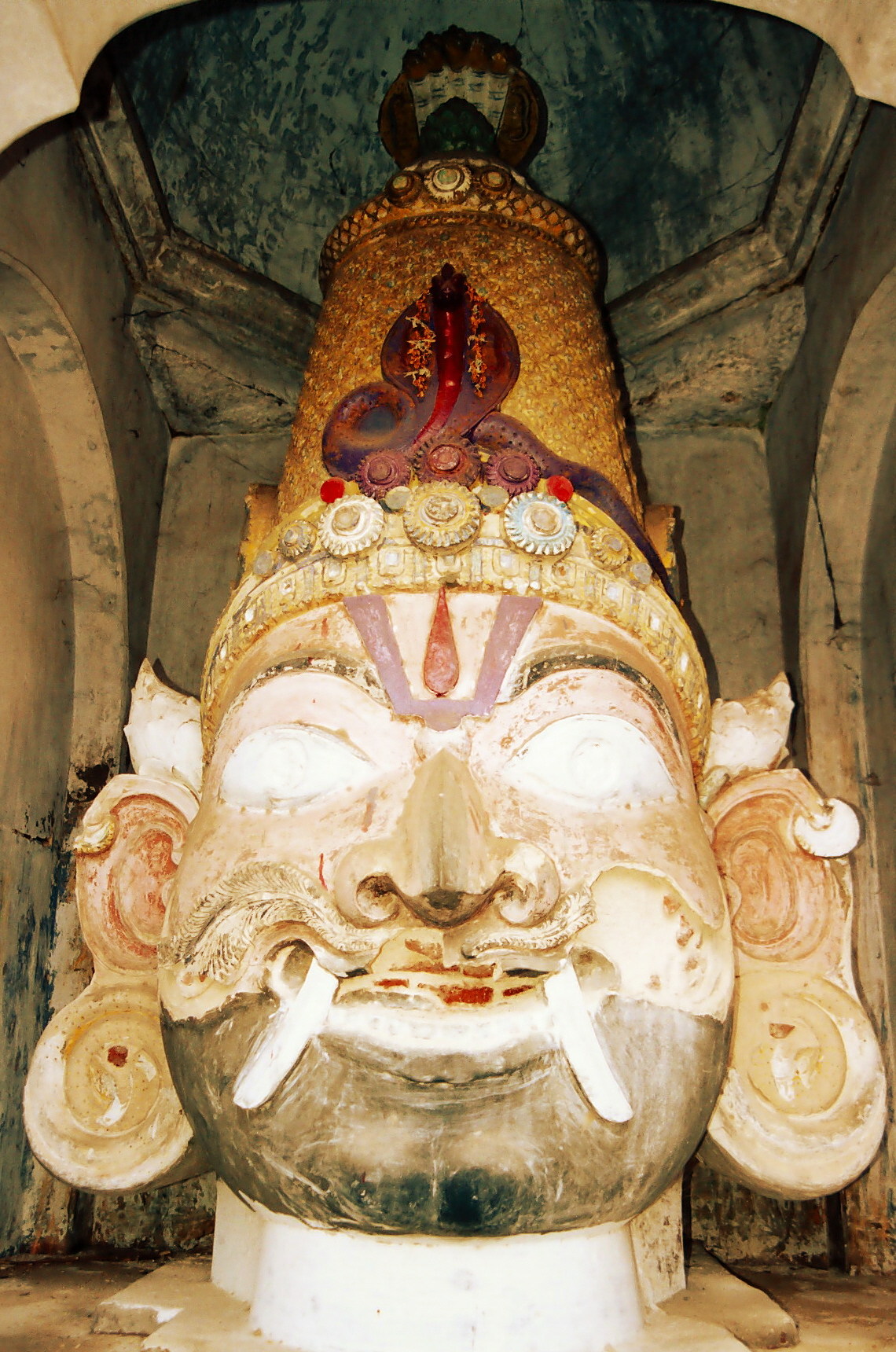
Iravan is a character from the Hindu epic Mahabharata who evolved into a distinct folk deity. In South Indian traditions, he is worshipped primarily in the form of his severed head. This iconography represents a specific boon granted by the god Krishna after Aravan sacrificed himself to the goddess Kali before the Kurukshetra War. The practice focuses on his ability to witness the war through his eyes even after death. Devotees believe this powerful state allows him to intervene in human affairs. He is widely venerated for his capacity to heal sickness and grant fertility to women who cannot have children.
Where it comes from
The character first appears in the Mahabharata as the son of Arjuna and the Naga princess Ulupi. While the epic describes his heroic death in battle, South Indian folklore developed a separate narrative. Here, Aravan voluntarily sacrifices himself to ensure victory for the Pandavas. This legend was recorded in Tamil texts starting with the ninth-century Parata Venpa. Over centuries, the story expanded through folk theatre and local temple traditions, shifting focus from the warrior to the divine head that remains conscious.
How it is done
Worship involves processions carrying painted wooden heads of Aravan. During the eighteen-day Draupadi festival, a ceremonial head is hoisted on a post to symbolically watch the ritual re-enactment of the war. In some temples, these heads are placed on roof corners to guard against spirits. Performers also stage Aravan Kalappali, a street theatre piece depicting his self-decapitation before Kali. These acts serve as communal remembrance and direct appeals for the deity's blessing.
Tools and materials
The primary tool is the Aravan head, crafted from wood or carved from black stone. Images often feature a red face, large ears, and fangs. A conical crown topped with a cobra hood signifies his mother's lineage. Some icons include a Vaishnava tilak mark on the forehead. Portable versions are used in processions, while permanent stone statues remain in shrines at sites like Koovagam and Kothattai.
Iravan, drawn and placed
- Living
- Revived
- Fading
- Historical
- Legendary
- Performed
- Lineage
- Hinduism
- Timing
- during festivals and annual rituals
What it is for
Devotees seek Aravan's aid for physical healing and reproductive health. Childless women specifically pray to the head form to induce pregnancy. The deity is also viewed as a guardian spirit. Placing his image on temple roofs is believed to protect the sacred space from malevolent forces. The worship acknowledges the cost of conflict while seeking renewal and life from the sacrifice.
Who does it
The cult is maintained by local communities and temple priests in South India. Women play a central role in the Draupadi sect rituals. In Indonesia, the figure is known as Irawan and is featured in Wayang Kulit shadow puppet performances. Javanese traditions have adapted the story, sometimes removing the snake lineage and altering the marriage details to fit local theatrical styles.
Peoples and places
The tradition is strongest among Tamil communities in India, particularly in regions like Thanjavur and Koovagam. The Kuttantavar cult is dedicated exclusively to him. In Indonesia, the Javanese people know him as Irawan. Indonesian stories differ significantly from Indian ones, often involving a dramatic marriage to Titisari and a death caused by mistaken identity rather than battlefield sacrifice.
At a glance: who, where and when
Who does it
Belief worlds
Occasions


What people believe
The theology rests on the boons given by Krishna. Aravan asked to be married before dying and to see the entire war. His severed head fulfills the second wish, allowing him to observe events continuously. This makes him a unique observer and participant in cosmic history. The association with Kali links his power to fierce feminine divinity and the acceptance of violent sacrifice for greater good.
When it is done
Major celebrations occur during the annual Draupadi festival, which lasts eighteen days and typically falls between April and May. Specific villages perform Aravan Kalappali annually. The rituals align with the lunar calendar and seasonal cycles common to South Indian temple festivals. The timing mirrors the duration of the original epic war.
Questions people ask about Iravan
Who is Iravan?
Iravan is a figure from the Hindu epic Mahabharata. He is the son of Arjuna and the Naga princess Ulupi. In South Indian folk religion, he is worshipped as a deity known as Aravan or Kuttantavar.
Why is he worshipped as a head?
According to legend, Krishna granted Aravan a boon to witness the war after his death. His head was severed but remained conscious, allowing him to see the entire battle. This unique state makes him a powerful object of worship.
What powers are attributed to him?
Devotees believe Aravan can cure diseases and help childless women conceive. His image is also used as a protective charm against evil spirits when placed on temple roofs or carried in processions.
How is he known in Indonesia?
In Indonesia, he is called Irawan. Javanese traditions tell different stories about him, often featuring a marriage to Titisari and a death by mistake. He appears in traditional shadow puppet plays called Wayang Kulit.
Good reading and sources
- Iravan on WikipediaEncyclopedia
- More photos on Wikimedia CommonsPhotos and video
- Wikidata recordOpen data
The facts on this page come from the Wikipedia article "Iravan", written by its contributors and used under the CC BY-SA 4.0 licence, and from its Wikidata record (CC0). EveryJaadu rewrote the text in its own words, with AI assistance, and compares every page with the article to make sure no passage is copied. It may be reused under the same CC BY-SA 4.0 licence with a link back.
It may contain mistakes. Names and customs differ from one community to the next, and some knowledge is closed to outsiders and left out here. This page describes belief and practice. It does not say that any of it works, it is not a how-to, and it is not medical advice. If something is wrong, tell us. Last refreshed 2026-10-15.
More from India
All the entries from India 🇮🇳 IndiaChakraचक्र
Meditation points in the subtle body used in Hindu and Buddhist yogaTradition · Speaking with spirits and the dead · Change and initiation Living
🇮🇳 IndiaMuhurtamuhūrta
A Hindu unit of time used to select auspicious moments for rituals and daily practiceBelief · Power and authority · Speaking with spirits and the dead Living
🇮🇳 IndiaChakraचक्र
Meditation points in the subtle body used in Hindu and Buddhist yogaTradition · Speaking with spirits and the dead · Change and initiation Living
🇮🇳 IndiaMuhurtamuhūrta
A Hindu unit of time used to select auspicious moments for rituals and daily practiceBelief · Power and authority · Speaking with spirits and the dead Living
 🇮🇳 India and 5 moreSpirit possession
A global belief that spirits or demons can take control of a person's body and mindBelief · Cursing and harm · Power and authority Living
🇮🇳 India and 5 moreSpirit possession
A global belief that spirits or demons can take control of a person's body and mindBelief · Cursing and harm · Power and authority Living
 🇮🇳 India and 5 moreKolamகோலம்
A daily geometric floor drawing made with rice flour at the home entrance in South IndiaTradition · Protection · Luck and prosperity Living
🇮🇳 India and 5 moreKolamகோலம்
A daily geometric floor drawing made with rice flour at the home entrance in South IndiaTradition · Protection · Luck and prosperity Living
Related elsewhere
All figure 🇪🇬 Egypt and 5 moreAmulet
A portable object worn or carried to ward off harm and invite fortuneCharm · Protection · Luck and prosperity Living
🇪🇬 Egypt and 5 moreAmulet
A portable object worn or carried to ward off harm and invite fortuneCharm · Protection · Luck and prosperity Living
 🇨🇳 China and 5 moreGuanyin觀音 (Guānyīn)
The Bodhisattva of compassion, worshipped across East Asia as a listener to human sufferingBeing · Protection · Healing Living
🇨🇳 China and 5 moreGuanyin觀音 (Guānyīn)
The Bodhisattva of compassion, worshipped across East Asia as a listener to human sufferingBeing · Protection · Healing Living
 🇮🇶 Iraq and 5 moreGrimoire
A textbook containing instructions for spells, rituals, and the creation of magical objects.Text · Protection · Healing Historical
🇮🇶 Iraq and 5 moreGrimoire
A textbook containing instructions for spells, rituals, and the creation of magical objects.Text · Protection · Healing Historical
 🇲🇳 Mongolia and 2 moreMongolian shamanismBöö mörgöl
The animistic and shamanic ethnic religion of the Mongol peoples, centered on sky worship and ancestral spirits.Tradition · Protection · Healing Living
🇲🇳 Mongolia and 2 moreMongolian shamanismBöö mörgöl
The animistic and shamanic ethnic religion of the Mongol peoples, centered on sky worship and ancestral spirits.Tradition · Protection · Healing Living