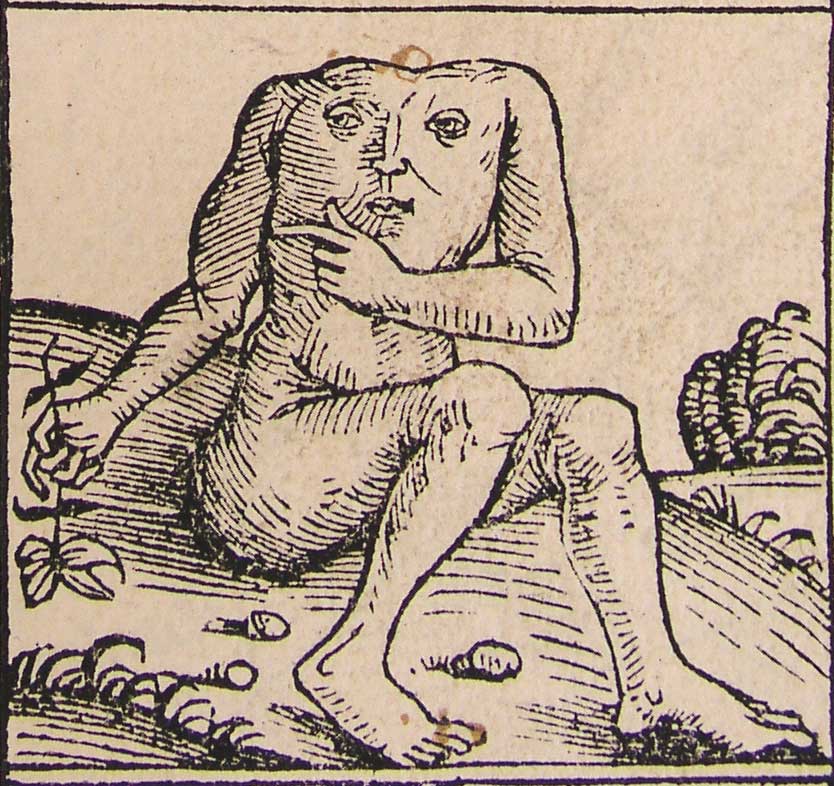
Headless men
from Greek akephaloi meaning headless ones, or Latin Blemmyes
A legendary race of people described as lacking heads or having facial features on their chest.
Headless men are mythical creatures found in ancient Greek and medieval European texts. They were said to live in remote regions like Libya, Ethiopia, and India. Their faces were believed to be located on their chests or shoulders.
- Blemmyes had faces on their chests or shoulders.
- Herodotus placed them in ancient Libya.
- Medieval maps showed them in Ethiopia and India.
- Raleigh reported Ewaipanoma in Guyana.
- Shark skull theory explains the chest face.
What it is
Headless men are mythical humanoids described in ancient and medieval literature. They are often called Blemmyes or akephaloi. These beings lack a head entirely. Instead, their eyes and mouth are placed on their chest. Some versions place these features on their shoulders. They appear in various cultures as examples of strange peoples. The descriptions vary across different historical periods.
Where it comes from
The concept likely began with Greek accounts of distant lands. Herodotus mentioned headless tribes in ancient Libya. Later writers expanded the legend to include other regions. The name Blemmyes may come from Hebrew or Coptic words. It might also derive from a term for desert people. The legend evolved through medieval maps and travel books.
Headless men, drawn and placed
- Living
- Revived
- Fading
- Historical
- Legendary
- Performed
- Lineage
- ancient mythology
What it is for
These figures served as wonders in geographical texts. They represented the unknown edges of the known world. Medieval scholars used them to illustrate divine creation. Cartographers placed them on maps to show distant territories. They were not worshipped but recorded as curiosities.
Peoples and places
The Blemmyes were originally linked to North Africa and the Nile. Later traditions moved them to India and Ethiopia. In South America, similar legends named them Ewaipanoma. Asian texts describe breast-eyed races in Zoroastrian scriptures. Chinese classics mention headless gods like Xingti. Different cultures adapted the core idea of missing heads.
At a glance: who, where and when
Peoples
![A blemmye, depicted in a map Guillaume Le Testu, Cosmographie universelle (Not labeled in manuscript but given here [1] )](https://upload.wikimedia.org/wikipedia/commons/1/18/Blemmyes-gallica-12148-btv1b8447838j-f64.jpg)


What people believe
Ancient writers treated these beings as real inhabitants of remote areas. Medieval maps depicted them alongside dog-headed men. Some scholars thought they resulted from ancestral sins. Others believed reports were exaggerations of local customs. Modern theories suggest misinterpretations of warrior tactics or animal remains.
How scholars and sceptics see it
Historians view these accounts as literary inventions. Anthropologists see parallels in global folklore about distorted bodies. Some researchers link the legend to hammerhead shark skulls. The physical description matches the shape of dried shark heads. This theory explains the chest face and shoulder eyes in new ways.
Compare and confuse
Headless men are related to cynocephali, or dog-headed men. Both appear on medieval mappae mundi. The Ewaipanoma of Guyana share the chest-face trait. Islamic geography describes war-čašmān similarly. All serve as markers of the exotic periphery in ancient texts.
Today
The legend persists in studies of myth and cartography. Maps from the Age of Discovery still feature these figures. Scholars analyze how Europeans perceived foreign lands. The stories remain examples of ancient imaginative geography.
Questions people ask about Headless men
What are headless men?
They are mythical beings described in ancient texts. They lack heads, with eyes and mouths on their chests. Writers first mentioned them in accounts of Libya and Ethiopia.
Where did the legend originate?
Greek historians like Herodotus wrote about headless tribes. They lived in remote parts of Africa and Asia. The names Blemmyes and akephaloi come from Greek sources.
Why do they have faces on their chests?
Ancient writers described this unusual anatomy. Some thought it was a combat tactic. Others believed it was a genetic trait. Modern scholars suggest shark skull misinterpretations.
Are they mentioned in other cultures?
Yes, Asian texts describe similar breast-eyed races. Zoroastrian scriptures and Chinese classics include them. South American legends also tell of headless people.
Good reading and sources
- Headless men on WikipediaEncyclopedia
- More photos on Wikimedia CommonsPhotos and video
- Wikidata recordOpen data
The facts on this page come from the Wikipedia article "Headless men", written by its contributors and used under the CC BY-SA 4.0 licence, and from its Wikidata record (CC0). EveryJaadu rewrote the text in its own words, with AI assistance, and compares every page with the article to make sure no passage is copied. It may be reused under the same CC BY-SA 4.0 licence with a link back.
It may contain mistakes. Names and customs differ from one community to the next, and some knowledge is closed to outsiders and left out here. This page describes belief and practice. It does not say that any of it works, it is not a how-to, and it is not medical advice. If something is wrong, tell us. Last refreshed 2026-10-06.
More from Libya
All the entries from Libya 🇮🇱 Israel and 2 moreLag BaOmerלַ״ג בָּעוֹמֶר
A Jewish holiday marking the end of a mourning period with bonfires and outdoor playTradition · Speaking with spirits and the dead · Wonder and entertainment Living
🇮🇱 Israel and 2 moreLag BaOmerלַ״ג בָּעוֹמֶר
A Jewish holiday marking the end of a mourning period with bonfires and outdoor playTradition · Speaking with spirits and the dead · Wonder and entertainment Living
 🇪🇬 Egypt and 2 moreSibylline Oracles
A mixed collection of ancient prophecies attributed to pagan prophetesses but shaped by Jewish and Christian writers.Text · Seeing and foretelling Historical
🇪🇬 Egypt and 2 moreSibylline Oracles
A mixed collection of ancient prophecies attributed to pagan prophetesses but shaped by Jewish and Christian writers.Text · Seeing and foretelling Historical
 🇬🇷 Greece and 5 moreZeusΖεύς
Supreme king of the Greek gods and ruler of the sky and thunderBeing · Power and authority Legendary
🇬🇷 Greece and 5 moreZeusΖεύς
Supreme king of the Greek gods and ruler of the sky and thunderBeing · Power and authority Legendary
 🇪🇬 Egypt and 2 moreAmunjmn (Old/Middle Egyptian); Amoun (Coptic)
The hidden creator god of ancient Egypt, later fused with the sun deity Ra.Being · Power and authority · Protection Historical
🇪🇬 Egypt and 2 moreAmunjmn (Old/Middle Egyptian); Amoun (Coptic)
The hidden creator god of ancient Egypt, later fused with the sun deity Ra.Being · Power and authority · Protection Historical
Related elsewhere
All being 🇬🇧 United Kingdom and 2 moreKing ArthurBrenin Arthur
A legendary British king and folk hero of medieval literature and Welsh mythologyFigure · Power and authority · Wonder and entertainment Legendary
🇬🇧 United Kingdom and 2 moreKing ArthurBrenin Arthur
A legendary British king and folk hero of medieval literature and Welsh mythologyFigure · Power and authority · Wonder and entertainment Legendary
 🇫🇷 France and 5 moreWerewolf
A mythical shapeshifter that turns into a wolf, central to European witch-hunts and Gothic horror.Being · Cursing and harm · Wonder and entertainment Legendary
🇫🇷 France and 5 moreWerewolf
A mythical shapeshifter that turns into a wolf, central to European witch-hunts and Gothic horror.Being · Cursing and harm · Wonder and entertainment Legendary
 🇬🇧 United KingdomBeltane Fire Festival
A modern Edinburgh performance celebrating the start of summer with fire and danceRite · Wonder and entertainment · Power and authority Living
🇬🇧 United KingdomBeltane Fire Festival
A modern Edinburgh performance celebrating the start of summer with fire and danceRite · Wonder and entertainment · Power and authority Living
 🇪🇸 Spain and 5 moreSt John's Eve
A Christian vigil marked by bonfires and plant gathering on the summer solstice eveRite · Protection · Speaking with spirits and the dead Living
🇪🇸 Spain and 5 moreSt John's Eve
A Christian vigil marked by bonfires and plant gathering on the summer solstice eveRite · Protection · Speaking with spirits and the dead Living