
Fengli
In its own language: 风狸 / 風狸
from Chinese fēng lí, meaning 'wind leopard cat'
A legendary flying mammal from Chinese lore, said to carry a magic wand and resist death.
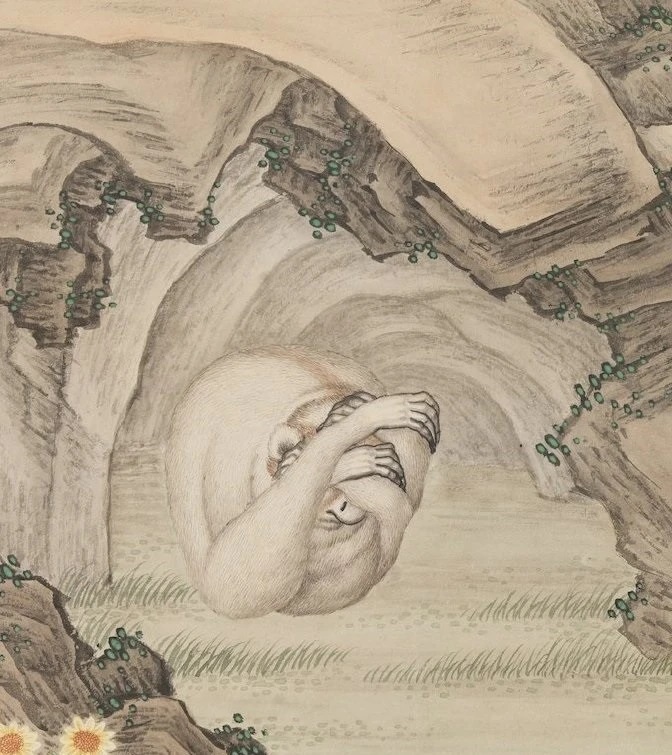
The fengli is a mythic creature from ancient Chinese texts, described as a small, spotted beast that glides between trees. Japanese sources later adopted the figure as the fūri. It was believed to possess magical immunity and carry a tool that could immobilize prey.
- Described as a small, spotted beast that glides between trees
- Carries a grass wand that immobilizes prey when pointed
- Feigns death but revives when exposed to wind
- Urine was used in traditional medicine for leprosy
- Japanese sources call the creature fūri
What it is
The fengli is a legendary mammal recorded in Chinese encyclopedias and medical compendiums. Texts describe it as a small animal with leopard-like spots that can glide through the air. Later Japanese writings refer to the creature as the fūri. Scholars view the fengli as a mythological figure rather than a biological reality. The stories blend descriptions of real animals with supernatural traits. It appears in major reference works from the tenth and sixteenth centuries.
Where it comes from
The name originates from the Guihai Yuheng zhi, a text about southern regions. Other aliases appear in records from Nanzhou and Lingnan. The Bencao gangmu compiled these earlier accounts into a single entry. Japanese scholars in the Edo period adapted the name and stories. Some writers confused the creature with local tanuki raccoon dogs. The lore likely grew from observations of gliding mammals in southern forests.
How it is done
Lore states the fengli carries a grass stalk or wand. Pointing this tool at birds or beasts causes them to fall or freeze. To obtain the wand, hunters strike the creature until it reveals its location. The beast feigns death when hit but revives when exposed to wind. It is said to be immune to blades and fire. Only crushing its bones or brain ensures permanent death.
Tools and materials
The primary magical item is a broken grass stalk called a wand. This tool grants control over other animals. A lethal counter-agent is the root of the sweet flag plant. Plugging the creature's nose with this root kills it instantly. Medicinal texts also mention its urine and brain for treating leprosy and extending life.
Fengli, drawn and placed
- Living
- Revived
- Fading
- Historical
- Legendary
- Performed
- Lineage
- Chinese bestiary tradition
What it is for
Ancient pharmacopoeias listed the fengli for medicinal use. Its urine was prescribed for leprosy, known as massive wind. The brain mixed with chrysanthemum flowers was believed to extend life by five hundred years. Hunters sought the creature for its magical wand. The wand provided an easy way to capture prey without chasing it.
Who does it
Scholars and compilers of encyclopedias documented the fengli. Writers like Minakata Kumagusu analyzed the creature as a potential colugo. Traditional hunters imagined capturing the beast for its wand. Medical practitioners referenced its parts in materia medica. No specific religious order or caste is associated with the creature.
Peoples and places
The fengli belongs to Chinese folklore and bestiaries. Japanese sources adopted the figure as the fūri during the Edo period. Chinese texts place the animal in southern provinces like Guangxi and Sichuan. Japanese writers initially doubted its existence in Japan. They later equated it with local tanuki species. The lore reflects interest in exotic southern fauna.
At a glance: who, where and when
Belief worlds

What people believe
The creature embodies wind and flight in Chinese thought. Immortals were thought to share its ability to fly. The fengli resists death through wind exposure, linking it to vital energy. Its immunity to fire and blades suggests a spiritual nature. The wand represents a bridge between human and animal worlds. These traits align with broader themes of transformation in folklore.
When it is done
No specific festivals or calendar days are tied to the fengli. It appears in general reference works rather than ritual calendars. Encounters were reported in southern regions year-round. The creature's activity was linked to wind conditions rather than seasons. Hunters waited near trees to catch it in action.
How scholars and sceptics see it
Researchers identify the fengli as a composite of real animals. Hypotheses suggest it resembles a colugo, palm civet, or slow loris. Scribal errors in ancient texts may have distorted its size and appearance. Scholars note confusion with the jiqu, another beast eating frankincense. The longevity claims reflect symbolic associations with immortals.
Cautions and what is closed
The fengli is a fictional entity with no physical presence. No actual harm comes from seeking the creature. Historical texts warn that striking the beast requires patience to retrieve the wand. Modern readers should treat medicinal claims as historical curiosities. The stories serve as entertainment and moral tales rather than practical guides.
Compare and confuse
The fengli is often compared to the colugo, a gliding mammal. It shares traits with the tanuki in Japanese folklore. The jiqu is a related beast noted for eating perfume. Both creatures appear in similar encyclopedic entries. The magic wand motif appears in other global folktales.
Questions people ask about Fengli
What is the fengli?
The fengli is a legendary mammal from Chinese texts. It is described as a small, spotted animal that glides through the air. Japanese sources later adopted the figure as the fūri. Scholars view it as a mythological figure based on real animals.
Where does the fengli come from?
The creature originates from Chinese encyclopedias and medical compendiums. Early texts like the Guihai Yuheng zhi mentioned it. Later works compiled these accounts into single entries. Japanese writers adapted the lore during the Edo period.
What magical powers does it have?
The fengli is said to carry a grass wand that freezes prey. It feigns death when hit but revives with wind. The beast is immune to blades and fire. Only crushing its bones ensures permanent death. These traits link it to wind and vitality.
Is the fengli a real animal?
No, the fengli is a mythical creature. Scholars believe it combines features of colugos, civets, and lorises. Ancient writers may have exaggerated observations of gliding mammals. The magical elements are symbolic rather than biological facts.
Good reading and sources
- Fengli on WikipediaEncyclopedia
- More photos on Wikimedia CommonsPhotos and video
- Wikidata recordOpen data
The facts on this page come from the Wikipedia article "Fengli", written by its contributors and used under the CC BY-SA 4.0 licence, and from its Wikidata record (CC0). EveryJaadu rewrote the text in its own words, with AI assistance, and compares every page with the article to make sure no passage is copied. It may be reused under the same CC BY-SA 4.0 licence with a link back.
It may contain mistakes. Names and customs differ from one community to the next, and some knowledge is closed to outsiders and left out here. This page describes belief and practice. It does not say that any of it works, it is not a how-to, and it is not medical advice. If something is wrong, tell us. Last refreshed 2026-10-06.
More from China
All the entries from China 🇨🇳 China and 2 moreJiang Ziya姜子牙
A historical strategist and war god who helped establish the Zhou dynastyFigure · Power and authority · Cursing and harm Historical
🇨🇳 China and 2 moreJiang Ziya姜子牙
A historical strategist and war god who helped establish the Zhou dynastyFigure · Power and authority · Cursing and harm Historical
 🇯🇵 Japan and 2 moreTamamo-no-Mae玉藻前
A nine-tailed fox spirit from Japanese legend who possessed emperors and concubines across Asia.Figure · Cursing and harm · Power and authority Legendary
🇯🇵 Japan and 2 moreTamamo-no-Mae玉藻前
A nine-tailed fox spirit from Japanese legend who possessed emperors and concubines across Asia.Figure · Cursing and harm · Power and authority Legendary
 🇨🇳 ChinaZhang Guolao张果老
A Taoist immortal known for his white donkey and fish drum, said to be a bat spirit.Figure · Protection · Luck and prosperity Legendary
🇨🇳 ChinaZhang Jue張角
A Taoist leader who used healing magic to spark a major rebellion in ancient China.Figure · Healing · Power and authority Historical
🇨🇳 ChinaZhang Guolao张果老
A Taoist immortal known for his white donkey and fish drum, said to be a bat spirit.Figure · Protection · Luck and prosperity Legendary
🇨🇳 ChinaZhang Jue張角
A Taoist leader who used healing magic to spark a major rebellion in ancient China.Figure · Healing · Power and authority Historical
Related elsewhere
All figure 🇬🇧 United Kingdom and 2 moreKing ArthurBrenin Arthur
A legendary British king and folk hero of medieval literature and Welsh mythologyFigure · Power and authority · Wonder and entertainment Legendary
🇬🇧 United Kingdom and 2 moreKing ArthurBrenin Arthur
A legendary British king and folk hero of medieval literature and Welsh mythologyFigure · Power and authority · Wonder and entertainment Legendary
 🇪🇬 Egypt and 1 moreSphinx
A mythical hybrid with a human head and lion body, serving as guardian or riddler in Egyptian and Greek traditions.Being · Protection · Wonder and entertainment Legendary
🇪🇬 Egypt and 1 moreSphinx
A mythical hybrid with a human head and lion body, serving as guardian or riddler in Egyptian and Greek traditions.Being · Protection · Wonder and entertainment Legendary
 🇫🇷 France and 5 moreWerewolf
A mythical shapeshifter that turns into a wolf, central to European witch-hunts and Gothic horror.Being · Cursing and harm · Wonder and entertainment Legendary
🇫🇷 France and 5 moreWerewolf
A mythical shapeshifter that turns into a wolf, central to European witch-hunts and Gothic horror.Being · Cursing and harm · Wonder and entertainment Legendary
 🇬🇧 United KingdomBeltane Fire Festival
A modern Edinburgh performance celebrating the start of summer with fire and danceRite · Wonder and entertainment · Power and authority Living
🇬🇧 United KingdomBeltane Fire Festival
A modern Edinburgh performance celebrating the start of summer with fire and danceRite · Wonder and entertainment · Power and authority Living