
Fangxiangshi
In its own language: 方相氏
from Chinese 方相氏, of disputed origin, with shi an honorific or clan suffix
An official Chinese exorcist who cleared demons from houses and tombs
The fangxiangshi was a ritual exorcist of early China, an office held under emperors from the Han to the Tang dynasty. He ran the seasonal Nuo rite that drove sickness-bringing demons out of buildings, and went ahead of coffins to keep corpse-eating wangliang spirits away from the tomb.
- Held as an official exorcist's post from the Han dynasty to the Tang
- Led the seasonal Nuo rite that drove sickness demons from houses
- Went ahead of coffins and struck the four corners of the burial chamber
- The Zhouli lists more than forty assistants attached to the office
- Survives as a masked character in Nuo opera and as Japan's hōsōshi
What it is
The fangxiangshi was an exorcist of early China, and the word names an office rather than one man. Two jobs belonged to the role. One was to run the Nuo, the seasonal clearing of sickness-bringing demons out of homes and public buildings. The other was to walk in front of a coffin and empty the burial chamber of wangliang, spirits said to feed on the dead. Texts describe the figure in a hide bearing four golden eyes, with a lance and a shield in hand. Those eyes were read as sight in every direction at once.
Where it comes from
The Chinese classics put the office's beginnings in the late Eastern Zhou, that is 771 to 256 BCE. Emperors kept fangxiangshi on the rolls from Han times (206 BCE to 220 CE) down to the Tang (618 to 907), after which the role passed into popular religion, where a mask with four eyes stood for it. The oldest full account sits in the Zhouli, the Rites of Zhou, in a section titled Offices of Summer and dated to about the 3rd century BCE. Whether the office truly began so early is not settled. A private form of the practice is said to have lasted to the present.
How it is done
During the Nuo, the exorcist and his retinue went through dwellings searching out pestilence and moving it on. A Han-era poem on Luoyang gives the scene at the year's end: lances raised, bundles of reed held aloft, a crowd of youths in dark clothing with red head coverings, bows of peach wood and arrows of wild jujube loosed at random, potsherds and pebbles thrown, torches carried after the retreating spectres, and bridges broken so that they could not return. At a burial the fangxiangshi went into the pit ahead of the coffin and struck its four corners with his lance.
Tools and materials
The ritual texts describe the equipment, though readers disagree about how it was assembled. A bear hide carried four eyes of gold; some take it as a cloak, others as something drawn over the head, and the 2nd-century commentator Zheng Xuan likened such a covering to a qitou, a demon mask. The four eyes matched the four quarters, the directions from which, in the Yellow River Valley, rain, wind, flood and drought were thought to arrive. A lance and a shield completed the gear. After the Tang, a four-eyed mask became the shorthand for the figure.
Fangxiangshi, drawn and placed
- Living
- Revived
- Fading
- Historical
- Legendary
- Performed
- Lineage
- Chinese state religion and Nuo exorcism
- Timing
- seasonally, at the year's end, and at funerals
What it is for
The office met two kinds of danger. Against epidemics, understood as demons that took up residence in buildings, the Nuo worked to shift them out of human space. Against the grave, the aim was the wangliang, beings believed to eat the liver and brain of the dead. Ying Shao, writing about 195 CE, used that belief to explain why tombs were planted with thuja and watched by stone tigers: the creature was said to fear both, and no household could keep an exorcist at the graveside permanently. Protection here covers the living and the body of the dead.
Who does it
The Zhouli gives the staff attached to the office: over forty people, among them four kuangfu, glossed as madmen or mediums, eight diviners with six helpers, scribes, accountants, servants and twenty runners. The fangxiangshi himself ranked among the wu, shamanic specialists inside the imperially sanctioned religion, and served as an official from Han to Tang. The texts do not say how a person was selected or taught. In later centuries the role moved into folk religion and masked performance, so that the exorcist became a part played rather than a post held.
Peoples and places
The practice is recorded in China, and a counterpart survived in Japan. Chinese material runs from the Zhouli through Han poetry and the dynastic histories to the masked Nuo opera of the present. The Japanese figure, hōsōshi, is written with the same characters and appears as an exorcist in Shinto ceremonies. Between the two, the office changed from a place in the state cult to a costumed role. The Zhouli description belongs to the Yellow River Valley, the region whose weather its four-eyed sight was meant to answer.
At a glance: who, where and when
Who does it
Belief worlds
Occasions

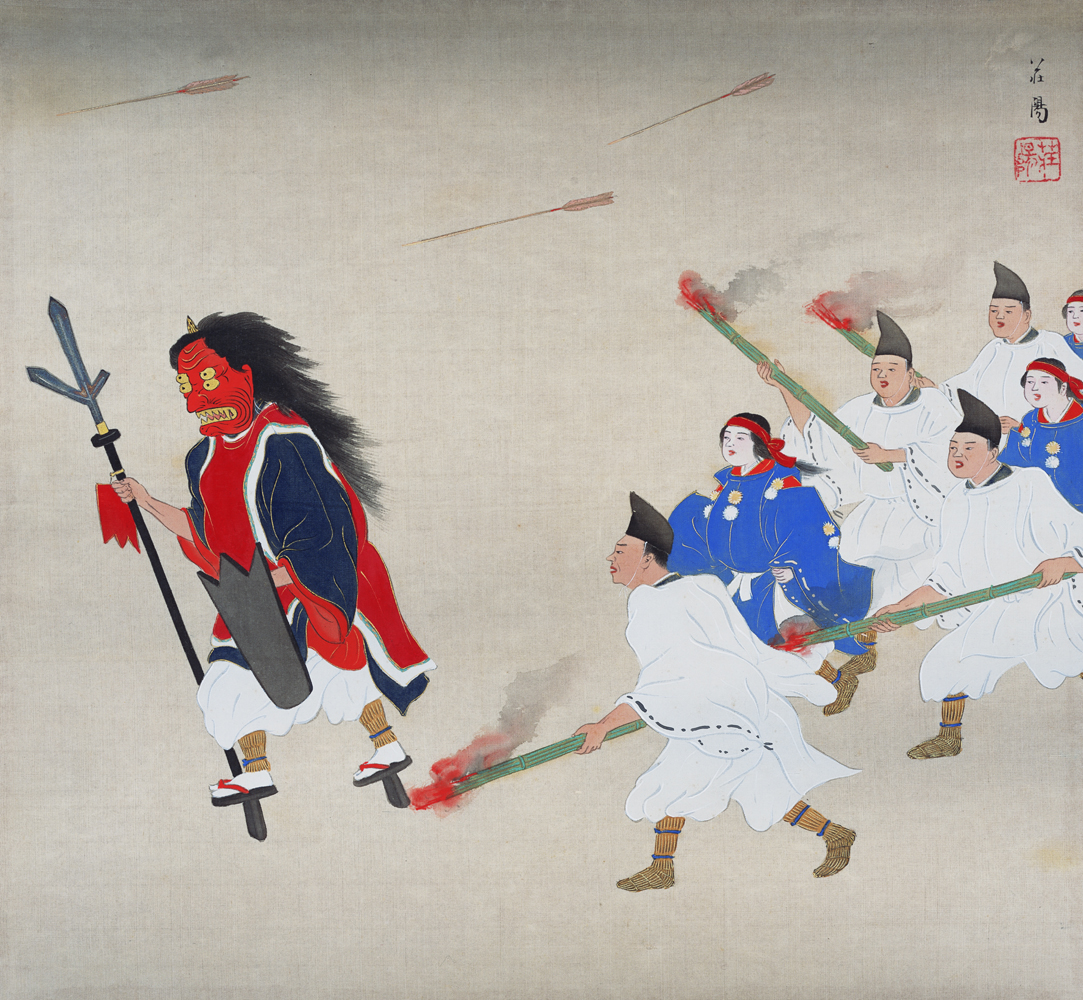

What people believe
Behind the office lies a world in which illness and misfortune are persons. A demon settles in a house; wangliang wait at a tomb to feed. Sight is the weapon: the four eyes stand for seeing every quarter at once, and the lance strikes the four corners to clear them. Scholars have noticed how close the names run, fangxiangshi beside fangliang, wangliang and wangxiang. Some, among them Chen Mengjia, Kobayashi Taichirō and William Boltz, argued that the exorcist personified the demons he drove out, so that he was in the end casting out himself.
When it is done
The Nuo was a seasonal rite, and the performance at the turn of the year was the great one; the Book of the Later Han places it a day before the sacrifice that closed the year. It came round again as the seasons did, an ordered clearing of the space people lived in. Funerals set the other date, whenever a death occurred: the exorcist went before the coffin and worked at the graveside as the body was laid in. The masked Nuo opera of later times keeps the figure before audiences.
How scholars and sceptics see it
The name carries most of the argument. Zheng Xuan, in the 2nd century, glossed fangxiang with two other characters meaning to banish and to imagine, which has been read as conjuring visions. Édouard Biot offered French renderings, 'inspecteurs de region' and 'preservateur universel'. English attempts run from 'square-faced exorcist' to 'he who scrutinizes for evil in many directions'. William Boltz, reviewing Derk Bodde's work, held that what counted was not the exorcist's look but the visions he called up, and suggested 'Master of Visions'. Boltz considered Bodde to have misread Zheng's gloss. The four-directions reading is common but not the only one.
Compare and confuse
The names crowd together: fangxiangshi, and the demons fangliang, wangliang and wangxiang. Some scholars think they share a single root. Zheng Xuan treated fangliang and wangliang as one being, and Ying Shao's Fengsu Tongyi quotes the Zhouli with wangxiang where the received text has fangliang. The Japanese hōsōshi is the same figure under another reading of the same characters.
Today
Today the fangxiangshi is met as a masked character in Chinese Nuo opera, and the same characters, read hōsōshi, name an exorcist in Japanese Shinto ceremonies. The office that emperors kept from Han to Tang is gone; what survives is a part performed in costume. Chinese tradition also holds that a private form of the practice continued among ordinary people down to the present.
Questions people ask about Fangxiangshi
What was a fangxiangshi?
An exorcist of early China. The role carried two duties: running the seasonal Nuo rite that drove disease-bearing demons out of houses, and going ahead of a coffin to clear corpse-eating wangliang spirits from the burial chamber. From Han to Tang the post was official.
Where does it come from?
Chinese classics date the office to the late Eastern Zhou, between 771 and 256 BCE, and the fullest early description is in the Zhouli, or Rites of Zhou. Emperors employed fangxiangshi from Han through Tang times, after which the role entered popular religion.
Why four golden eyes?
The hide worn by the exorcist was said to carry four eyes of gold. Commentators read them as sight in all four directions at once, the quarters from which, in the Yellow River Valley, rain, wind, flood and drought were believed to arrive.
What became of it?
After the Tang it moved from the state cult into folk religion, marked by a four-eyed mask. Today it appears as a masked character in Chinese Nuo opera, and the same characters are read hōsōshi in Japan, where the figure is an exorcist in Shinto ceremonies.
Does the name have a settled meaning?
No. Scholars agree the last character, shi, is an honorific or clan suffix, but read the rest differently: 'one who sees in all four directions', 'Master of Visions', 'square-faced exorcist'. Zheng Xuan's 2nd-century gloss has been understood as describing someone who conjures visions.
Good reading and sources
- Fangxiangshi on WikipediaEncyclopedia
- More photos on Wikimedia CommonsPhotos and video
- Wikidata recordOpen data
The facts on this page come from the Wikipedia article "Fangxiangshi", written by its contributors and used under the CC BY-SA 4.0 licence, and from its Wikidata record (CC0). EveryJaadu rewrote the text in its own words, with AI assistance, and compares every page with the article to make sure no passage is copied. It may be reused under the same CC BY-SA 4.0 licence with a link back.
It may contain mistakes. Names and customs differ from one community to the next, and some knowledge is closed to outsiders and left out here. This page describes belief and practice. It does not say that any of it works, it is not a how-to, and it is not medical advice. If something is wrong, tell us. Last refreshed 2026-10-18.
More from China
All the entries from China 🇨🇳 China and 1 moreAncestor veneration in China中國傳統宗法性宗教
Rites for dead kin who are thought to watch over the familyTradition · Protection · Speaking with spirits and the dead Living
🇨🇳 China and 1 moreAncestor veneration in China中國傳統宗法性宗教
Rites for dead kin who are thought to watch over the familyTradition · Protection · Speaking with spirits and the dead Living
 🇨🇳 ChinaZhang Guolao张果老
A Taoist immortal known for his white donkey and fish drum, said to be a bat spirit.Figure · Protection · Luck and prosperity Legendary
🇨🇳 ChinaZhang Guolao张果老
A Taoist immortal known for his white donkey and fish drum, said to be a bat spirit.Figure · Protection · Luck and prosperity Legendary
 🇨🇳 China and 5 moreJoss paper金紙
Paper burned as money and goods for ancestors, gods and the deadCharm · Speaking with spirits and the dead · Luck and prosperity Living
🇨🇳 China and 5 moreJoss paper金紙
Paper burned as money and goods for ancestors, gods and the deadCharm · Speaking with spirits and the dead · Luck and prosperity Living
 🇰🇷 South Korea and 1 moreKorean shamanismKorean shamanism (Korean: Korean shamanism)
A traditional practice of ritual specialists who mediate between the human and spirit worlds.Tradition · Healing · Protection Living
🇰🇷 South Korea and 1 moreKorean shamanismKorean shamanism (Korean: Korean shamanism)
A traditional practice of ritual specialists who mediate between the human and spirit worlds.Tradition · Healing · Protection Living
Related elsewhere
All rite 🇬🇷 Greece and 5 moreBay Laurelδάφνη
An aromatic Mediterranean plant used in cooking and as a symbol of victory and purification.Substance · Protection · Cleansing and purification Living
🇬🇷 Greece and 5 moreBay Laurelδάφνη
An aromatic Mediterranean plant used in cooking and as a symbol of victory and purification.Substance · Protection · Cleansing and purification Living
 🇸🇪 Sweden and 5 moreMidsummerJāņi; Joninės; Jaanipäev; Enyovden; Litha; Juhannus
A summer solstice festival marked by bonfires, maypole dancing, and feasting across Europe.Tradition · Protection · Luck and prosperity Living
🇸🇪 Sweden and 5 moreMidsummerJāņi; Joninės; Jaanipäev; Enyovden; Litha; Juhannus
A summer solstice festival marked by bonfires, maypole dancing, and feasting across Europe.Tradition · Protection · Luck and prosperity Living
 🇳🇵 Nepal and 1 morePrayer flagLung ta
Cloth banners printed with mantras, hung in high places to spread blessings on the windCharm · Protection · Cleansing and purification Living
🇳🇵 Nepal and 1 morePrayer flagLung ta
Cloth banners printed with mantras, hung in high places to spread blessings on the windCharm · Protection · Cleansing and purification Living
 🇩🇪 Germany and 4 moreNeed-fireNotfeuer
A ritual fire lit by friction to protect livestock and people from disease and witchcraftRite · Protection · Cleansing and purification Historical
🇩🇪 Germany and 4 moreNeed-fireNotfeuer
A ritual fire lit by friction to protect livestock and people from disease and witchcraftRite · Protection · Cleansing and purification Historical