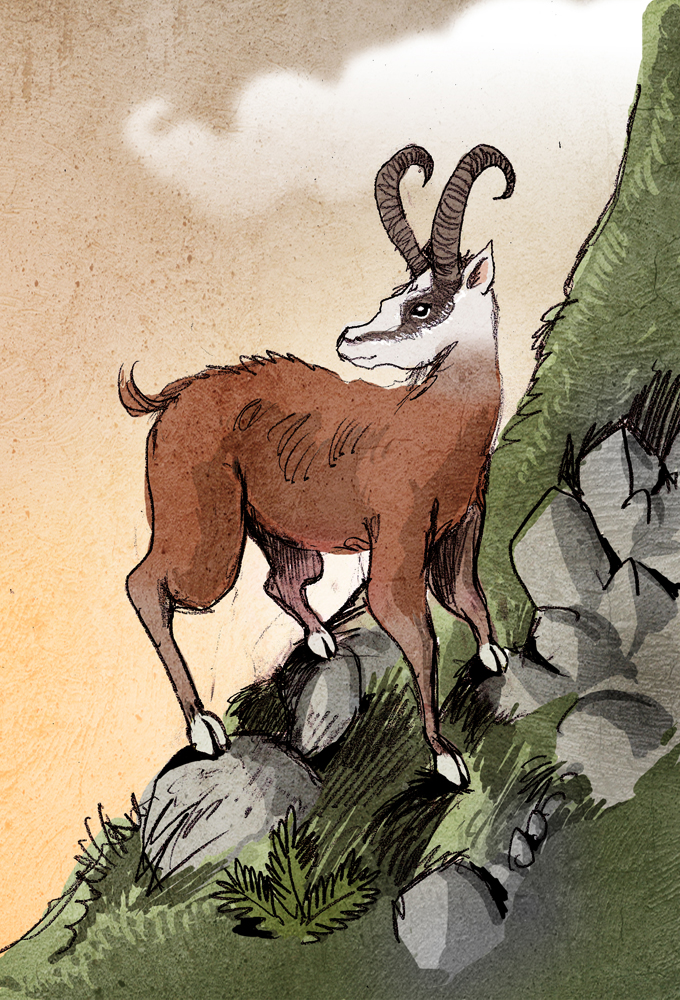
The dahu is a legendary creature from the Alps and Jura mountains of France, Switzerland, and Italy. It is described as a goat-like animal with uneven legs that forces it to circle mountains in one direction.
- Legs on one side are shorter than the other
- Forces the animal to circle mountains clockwise or counter-clockwise
- Legend grew with 19th-century Alpine tourism
- Pranksters abandon victims on slopes during fake hunts
- Marcel Jacquat documented the legend in Switzerland
What it is
The dahu is a fictional beast rooted in the Alpine regions of western Europe. It appears as a quadruped similar to a chamois or ibex but possesses a unique physical trait: its legs on one side of the body are shorter than those on the other. This anatomical oddity dictates that the animal can only walk around a mountain in a single circular direction. Some accounts distinguish between left-legged and right-legged varieties based on which side has the shorter limbs.
Where it comes from
The legend gained traction in the late nineteenth century alongside the growth of tourism in the Alps. Mountain guides exploited the ignorance of wealthy city visitors by claiming the dahu was a rare quarry. The story served as a vehicle for pranks, where tourists were sent into the cold night air under false pretenses. Over time, the tale moved from adult humor to children's folklore and summer camp antics.
How it is done
The primary ritual associated with the dahu is the 'dahu hunt.' Pranksters convince a victim that capturing the beast requires specific techniques. One version involves two people: one holding a bag at the bottom of a slope and another mimicking the animal's calls. When the imaginary dahu turns to face the sound, it supposedly loses its balance and rolls down the hill.
Tools and materials
No physical tools are required for the creature itself, as it is imaginary. However, the prank relies on environmental features like steep mountain slopes and darkness. Participants may use bags to simulate catching the rolling animal. The legend also references specific regional names for the beast, such as dahut in Jura or tamarou in Aubrac, which serve as linguistic markers of the joke's local variations.
Dahu, drawn and placed
- Living
- Revived
- Fading
- Historical
- Legendary
- Performed
- Lineage
- European folklore
What it is for
The dahu functions primarily as a source of amusement and social bonding through deception. It allows locals to playfully mock outsiders or younger generations. The legend provides a shared cultural reference point for communities in France, Switzerland, and Italy. It transforms the harsh reality of mountain life into a lighthearted narrative that can be retold and adapted across generations.
Who does it
Scholars and folklorists study the dahu as a case of modern mythology. Marcel Jacquat, a former museum director in Switzerland, documented the legend extensively. He wrote monographs and organized exhibitions dedicated to the creature. His work helped preserve the details of the legend and its various regional iterations for academic and public interest.
Peoples and places
The legend is strongest in French-speaking areas, including Lorraine, the Jura, and the Vosges. It extends into the Aosta Valley in Italy and parts of Switzerland. In Catalonia and Andorra, a similar figure called the tamarro exists. Each region adds its own name and slight variations to the core concept of the asymmetrical mountain goat.
At a glance: who, where and when
What people believe
There is no spiritual belief system attached to the dahu. It is not worshipped or feared as a supernatural entity. Instead, it is treated as a humorous fiction. The creature's existence is accepted as a tall tale rather than a literal truth. People engage with the legend for entertainment rather than religious or magical purposes.
When it is done
The dahu hunt is often performed during spring or summer months when tourists are present. April Fools' Day is a notable occasion for spreading the legend, as seen in exhibitions and announcements made on that date. The timing aligns with periods of increased outdoor activity and visitor influx into mountainous regions.
How scholars and sceptics see it
Anthropologists view the dahu as a product of tourist-local dynamics. The legend emerged when rural guides encountered urban visitors with little knowledge of the terrain. Researchers note how the story evolved from a scam against adults to a harmless game for children. The persistence of the tale demonstrates how folklore adapts to changing social contexts.
Cautions and what is closed
The dahu hunt can pose risks if taken too seriously. Abandoning someone on a mountain slope in cold weather can lead to hypothermia or injury. There have been incidents where participants suffered due to the physical demands of the prank. Organizers must ensure safety measures are in place to prevent harm to those involved in the joke.
Compare and confuse
The dahu is similar to the snipe hunt, another prank involving a non-existent animal. It also relates to the sidehill gouger, a cryptid with a similar asymmetrical trait. These creatures share the theme of impossible biology used to deceive observers. The dahu is distinct in its specific Alpine setting and French cultural origin.
Questions people ask about Dahu
What is a dahu?
It is a legendary creature from the Alps resembling a goat with uneven legs. The shortness of the limbs on one side causes the animal to walk in circles around mountains.
Where does the dahu legend come from?
The story originated in French-speaking regions of France, Switzerland, and Italy. It became popular in the late nineteenth century as a way for locals to joke about inexperienced tourists.
How do people hunt a dahu?
Hunters pretend to track the animal by making sounds. The prank usually ends with the victim being abandoned on a mountain slope or tricked into chasing an imaginary target.
Is the dahu considered real by anyone?
Most people recognize it as a tall tale or joke. However, some enthusiasts and museums have preserved the legend as part of regional cultural heritage and folklore studies.
Good reading and sources
- Dahu on WikipediaEncyclopedia
- More photos on Wikimedia CommonsPhotos and video
- Wikidata recordOpen data
The facts on this page come from the Wikipedia article "Dahu", written by its contributors and used under the CC BY-SA 4.0 licence, and from its Wikidata record (CC0). EveryJaadu rewrote the text in its own words, with AI assistance, and compares every page with the article to make sure no passage is copied. It may be reused under the same CC BY-SA 4.0 licence with a link back.
It may contain mistakes. Names and customs differ from one community to the next, and some knowledge is closed to outsiders and left out here. This page describes belief and practice. It does not say that any of it works, it is not a how-to, and it is not medical advice. If something is wrong, tell us. Last refreshed 2026-10-06.
More from France
All the entries from France 🇬🇧 United Kingdom and 2 moreKing ArthurBrenin Arthur
A legendary British king and folk hero of medieval literature and Welsh mythologyFigure · Power and authority · Wonder and entertainment Legendary
🇬🇧 United Kingdom and 2 moreKing ArthurBrenin Arthur
A legendary British king and folk hero of medieval literature and Welsh mythologyFigure · Power and authority · Wonder and entertainment Legendary
 🇫🇷 France and 5 moreWerewolf
A mythical shapeshifter that turns into a wolf, central to European witch-hunts and Gothic horror.Being · Cursing and harm · Wonder and entertainment Legendary
🇫🇷 France and 5 moreWerewolf
A mythical shapeshifter that turns into a wolf, central to European witch-hunts and Gothic horror.Being · Cursing and harm · Wonder and entertainment Legendary
 🇫🇷 FranceHoly GrailSaint Graal
A cup or stone from Arthurian tales that grants healing and eternal lifeFigure · Healing · Luck and prosperity Legendary
🇬🇧 United Kingdom and 1 moreSamuel Liddell MacGregor Mathers
British occultist and co-founder of the Hermetic Order of the Golden DawnFigure Historical
🇫🇷 FranceHoly GrailSaint Graal
A cup or stone from Arthurian tales that grants healing and eternal lifeFigure · Healing · Luck and prosperity Legendary
🇬🇧 United Kingdom and 1 moreSamuel Liddell MacGregor Mathers
British occultist and co-founder of the Hermetic Order of the Golden DawnFigure Historical
Related elsewhere
All figure 🇪🇬 Egypt and 1 moreSphinx
A mythical hybrid with a human head and lion body, serving as guardian or riddler in Egyptian and Greek traditions.Being · Protection · Wonder and entertainment Legendary
🇷🇺 Russia and 3 moreNart sagaНарты кадджытæ
A collection of epic tales from the North Caucasus about a legendary group of heroes.Text · Wonder and entertainment Historical
🇨🇱 ChileChilean mythology
The myths and legends of Chile, blending indigenous roots with colonial influences.Tradition · Wonder and entertainment Living
🇪🇬 Egypt and 1 moreSphinx
A mythical hybrid with a human head and lion body, serving as guardian or riddler in Egyptian and Greek traditions.Being · Protection · Wonder and entertainment Legendary
🇷🇺 Russia and 3 moreNart sagaНарты кадджытæ
A collection of epic tales from the North Caucasus about a legendary group of heroes.Text · Wonder and entertainment Historical
🇨🇱 ChileChilean mythology
The myths and legends of Chile, blending indigenous roots with colonial influences.Tradition · Wonder and entertainment Living
 🇨🇳 ChinaLan Caihe藍采和
An ambiguous Taoist immortal known for a flower basket and wandering songsBeing · Wonder and entertainment Legendary
🇨🇳 ChinaLan Caihe藍采和
An ambiguous Taoist immortal known for a flower basket and wandering songsBeing · Wonder and entertainment Legendary