Belgian Tarot
from French for Swiss cards, despite no Swiss production
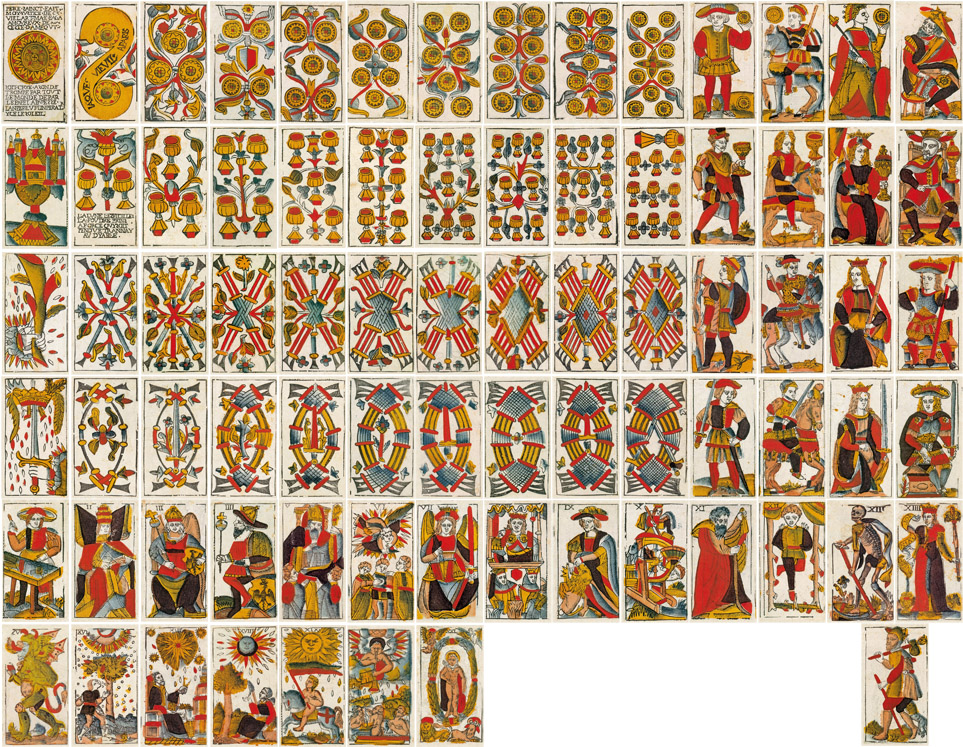
A standard tarot deck printed in the Low Countries, mislabeled as Swiss.
The Belgian Tarot is a specific design for playing cards created in the late seventeenth century. It was produced in Liège and Rouen before spreading to the Austrian Netherlands. The name Cartes de Suisses appears on the wrappers but refers to no actual Swiss origin.
- Produced in Liège, Rouen, and the Austrian Netherlands.
- Labelled Cartes de Suisses despite no Swiss manufacturing.
- Features a Spanish Captain instead of the Popess.
- The Fool card is numbered XXII.
- Bacchus replaces the Pope in the trump suit.
What it is
This entry covers a specific layout for tarot playing cards known as the Belgian Tarot. It belongs to the broader family of trionfi decks that originated in northern Italy during the fifteenth century. The design features unique trump cards that differ from the more famous Tarot of Marseilles. For example, the Popess card shows a Spanish captain instead. The Fool card carries the number XXII, which is unusual for the suit. These visual changes mark it as a distinct branch of the Italian tradition.
Where it comes from
The design emerged between the late seventeenth and late eighteenth centuries. Gérard Bodet of Liège created the earliest version in 1693. Adam C. de Houtot of Rouen later added numbering to the Fool around 1723. The pattern spread to the Austrian Netherlands, likely through Swiss mercenaries who played games like Troggu there. Despite the label Cartes de Suisses on the packaging, no evidence exists that these cards were ever made or used in Switzerland.
How it is done
The cards functioned as a standard pack for gaming rather than divination. Players used the seventy-eight cards, which included twenty-two trump cards. The game involved matching suits and following specific rules common to tarot variants of the era. The visual style relied on woodcut or engraving techniques typical of the period. The designs retained strong Italian influences while incorporating French stylistic details.
Tools and materials
The primary tool is the deck itself, containing seventy-eight cards. The pack includes four suits and twenty-two trump cards. Key images include Bacchus replacing the Pope and Lightning replacing the House of God. The Star depicts a seated astronomer. The Fool is numbered XXII. The packaging often bore the inscription Cartes de Suisses, misleading buyers about the place of manufacture.
Belgian Tarot, drawn and placed
- Living
- Revived
- Fading
- Historical
- Legendary
- Performed
- Lineage
- Tarot of Milanese origin
What it is for
These cards were designed for entertainment and social gaming. They served as a pastime for households and military garrisons. The name Flemish Tarot arose from a mistaken belief that they came from Flanders. In reality, they were produced in cities like Brussels, Liège, and Dinant. The mislabeling as Swiss cards persisted even after the practice ceased in the early nineteenth century.
Who does it
Cardmakers such as Gérard Bodet and Adam C. de Houtot developed the initial designs. Later producers like F. J. Vandenborre in Brussels continued the pattern into the nineteenth century. Scholars study these decks to trace the migration of card designs across Europe. Researchers note the lack of Swiss involvement despite the persistent naming convention.
Peoples and places
The design originated in Italy and moved northward. It became established in the Prince-Bishopric of Liège and Rouen. The Austrian Netherlands adopted the pattern widely during the eighteenth century. Swiss mercenaries helped popularize the associated games in this region. The misconception that the cards were Swiss remains a notable historical error.
At a glance: who, where and when
Who does it
What people believe
No spiritual or magical beliefs are attached to this specific deck. It is treated purely as a gaming artifact. The visual elements reflect secular themes like Bacchus and Spanish captains. The numbering of the Fool suggests a connection to other regional games like Troggu. The design prioritizes aesthetic variation over occult symbolism.
When it is done
The cards were produced continuously from the late seventeenth century onward. There are no specific festivals or seasonal timings linked to their use. They were available for general purchase throughout the year. Advertisements from 1849 show they remained in circulation well into the modern era.
How scholars and sceptics see it
Historians of playing cards document the Belgian Tarot as a distinct variant. Researchers emphasize the false Swiss attribution. Studies by experts like Thierry Depaulis and Michael Dummett clarify the Italian and French roots of the design. They reject the theory that French taxes drove makers to Switzerland, noting that Swiss production had already ceased.
Cautions and what is closed
There are no known risks associated with these historical cards. The main caution is historical accuracy regarding their origin. Collectors should be aware that the Cartes de Suisses label is a misnomer.
Compare and confuse
The Belgian Tarot differs significantly from the Tarot of Marseilles. While both share Italian origins, the Belgian version features unique trump imagery. The replacement of traditional figures with secular characters sets it apart. The name Flemish Tarot is another common misidentification that confuses its geographic origin.
Questions people ask about Belgian Tarot
What is the Belgian Tarot?
It is a specific design for tarot playing cards created in the late seventeenth century. The layout differs from the Tarot of Marseilles and features unique trump cards. It was produced in Liège, Rouen, and the Austrian Netherlands.
Why are they called Cartes de Suisses?
The name appears on the wrapping paper starting in the mid-eighteenth century. However, there is no evidence the cards were made or used in Switzerland. The label is considered a historical misattribution by scholars.
Where did the design originate?
The design has strong Italian roots, similar to the Tarot of Marseilles. The earliest known maker was Gérard Bodet of Liège in 1693. French details were added later, particularly in Rouen.
How does it differ from other tarots?
Key differences include the Spanish Captain replacing the Popess and Bacchus replacing the Pope. The Star shows an astronomer, and the Fool is numbered XXII. These changes distinguish it from the standard Marseilles pattern.
Good reading and sources
The facts on this page come from the Wikipedia article "Belgian Tarot", written by its contributors and used under the CC BY-SA 4.0 licence, and from its Wikidata record (CC0). EveryJaadu rewrote the text in its own words, with AI assistance, and compares every page with the article to make sure no passage is copied. It may be reused under the same CC BY-SA 4.0 licence with a link back.
It may contain mistakes. Names and customs differ from one community to the next, and some knowledge is closed to outsiders and left out here. This page describes belief and practice. It does not say that any of it works, it is not a how-to, and it is not medical advice. If something is wrong, tell us. Last refreshed 2026-10-06.
More from Switzerland
All the entries from Switzerland 🇩🇪 Germany and 2 moreFranz Anton Mesmer
A German physician who proposed a universal fluid of natural energy and founded mesmerism.Tradition · Healing Historical
🇩🇪 Germany and 2 moreFranz Anton Mesmer
A German physician who proposed a universal fluid of natural energy and founded mesmerism.Tradition · Healing Historical
 🇨🇭 SwitzerlandValais witch trials
The first systematic European witch-hunt, beginning in the Valais region of Switzerland in 1428.Tradition · Cursing and harm Historical
🇨🇭 SwitzerlandValais witch trials
The first systematic European witch-hunt, beginning in the Valais region of Switzerland in 1428.Tradition · Cursing and harm Historical
 🇮🇹 Italy and 5 moreTarottarocchi
A set of playing cards used for games and divinationTradition · Seeing and foretelling · Luck and prosperity Living
🇮🇹 Italy and 5 moreTarottarocchi
A set of playing cards used for games and divinationTradition · Seeing and foretelling · Luck and prosperity Living
 🇨🇭 SwitzerlandMagic circle
A ritual boundary drawn or visualised to create sacred space and protectionTradition · Protection · Speaking with spirits and the dead Living
🇨🇭 SwitzerlandMagic circle
A ritual boundary drawn or visualised to create sacred space and protectionTradition · Protection · Speaking with spirits and the dead Living
Related elsewhere
All tradition 🇮🇳 India and 5 moreAstrology
A divinatory practice that reads human fate through the positions of celestial bodies.Belief · Seeing and foretelling · Luck and prosperity Living
🇮🇳 India and 5 moreAstrology
A divinatory practice that reads human fate through the positions of celestial bodies.Belief · Seeing and foretelling · Luck and prosperity Living
 🇪🇬 EgyptCurse
A spoken wish for misfortune to befall a person or placeBelief · Cursing and harm · Luck and prosperity Historical
🇪🇬 EgyptCurse
A spoken wish for misfortune to befall a person or placeBelief · Cursing and harm · Luck and prosperity Historical
 🇪🇬 Egypt and 3 moreAmulet
A portable object worn or carried to ward off harm and invite fortuneCharm · Protection · Luck and prosperity Living
🇪🇬 Egypt and 3 moreAmulet
A portable object worn or carried to ward off harm and invite fortuneCharm · Protection · Luck and prosperity Living
 🇨🇳 China and 3 moreChinese dragon龍
A legendary water deity and imperial symbol in East Asian cultureBeing · Protection · Luck and prosperity Historical
🇨🇳 China and 3 moreChinese dragon龍
A legendary water deity and imperial symbol in East Asian cultureBeing · Protection · Luck and prosperity Historical