
Barong
In its own language: ᬩᬭᭀᬂ
from local bahruang, meaning bear
A lion-like spirit king of Bali who battles the witch queen Rangda in dance and myth
Barong is a panther or lion-shaped guardian spirit central to Balinese mythology in Indonesia. He leads the forces of good against Rangda, a demon queen representing evil, in an eternal struggle depicted through ritual dance.
- Barong means bear in the local language
- He fights the witch queen Rangda in dance
- Costumes feature mirrors and white fur
- Dancers use daggers in trance rituals
- Performed during Galungan festival
What it is
Barong serves as the monarch of spirits within the cultural framework of Bali, an island province of Indonesia. This figure appears as a large, costumed entity resembling a lion or panther, covered in thick white fur with a red head. He acts as the primary defender against dark forces, specifically opposing Rangda, a powerful witch queen. The character embodies the concept of protective goodness, standing in direct contrast to the chaos and destruction associated with his adversary. Communities view him as a vital spiritual anchor that maintains cosmic balance.
Where it comes from
The roots of Barong likely predate Hindu influences on the island, stemming from indigenous animist traditions. Villagers originally worshipped the supernatural protective power of animals, particularly those guarding forests. The name derives from the word for bear, linking the spirit to earlier animal worship practices. In myth, he is identified as Banas Pati Raja, a guardian spirit that accompanies individuals throughout life. This concept parallels the idea of personal guardian angels found in other belief systems.
How it is done
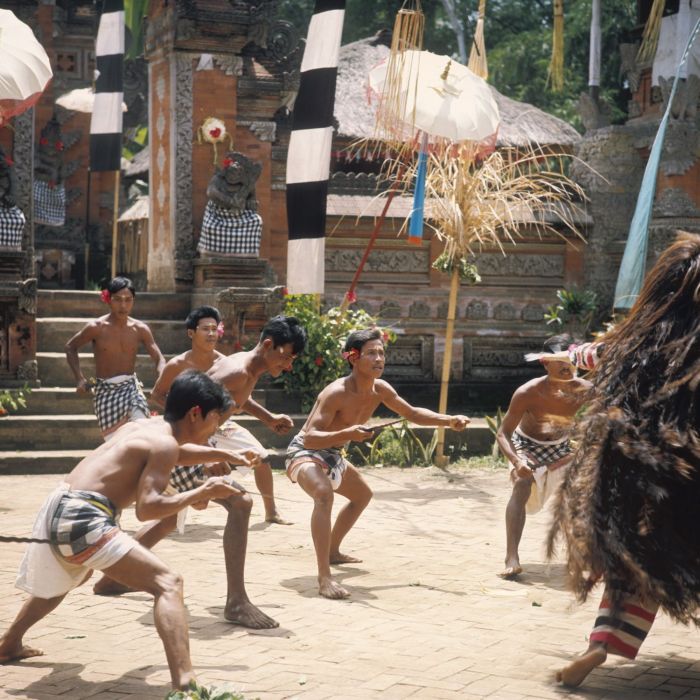
The most visible expression of Barong is the traditional dance drama known as Calon Arang. Performers wear elaborate costumes to embody the spirit, moving through streets and temple spaces. A priest often sprinkles holy water on the figure to sanctify the space. The performance involves complex choreography where Barong interacts with Rangda and her followers. Dancers enter trance states, using daggers in rituals that demonstrate spiritual protection against magical harm.
Tools and materials
The physical representation relies on heavy masks and costumes crafted from velvet and leather. Decorations include carved elements and small pieces of mirror that catch light. The lion form wears gilded jewellery, emphasizing its royal status among spirits. In the dance narrative, sharp daggers called keris play a crucial role, serving as props that test the limits of magical protection during the climactic battle scenes.
Barong, drawn and placed
- Living
- Revived
- Fading
- Historical
- Legendary
- Performed
- Lineage
- Balinese mythology
- Timing
- during festivals and ritual dances
What it is for
Communities invoke Barong to restore order after disturbances caused by malevolent forces. The spirit protects villages from plagues, crop damage, and general misfortune attributed to black magic. Ritual performances aim to cleanse areas of negative energy and reaffirm the dominance of good over evil. Participants seek the spirit's blessing for safety and stability, believing his presence wards off harmful influences.
Who does it
Dancers trained in specific regional styles perform the role, often entering altered states of consciousness during key moments. Priests oversee the rituals, providing spiritual guidance and performing cleansing rites. The tradition requires deep knowledge of local myths and precise movement techniques passed down through generations. Performers are respected members of their community who carry significant cultural responsibility.
Peoples and places
The Balinese people maintain this tradition as a core component of their religious and cultural identity. Variations exist across different regions of Bali, with each area claiming its own protective spirit form. Some versions resemble tigers, elephants, or dogs, reflecting local ecological features. Despite these differences, the central theme of battling darkness remains consistent throughout the island's diverse practices.
At a glance: who, where and when
Who does it
Peoples
Belief worlds
Occasions


What people believe
The worldview underlying Barong centers on the perpetual conflict between constructive and destructive forces. Spirits inhabit natural elements, requiring respect and ritual attention to maintain harmony. Rangda represents the chaotic side of nature, while Barong symbolizes structured protection. The myth suggests that balance must be actively maintained through ceremony, as evil forces constantly seek to disrupt the celestial order.
When it is done
Performances occur during major Hindu-Balinese festivals, particularly Galungan and Kuningan. These holidays mark important cycles in the local calendar, celebrating the victory of dharma over adharma. The timing aligns with agricultural seasons and ancestral veneration periods, reinforcing the connection between spiritual health and communal well-being.
How scholars and sceptics see it
Anthropologists study Barong as a manifestation of indigenous animism adapted within a Hindu framework. Researchers note how the figure preserves pre-Hindu beliefs about animal spirits and forest guardians. Psychologists examine the trance states induced during performances as examples of collective ritual experience. Historians trace the evolution of the myth from ancient Javanese legends to modern Balinese practice.
Cautions and what is closed
The rituals involve intense physical activity and psychological immersion, which can be overwhelming for participants. Outsiders may find the depiction of violence and supernatural horror disturbing. The tradition contains closed knowledge regarding specific magical incantations and spirit communication methods not shared with non-initiates.
Compare and confuse
Barong shares similarities with other Southeast Asian mask dance traditions, such as the Hudoq of the Dayak people. Both use animal forms to represent ancestral or natural spirits. The dynamic with Rangda parallels other mythological conflicts between order and chaos figures found across Indonesian folklore.
Law and persecution
The tradition is protected as part of Indonesia's national cultural heritage. Government support ensures the preservation of dance forms and costume craftsmanship. Local communities retain control over sacred aspects of the practice, limiting access to certain ceremonial details.
Days linked to Barong
Questions people ask about Barong
What is Barong?
Barong is a lion-like spirit king in Balinese mythology who leads the forces of good against evil.
Where does Barong come from?
He originates from indigenous animist traditions in Bali, Indonesia, predating Hindu influences on the island.
Who does Barong fight?
He battles Rangda, a demon queen representing black magic and chaos, in an eternal struggle for balance.
How is Barong represented?
He appears as a large masked figure covered in white fur, adorned with mirrors and gold jewellery.
Good reading and sources
- Barong (mythology) on WikipediaEncyclopedia
- More photos on Wikimedia CommonsPhotos and video
- Wikidata recordOpen data
The facts on this page come from the Wikipedia article "Barong (mythology)", written by its contributors and used under the CC BY-SA 4.0 licence, and from its Wikidata record (CC0). EveryJaadu rewrote the text in its own words, with AI assistance, and compares every page with the article to make sure no passage is copied. It may be reused under the same CC BY-SA 4.0 licence with a link back.
It may contain mistakes. Names and customs differ from one community to the next, and some knowledge is closed to outsiders and left out here. This page describes belief and practice. It does not say that any of it works, it is not a how-to, and it is not medical advice. If something is wrong, tell us. Last refreshed 2026-10-06.
More from Indonesia
All the entries from Indonesia 🇲🇾 Malaysia and 5 morePenanggalan
A floating head with trailing organs from Malay folklore, said to hunt pregnant women and newborns.Being · Cursing and harm Legendary
🇮🇩 Indonesia and 2 moreKuntilanak
A vengeful female spirit of Indonesian and Malaysian folklore, known for luring victims with beauty before revealing a mBeing · Cursing and harm · Love and attraction Legendary
🇲🇾 Malaysia and 5 morePenanggalan
A floating head with trailing organs from Malay folklore, said to hunt pregnant women and newborns.Being · Cursing and harm Legendary
🇮🇩 Indonesia and 2 moreKuntilanak
A vengeful female spirit of Indonesian and Malaysian folklore, known for luring victims with beauty before revealing a mBeing · Cursing and harm · Love and attraction Legendary
Related elsewhere
All being 🇪🇬 Egypt and 1 moreSphinx
A mythical hybrid with a human head and lion body, serving as guardian or riddler in Egyptian and Greek traditions.Being · Protection · Wonder and entertainment Legendary
🇪🇬 Egypt and 1 moreSphinx
A mythical hybrid with a human head and lion body, serving as guardian or riddler in Egyptian and Greek traditions.Being · Protection · Wonder and entertainment Legendary
 🇧🇪 Belgium and 2 moreHorseshoe
A metal shoe for a horse's hoof and a talisman of good fortuneCharm · Protection · Luck and prosperity Living
🇧🇪 Belgium and 2 moreHorseshoe
A metal shoe for a horse's hoof and a talisman of good fortuneCharm · Protection · Luck and prosperity Living
 🇪🇬 Egypt and 3 moreAmulet
A portable object worn or carried to ward off harm and invite fortuneCharm · Protection · Luck and prosperity Living
🇪🇬 Egypt and 3 moreAmulet
A portable object worn or carried to ward off harm and invite fortuneCharm · Protection · Luck and prosperity Living
 🇹🇷 Turkey and 5 moreEvil eye
A curse believed to be cast by a jealous glare and the charms used to stop itBelief · Protection Living
🇹🇷 Turkey and 5 moreEvil eye
A curse believed to be cast by a jealous glare and the charms used to stop itBelief · Protection Living