
Barong
In its own language: ᬩᬭᭀᬂ
from the local term bahruang, corresponding to the Indonesian word for bear
A lion-like spirit king of Balinese mythology who battles the witch-queen Rangda in ritual dance.
Barong is a panther-like creature and the king of spirits in the Balinese culture of Indonesia. He leads the forces of good against Rangda, a demon queen representing evil. Their eternal conflict is enacted in traditional dances to restore cosmic balance.
- Barong means bear in Balinese, derived from bahruang.
- He is the king of spirits and enemy of the witch queen Rangda.
- Five main types exist: Lion, Pig, Tiger, Dog, and Elephant.
- Dancers stab themselves with keris daggers in a trance.
- Paraded during Galungan and Kuningan festivals.
What it is
Barong is a mythical creature and character in the culture of Bali, Indonesia. He appears as a panther-like or lion-like spirit with thick white fur and a red head. Barong serves as the king of spirits and the leader of the hosts of good. He stands in direct opposition to Rangda, a demon queen who represents evil and chaos. The two figures embody an eternal struggle between order and disorder. This dynamic is central to Balinese spiritual life and artistic expression.
Where it comes from
The origins of Barong are ancient and uncertain, likely predating Hindu influences on the island. The name derives from the local word bahruang, meaning bear, linking him to animist worship of protective forest animals. In myth, he is animated by Banas Pati Raja, a protector spirit similar to a guardian angel. Some accounts link his adversary Rangda to historical figures like Queen Mahendradatta, a widow who practiced black magic. These legends frame Barong as a native Balinese spirit rather than an imported deity.
How it is done
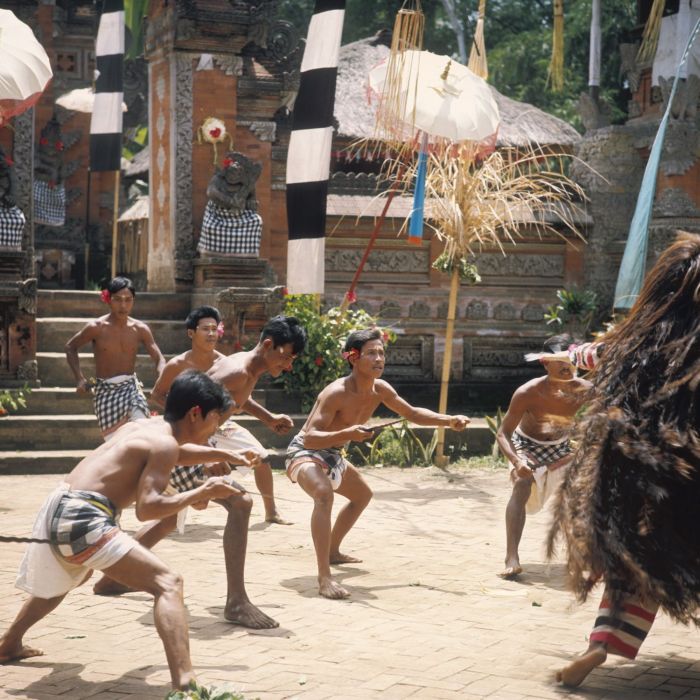
The primary manifestation of Barong is through ritual dance. Performers wear elaborate masks and costumes to embody the spirit. A priest may sprinkle holy water to activate the performance. The dance often begins with playful monkeys teasing Barong before the antagonist Rangda appears. She casts spells that drive male dancers into a trance, causing them to stab themselves with keris daggers. Barong and the priest cast protective magic to make the dancers invulnerable, restoring safety and balance.
Tools and materials
Barong is represented by specific masks and costumes. The most common form, Barong Ket, resembles a lion with gilded jewellery and small mirrors. Other variations include Barong Bangkal (pig), Barong Macan (tiger), Barong Asu (dog), and Barong Gajah (elephant). These are crafted from velvet fabric and carved leather. Dancers use keris daggers during the trance sequences. Holy water is used by priests to bless the space and participants.
Barong, drawn and placed
- Living
- Revived
- Fading
- Historical
- Legendary
- Performed
- Lineage
- Balinese mythology
- Timing
- during festivals like Galungan and Kuningan
What it is for
Barong is invoked to protect communities from evil spirits and misfortune. His battle with Rangda symbolizes the restoration of cosmic balance after chaos. The rituals are performed to cleanse villages and ensure safety from disease and crop damage. People believe that witnessing the dance or carrying a representation of Barong brings good fortune and wards off negative influences.
Who does it
The role of Barong is performed by trained dancers who wear the heavy masks. Priests oversee the rituals, using holy water and incantations to guide the spiritual forces. The performance is a communal effort, involving musicians and other actors. Dancers often enter trances during the Keris Dance sequence, believed to be possessed by protective spirits.
Peoples and places
Barong is central to Balinese culture in Indonesia. Each region of Bali has its own version of the spirit, modeled after different animals. The Gianyar region is known for the lion Barong Ket. Tabanan features the sacred Barong Asu. These regional variations reflect local beliefs about forest guardians. The tradition is deeply embedded in daily life and religious festivals across the island.
At a glance: who, where and when
Peoples
Belief worlds
Occasions



What people believe
Balinese belief views Barong as a benevolent force maintaining harmony. He is part of a dualistic worldview where good and evil constantly interact. Rangda is seen as a powerful but destructive force, often linked to widowhood and black magic. Barong’s protection allows humans to resist supernatural harm. The spirit world is considered active and influential in human affairs, requiring regular appeasement and celebration.
When it is done
Barong dances are performed during major Balinese festivals. Galungan and Kuningan are key occasions when various Barong forms are paraded. The dances also occur at temple ceremonies and village purification rites. Specific performances may be scheduled to address particular crises or to celebrate seasonal changes. The timing aligns with the Balinese pawukon calendar.
How scholars and sceptics see it
Scholars view Barong as a synthesis of indigenous animism and later Hindu influences. Anthropologists note the dance as a mechanism for community cohesion and psychological release. The trance elements are studied as examples of controlled altered states. Researchers highlight the narrative of Calon Arang as a cultural explanation for historical conflicts and social tensions.
Cautions and what is closed
The Keris Dance involves real danger, as performers stab themselves with bladed weapons. While believed to be protected by magic, accidents can occur. The rituals are sacred and require respect from observers. Outsiders are expected to follow proper etiquette during performances. The trance state is a serious spiritual event, not mere entertainment.
Compare and confuse
Barong is often compared to other Southeast Asian spirit masks, such as the Dayak Hudoq. He shares traits with lion-dance figures in Chinese culture, though the origins are distinct. The duality of Barong and Rangda resembles other cosmic battle myths. However, Barong is uniquely tied to Balinese village protection and specific local legends.
Days linked to Barong
Questions people ask about Barong
What is Barong?
Barong is a lion-like spirit king in Balinese mythology. He leads the forces of good against evil. He is portrayed as a guardian with white fur and a red head. His story is told through ritual dance and community belief.
Where does Barong come from?
Barong originates from Bali, Indonesia. His name comes from the local word for bear. He likely stems from pre-Hindu animist traditions. He is a native Balinese spirit, not an imported deity.
Who is Barong's enemy?
Rangda is Barong's opposite. She is a demon queen and mother of spirit guarders. She represents evil and chaos. Her battle with Barong restores cosmic balance in the myth.
What happens in the Barong dance?
The dance shows Barong fighting Rangda. Dancers enter a trance and stab themselves with keris daggers. Barong and a priest cast protective magic. The performance ends with good defeating evil and restoring order.
When is Barong performed?
Barong is performed during festivals like Galungan and Kuningan. It is also shown at temple ceremonies. Different regions parade their own Barong variants. The timing follows the Balinese religious calendar.
Good reading and sources
- Barong (mythology) on WikipediaEncyclopedia
- More photos on Wikimedia CommonsPhotos and video
- Wikidata recordOpen data
The facts on this page come from the Wikipedia article "Barong (mythology)", written by its contributors and used under the CC BY-SA 4.0 licence, and from its Wikidata record (CC0). EveryJaadu rewrote the text in its own words, with AI assistance, and compares every page with the article to make sure no passage is copied. It may be reused under the same CC BY-SA 4.0 licence with a link back.
It may contain mistakes. Names and customs differ from one community to the next, and some knowledge is closed to outsiders and left out here. This page describes belief and practice. It does not say that any of it works, it is not a how-to, and it is not medical advice. If something is wrong, tell us. Last refreshed 2026-10-05.
More from Indonesia
All the entries from Indonesia 🇲🇾 Malaysia and 5 morePenanggalan
A floating head with trailing organs from Malay folklore, said to hunt pregnant women and newborns.Being · Cursing and harm Legendary
🇮🇩 Indonesia and 2 moreKuntilanak
A vengeful female spirit of Indonesian and Malaysian folklore, known for luring victims with beauty before revealing a mBeing · Cursing and harm · Love and attraction Legendary
🇲🇾 Malaysia and 5 morePenanggalan
A floating head with trailing organs from Malay folklore, said to hunt pregnant women and newborns.Being · Cursing and harm Legendary
🇮🇩 Indonesia and 2 moreKuntilanak
A vengeful female spirit of Indonesian and Malaysian folklore, known for luring victims with beauty before revealing a mBeing · Cursing and harm · Love and attraction Legendary
Related elsewhere
All being 🇪🇬 Egypt and 1 moreSphinx
A mythical hybrid with a human head and lion body, serving as guardian or riddler in Egyptian and Greek traditions.Being · Protection · Wonder and entertainment Legendary
🇪🇬 Egypt and 1 moreSphinx
A mythical hybrid with a human head and lion body, serving as guardian or riddler in Egyptian and Greek traditions.Being · Protection · Wonder and entertainment Legendary
 🇸🇩 Sudan and 5 moreIncense
Aromatic plant materials burned to release fragrant smoke for ritual, scent, or timekeeping.Substance · Protection · Speaking with spirits and the dead Living
🇸🇩 Sudan and 5 moreIncense
Aromatic plant materials burned to release fragrant smoke for ritual, scent, or timekeeping.Substance · Protection · Speaking with spirits and the dead Living
 🇪🇸 Spain and 5 moreSt John's Eve
A Christian vigil marked by bonfires and plant gathering on the summer solstice eveRite · Protection · Speaking with spirits and the dead Living
🇪🇸 Spain and 5 moreSt John's Eve
A Christian vigil marked by bonfires and plant gathering on the summer solstice eveRite · Protection · Speaking with spirits and the dead Living
 🇦🇺 Australia and 1 moreTattoo
A permanent mark made by placing pigment under the skin to form a design.Tradition · Protection · Power and authority Living
🇦🇺 Australia and 1 moreTattoo
A permanent mark made by placing pigment under the skin to form a design.Tradition · Protection · Power and authority Living