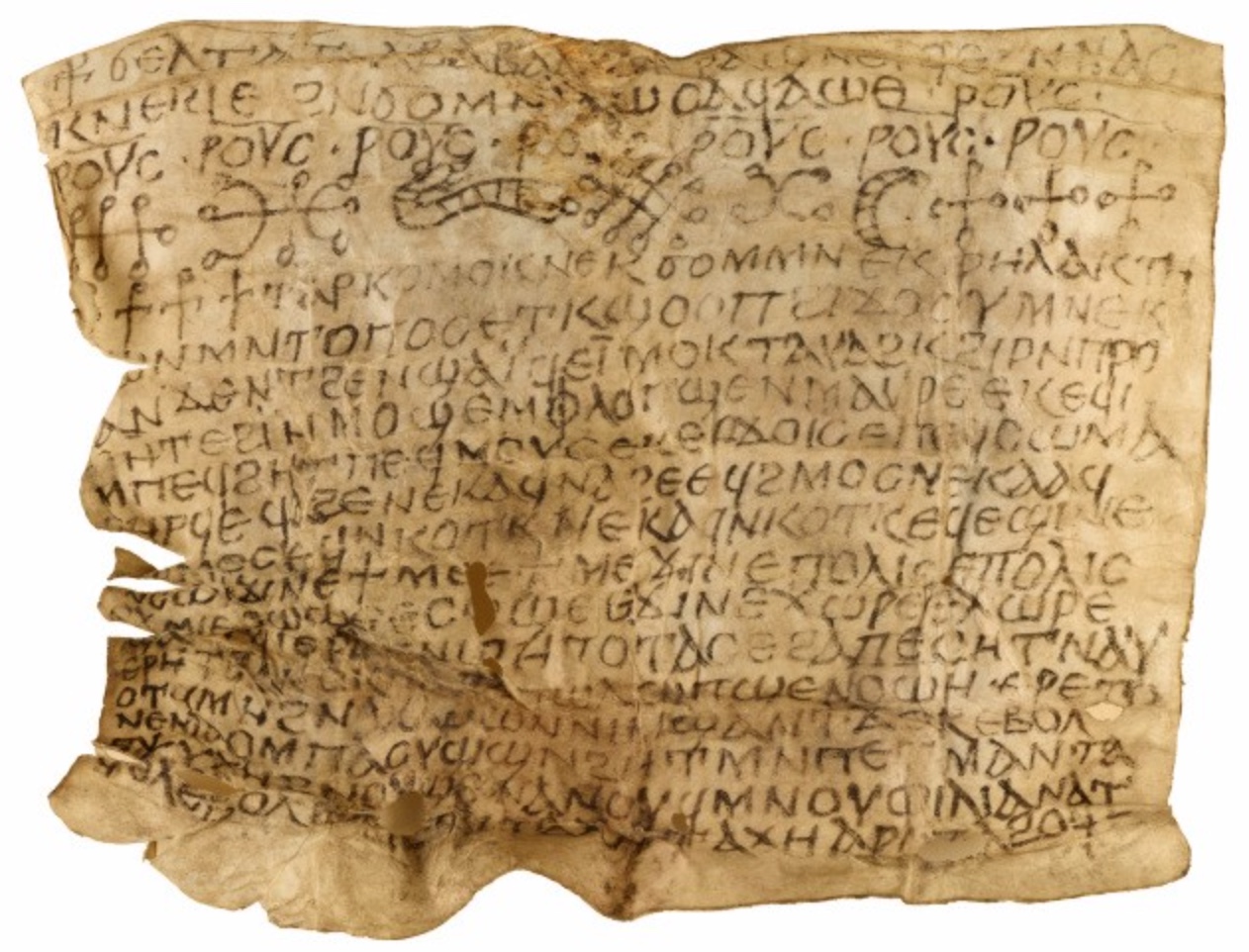
Ashmolean Parchment AN 1981.940
A folded Coptic love charm from Egypt, written by one man to win another
A vellum leaf from sixth- or seventh-century Egypt, written in Coptic, carries a charm by which a man called Apapolo asks the spirits to kindle another man's love for him. Kept at Oxford's Ashmolean Museum, it is the only such Coptic charm between two men known to survive.
- Coptic charm in which Apapolo seeks the love of another man, Phello
- Dated to the sixth or seventh century; its dialect points to middle Egypt
- Creases show it was folded to just 2.5 by 1.3 cm
- The only love charm between two men known in the Coptic language
- Calls on spirits by their names and on the power of Iao Sabaoth
What it is
A single leaf of vellum kept at Oxford's Ashmolean Museum, catalogued as AN 1981.940, preserves a rare piece of Egyptian magic: a charm in the Coptic language in which one man asks unseen powers to kindle another man's passion for him. The sheet was made in sixth- or seventh-century Egypt and is tiny, about 10.5 by 8 cm, with creases showing it was folded down to the size of a thumbnail. Its speaker names himself Apapolo, son of Nooe, and names the man he longs for, Phello, son of Maure. Researchers report no other Coptic text of the kind that joins two men.
Where it comes from
The text was written in the sixth or seventh century, when Egypt formed part of the Byzantine world. The clearest clue is linguistic: its Coptic is a Hermopolitan dialect, which points to middle Egypt, perhaps the city of Hermopolis and the country around it. The British Egyptologist Francis Llewellyn Griffith obtained the piece from Fanous, an Egyptian lawyer, an avocat, and it has since belonged to the Ashmolean in Oxford.
How it is done
As written, the rite is an adjuration: a form of words that summons spirits and gives them orders. The speaker swears by the spirits' names, their dwelling places, their powers and their protective emblems, called phylacteries, and he calls on the power of Iao Sabaoth. The text opens with strings of what it marks as magical words, including one short call repeated seven times. It then imagines itself placed at Phello's door and on his path, ordering that his heart and body be gripped so that he can neither stand nor sit nor sleep until he tracks Apapolo down and gives him what he asks.
Tools and materials
The writing surface is vellum, that is, fine skin prepared to take ink. The leaf measures roughly 10.5 cm across and 8 cm high, and its creases show that it spent time folded to about 2.5 by 1.3 cm. Its force, as the words present it, lies in language rather than in added materials: spirits are bound by their names and dwelling places, guarded by phylacteries, and pressed into service under the authority of Iao Sabaoth.
Ashmolean Parchment AN 1981.940, drawn and placed
- Living
- Revived
- Fading
- Historical
- Legendary
- Performed
- Lineage
- Coptic magical papyri
What it is for
The declared aim is romantic and sexual: to wake love and passion in one named man. Apapolo asks that Phello grow restless, driven to search village after village, city after city, field after field, until he comes to Apapolo, sets himself at his feet with hands full of good things, and lets the writer carry out his heart's request. The text describes the bond it wants as desire that is good and an attachment that cannot be broken, and it ends by demanding speed, twice over.
Peoples and places
Every feature of the object is Egyptian: the language, the dialect of middle Egypt, and the probable connection with Hermopolis. The sheet reached the antiquities trade through Fanous, a lawyer (an avocat) in Egypt, who left no account of where it had come from. From Griffith the leaf passed to the Ashmolean at Oxford, where it is kept now. Because of its subject it also interests those studying homosexuality in ancient Egypt.
At a glance: who, where and when
What people believe
The worldview behind the words is one where spirits can be commanded by whoever knows what holds them. The speaker adjures them by their names, their homes, their powers and their phylacteries, small protective charms, and he swears by Iao Sabaoth's power. Writing is treated as active: the charm speaks of being set at the beloved's door and on his road, and of gripping his heart, his mind and his whole body thereafter. Rest is denied him whether he stands, sits or sleeps, until he yields.
How scholars and sceptics see it
Coptic specialists have done much of the reading. Identifying the dialect as Hermopolitan is what grounds the guess that the piece came from middle Egypt, since the sheet surfaced without a recorded provenance. The claim that it stands alone, the sole love charm in Coptic joining one man to another, gives it a place in work on both magic and same-sex love in Egypt. A research project at the University of Würzburg has published a full English rendering, which is how most readers now meet the words.
Compare and confuse
The leaf is read alongside the wider Coptic magical papyri, the spells and spell-books surviving from Egypt in the Coptic tongue. Love magic in Coptic is otherwise attested for men and women, which is what sets this piece apart. It also figures in discussions of homosexuality in ancient Egypt.
Questions people ask about Ashmolean Parchment AN 1981.940
What is the Ashmolean Parchment AN 1981.940?
A small vellum leaf from sixth- or seventh-century Egypt, written in Coptic, that carries a charm for love. In it a man called Apapolo, son of Nooe, seeks to stir desire in another man, Phello, son of Maure. It is kept at Oxford's Ashmolean Museum.
Where does it come from?
Its findspot is unknown. The Hermopolitan dialect of its Coptic points to middle Egypt, with Hermopolis a likely home. The Egyptologist Francis Llewellyn Griffith obtained it in Egypt from a lawyer named Fanous, and it later entered the Ashmolean's collection.
What does the charm actually say?
It adjures spirits by their names, dwelling places, powers and protective emblems, and by the power of Iao Sabaoth, then demands that Phello's heart and body be mastered. He is to find no rest but chase Apapolo through village, city, field and land until desire is fulfilled, and the text begs that this happen fast.
Why do researchers consider it important?
It is the only love charm known in the Coptic language to join two men, which makes it valuable evidence for both magical practice and same-sex love in Egypt's past. An English translation by a University of Würzburg project has made it widely readable.
How big is it, and can it be seen?
The leaf measures about 10.5 by 8 cm, and its creases show it was kept folded to roughly 2.5 by 1.3 cm, no bigger than a thumbnail. It belongs to the Ashmolean in Oxford, and photographs and a full English translation have been published.
Good reading and sources
The facts on this page come from the Wikipedia article "Ashmolean Parchment AN 1981.940", written by its contributors and used under the CC BY-SA 4.0 licence, and from its Wikidata record (CC0). EveryJaadu rewrote the text in its own words, with AI assistance, and compares every page with the article to make sure no passage is copied. It may be reused under the same CC BY-SA 4.0 licence with a link back.
It may contain mistakes. Names and customs differ from one community to the next, and some knowledge is closed to outsiders and left out here. This page describes belief and practice. It does not say that any of it works, it is not a how-to, and it is not medical advice. If something is wrong, tell us. Last refreshed 2026-10-19.
More from Egypt
All the entries from Egypt 🇪🇬 Egypt and 1 moreEbers Papyrus
An ancient Egyptian medical scroll detailing herbal remedies and bodily theories from around 1550 BCE.Text · Healing Historical
 🇪🇬 EgyptScarab
A carved beetle amulet and seal used in ancient Egypt for protection, identity, and ritual.Charm · Protection · Luck and prosperity Historical
 🇪🇬 Egypt and 1 moreDendera zodiac
A carved Egyptian sky map now held in a Paris museumText · Seeing and foretelling · Power and authority Historical
🇪🇬 EgyptPapyrus Graecus Holmiensis
A third-century Egyptian manuscript of craft and alchemical recipes written in GreekText · Power and authority Historical
Related elsewhere
All text 🇨🇱 ChileTrauco
A short forest man of Chiloé whom islanders blame for unclaimed pregnanciesBeing · Love and attraction · Cursing and harm Legendary
 🇮🇳 India and 5 moreHoliहोली
A Hindu spring festival marked by coloured powders and bonfires to celebrate love and virtue.Tradition · Love and attraction · Cursing and harm Living
 🇲🇽 Mexico and 5 moreWitchcraft in Latin AmericaBrujería
A syncretic blend of Indigenous, African, and European magical practices across Latin AmericaTradition · Protection · Healing Living
 🇮🇳 India and 1 moreSantoshi Mataसंतोषी माता
A Hindu goddess of contentment worshipped through a Friday ritual fast.Being · Protection · Luck and prosperity Living