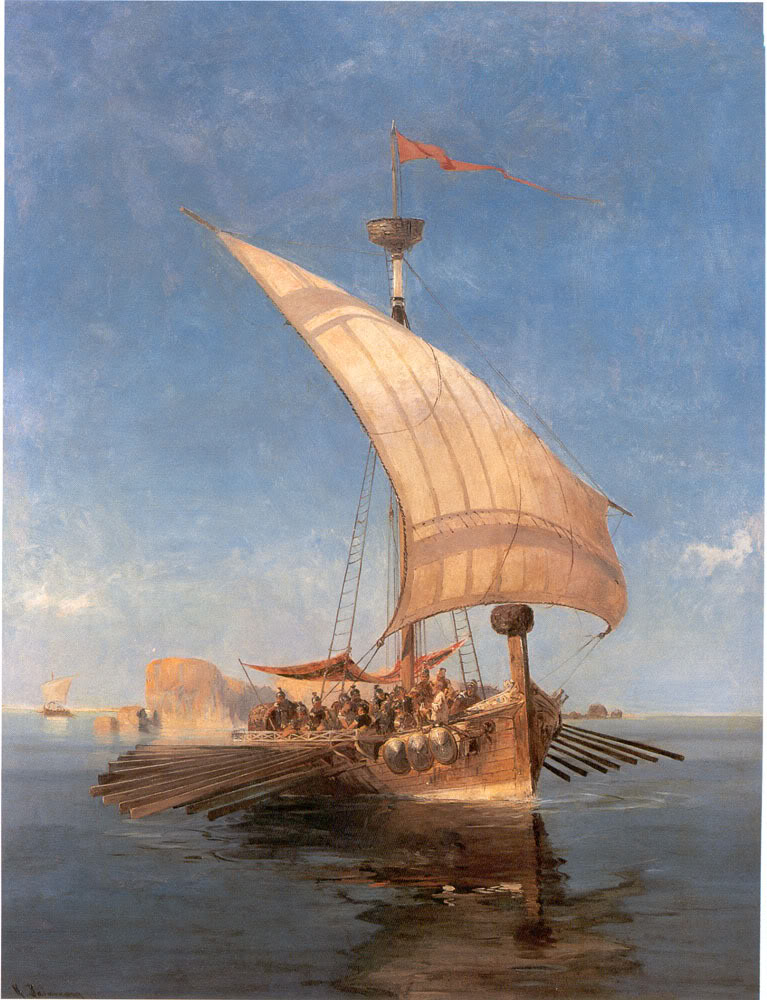
Argo
In its own language: Ἀργώ
Named after its builder Argus, or derived from words meaning swift or referring to the city of Argos.
The mythic ship of Jason and the Argonauts, built with divine aid for a quest across the sea.
In Greek mythology, the Argo was the vessel that carried Jason and his crew on their journey to retrieve the Golden Fleece. Constructed with help from gods, it is considered the first ship to sail the open sea in ancient lore.
- Built by Argus with help from Athena and Hera.
- Featured a speaking oak beam from the oracle at Dodona.
- Considered the first ship to sail the open sea in myth.
- Jason died when a beam from the sacred ship fell on him.
- Transformed into the constellation Argo Navis after death.
What it is
The Argo stands as the most famous vessel in Greek myth, serving as the transport for Jason and the Argonauts during their quest for the Golden Fleece. It is not merely a boat but a sacred object, constructed with direct assistance from deities like Athena and Hera. The ship represents the dawn of seafaring in ancient imagination, often cited as the very first craft to navigate the open ocean beyond coastal waters. Its legacy extends into the night sky as the constellation Argo Navis, preserving the memory of the voyage long after the wood decayed.
Where it comes from
Ancient sources offer several explanations for the ship's name and origin. Some claim it was named after its builder, Argus, while others link it to an ancient word for speed. Roman writers like Cicero suggested the name honored the people of Argos. Construction took place in Thessaly near Mount Pelion, using timber gathered from various sacred groves. The inclusion of speaking oak from Dodona tied the vessel directly to the oracle of Zeus, ensuring divine guidance throughout its life.
How it is done
The Argo combined rowing and sailing, equipped with fifty oars and a single mast taught by Athena. Crew members included specialists like Lynceus, whose keen sight aided navigation, and Tiphys, who managed the sails. The ship required frequent resupply, carrying water vases and bronze tripods. During difficult stretches, such as crossing land between seas, the vessel was physically dragged by the crew over a period of twelve days, demonstrating its role as both a maritime and terrestrial symbol.
Tools and materials
Craftsmen used diverse woods to build the hull, including pine for oars and fir for the body. A crucial component was a piece of oak from the sacred site of Dodona, which possessed the gift of speech. This prophetic timber served as the ship's voice, offering counsel during the journey. Bronze tripods were also carried aboard, later offered to river gods for safe passage. The vessel featured a distinctive red sail marked with the image of a golden ram, signaling the destination of the quest.
Argo, drawn and placed
- Living
- Revived
- Fading
- Historical
- Legendary
- Performed
- Lineage
- Greek mythology
What it is for
The primary purpose of the Argo was to enable the retrieval of the Golden Fleece from Colchis. Beyond this specific mission, the ship symbolized human ambition and the courage to venture into unknown waters. It served as a mobile sanctuary protected by goddesses, allowing heroes to face monsters and divine challenges. The vessel's survival through countless perils validated the favor of the gods and the worthiness of its crew.
Who does it
No living practitioners perform rituals with the Argo, as it belongs to the realm of legend. In ancient times, the shipwright Argus designed and built the craft under divine instruction. The crew consisted of legendary heroes chosen for their unique abilities, such as strength, sight, or musical talent. These figures acted as sailors, steersmen, and warriors, relying on the ship's magical properties rather than technical seamanship alone.
Peoples and places
The Argo is central to Greek mythology, particularly the stories surrounding Iolcos and the Peloponnese. Different regions claimed connections to its construction or departure, with Thessaly and the port of Pagasae highlighted in poetic accounts. Roman authors later adopted the myth, integrating the ship into their own literary traditions. The narrative spread through plays and philosophical texts, making the Argo a shared cultural touchstone across the Mediterranean world.
At a glance: who, where and when
Peoples
Belief worlds


What people believe
Ancient believers viewed the Argo as more than wood; it was a living entity blessed by the gods. The speaking oak from Dodona provided oracles, guiding the crew through treacherous waters. The Nereids and river gods assisted the ship, indicating a worldview where nature and divinity actively participated in human affairs. The ship's eventual dedication to Poseidon affirmed its status as a sacred offering, bridging the mortal and divine realms.
Cautions and what is closed
The myth contains warnings about hubris and fate. After the journey, a beam from the consecrated ship fell and killed Jason, illustrating the dangers of resting on past glory. The vessel itself was treated with reverence, becoming a monument rather than a working boat. Ancient writers sometimes described the Argo as a monster, reflecting the awe and fear inspired by large, unfamiliar ships venturing far from shore.
Questions people ask about Argo
What is the Argo?
The Argo is the legendary ship of Jason and the Argonauts in Greek mythology, built with divine aid to retrieve the Golden Fleece.
Where did the Argo come from?
It was constructed in Thessaly, Greece, using timber from sacred sites like Dodona, and named after its builder Argus or the city of Argos.
Why is the Argo special?
It is believed to be the first ship to sail the open sea, equipped with a prophetic oak beam and protected by goddesses like Athena and Hera.
What happened to the Argo?
After the quest, it was dedicated to Poseidon at Corinth. Years later, a beam from the ship fell and killed Jason, after which it became a constellation.
Good reading and sources
- Argo on WikipediaEncyclopedia
- More photos on Wikimedia CommonsPhotos and video
- Wikidata recordOpen data
The facts on this page come from the Wikipedia article "Argo", written by its contributors and used under the CC BY-SA 4.0 licence, and from its Wikidata record (CC0). EveryJaadu rewrote the text in its own words, with AI assistance, and compares every page with the article to make sure no passage is copied. It may be reused under the same CC BY-SA 4.0 licence with a link back.
It may contain mistakes. Names and customs differ from one community to the next, and some knowledge is closed to outsiders and left out here. This page describes belief and practice. It does not say that any of it works, it is not a how-to, and it is not medical advice. If something is wrong, tell us. Last refreshed 2026-10-13.
More from Greece
All the entries from Greece 🇷🇸 Serbia and 5 moreVampire
An undead being from European folklore that feeds on the life force of the living.Being · Cursing and harm Legendary
🇷🇸 Serbia and 5 moreVampire
An undead being from European folklore that feeds on the life force of the living.Being · Cursing and harm Legendary
 🇬🇷 GreeceCirceΚίρκη
A Greek goddess and witch known for turning men into beasts with her potionsBeing · Cursing and harm · Love and attraction Legendary
🇬🇷 GreeceCirceΚίρκη
A Greek goddess and witch known for turning men into beasts with her potionsBeing · Cursing and harm · Love and attraction Legendary
 🇬🇷 Greece and 3 moreHellhound
A mythological canine that guards the underworld or serves demonic forces across global folkloreBeing · Protection · Cursing and harm Legendary
🇬🇷 Greece and 3 moreHellhound
A mythological canine that guards the underworld or serves demonic forces across global folkloreBeing · Protection · Cursing and harm Legendary
 🇬🇷 Greece and 1 moreHecateἙκάτη
A Greek goddess of magic, crossroads, and the moon, often shown in three forms.Being · Protection · Power and authority Historical
🇬🇷 Greece and 1 moreHecateἙκάτη
A Greek goddess of magic, crossroads, and the moon, often shown in three forms.Being · Protection · Power and authority Historical
Related elsewhere
All being 🇮🇶 Iraq and 4 moreAstrology
A system of divination that links human affairs to the positions of celestial bodiesTradition · Seeing and foretelling · Luck and prosperity Living
🇮🇶 Iraq and 4 moreAstrology
A system of divination that links human affairs to the positions of celestial bodiesTradition · Seeing and foretelling · Luck and prosperity Living
 🇺🇸 United States and 5 moreSatanism
A modern set of beliefs using the figure of Satan as a symbol or deity.Tradition · Power and authority · Cursing and harm Living
🇺🇸 United States and 5 moreSatanism
A modern set of beliefs using the figure of Satan as a symbol or deity.Tradition · Power and authority · Cursing and harm Living
 🇮🇳 India and 1 moreGarba
A Gujarati circle dance performed around a central symbol during NavaratriIllusion · Power and authority · Luck and prosperity Living
🇮🇳 India and 1 moreGarba
A Gujarati circle dance performed around a central symbol during NavaratriIllusion · Power and authority · Luck and prosperity Living
 🇮🇳 IndiaTaraतारा (Sanskrit), তারা (Bengali)
A fierce Hindu goddess of protection and wisdom, central to the Mahavidya tradition.Being · Protection · Power and authority Living
🇮🇳 IndiaTaraतारा (Sanskrit), তারা (Bengali)
A fierce Hindu goddess of protection and wisdom, central to the Mahavidya tradition.Being · Protection · Power and authority Living