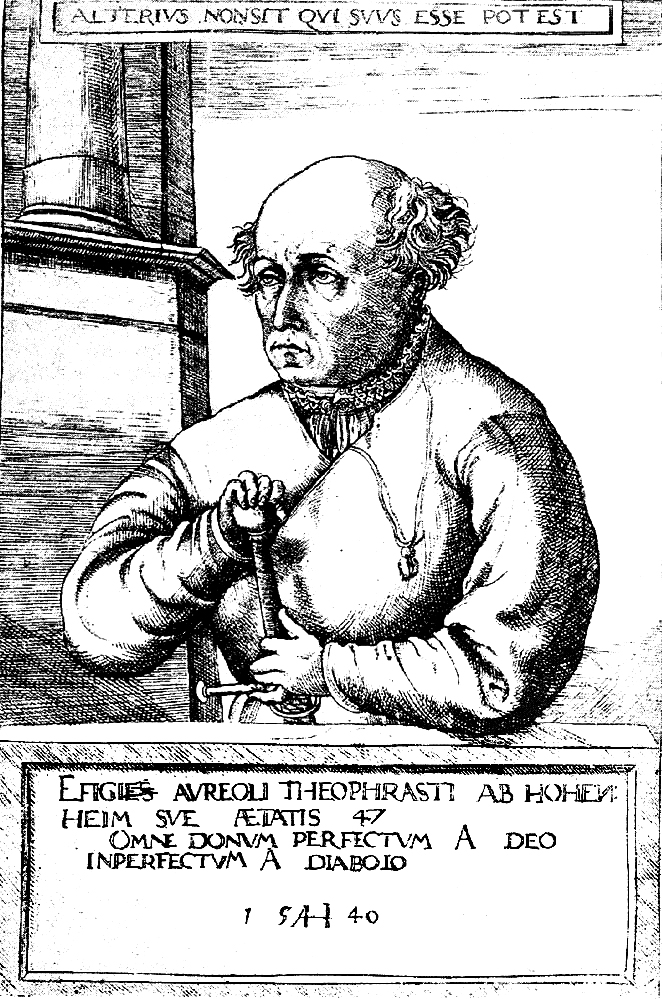
A Book on Nymphs, Sylphs, Pygmies, and Salamanders, and on the Other Spirits
In its own language: Ex Libro de Nymphis, Sylvanis, Pygmaeis, Salamandris et Gigantibus, etc
Paracelsus's late treatise on the spirits of the four classical elements
A treatise written near the end of his life by Paracelsus, a Swiss thinker of theology and philosophy, and printed after his death in 1566. It describes the spirits of the four classical elements as water, air, earth and fire peoples that belong to God's created world rather than to the devil.
- Paracelsus wrote the treatise late in life; it first appeared in print in 1566, after his death.
- It gives the spirits of water, air, earth and fire several names each, from undines to vulcans.
- Paracelsus rejects calling elementals devils and counts them among God's creatures instead.
- Monsters born to the spirit peoples are read as omens, like comets were in his day.
- Comte de Gabalis of 1670 drew its elementals from the book, passing them on to Pope and Baudelaire.
What it is
A treatise by Paracelsus, a Swiss layman who wrote theology and philosophy, set down in his last years and printed in 1566, after his death. Its subject is the spirits tied to the four classical elements: water, air, earth and fire. Paracelsus treats these beings as peoples with names and homes of their own, not as devils, and reads them as ordinary features of the world God made, open to study like stones or stars. The book also turns to monsters born of these peoples, which it reads as signs of things to come. It sits where theology, natural philosophy and spirit-lore meet, and its fairy-tale manner later fed poets and novelists.
Where it comes from
The author, born Theophrastus von Hohenheim, lived from 1493 or 1494 until 1541 and wrote this text in his last years; the precise date is lost. For its portraits of the elemental spirits he drew on old and customary writings, reshaping what he found rather than repeating it. The work reached print only after his death: a stand-alone edition in 1566, a place the next year in a gathering of his philosophical writings, and later many collected editions. English readers received Henry E. Sigherist's translation in a Johns Hopkins University Press volume of four Paracelsus treatises, first printed in 1941 and issued again in 1996.
How it is done
The treatise works by sorting. Paracelsus begins from the biblical creation story and argues that a person must use philosophy to learn about nature; without that study, he holds, no one can grasp Christ or read the Bible aright. He then gives each element a people and several names. Water holds the nymphs, also called water people or undines; air the sylphs, or forest, wind and air people; earth the gnomes, pygmies or mountain people; fire the salamanders, or fire people, vulcans and aetnans, a nod to Mount Etna. Each people can bear monsters, and he likens this to the idea, current in his day, that comets are an odd form of star.
A Book on Nymphs, Sylphs, Pygmies, and Salamanders, and on the Other Spirits, drawn and placed
- Living
- Revived
- Fading
- Historical
- Legendary
- Performed
- Lineage
- the natural philosophy and theology of Paracelsus
What it is for
The book serves an argument about knowledge. Paracelsus holds that studying nature, spirits included, is part of the Christian's road: philosophy opens the natural world, and without it Christ and the Bible stay shut to understanding. Against the habit of branding elementals as devils, he claims them as genuine members of God's creation and examines them like any other creature. The monsters born to the four peoples act as warnings, each with its meaning: will-o'-the-wisps foretell the end of a monarchy, giants great calamities, dwarfs hardship among the people, and sirens the fall of princes and lords or the growth of sects and factions.
At a glance: who, where and when
Who does it
Belief worlds
What people believe
The world of the book is a Christian one, ordered by the four elements of classical philosophy. Each element shelters a people of spirits, and these beings are neither angels nor fallen angels: Paracelsus sets aside the usual Christian label of devil for them and counts them among God's creatures instead. Their lives belong to natural history, studied like anything else God made. The peoples can bear monsters of many shapes: the water folk produce sirens and sea monks, the air folk giants, the fire folk will-o'-the-wisps, and the mountain folk dwarfs. These monsters arrive as omens, much as comets were thought to do, announcing public things: the fate of monarchs, princes and religious factions.
Compare and confuse
The same spirits travel under many names in the treatise: the water folk are nymphs, undines or water people; the air folk sylphs, sylvestres or wind people; the earth folk gnomes, pygmies or mountain men; the fire folk salamanders, vulcans or aetnans. The book also defines itself against a rival reading, the conventional Christian teaching that such beings are devils, which Paracelsus refuses. Later the 1670 Comte de Gabalis took its elementals from this text and handed them on to poets and novelists.
Today
The book lives on mostly through literature. Its fairy-tale quality made it a favourite quarry for poets and writers of fiction. Comte de Gabalis, a 1670 work, drew its pictures of elementals chiefly from this treatise, and through that channel it reached Charles Baudelaire, Alexander Pope, Anatole France and Friedrich de la Motte Fouqué. Jean Giraudoux, whose play Ondine opened in 1938, named Paracelsus in its preface as the writer he had drawn on. Academic readers meet the text through the 1941 English translation, brought out again in 1996.
Questions people ask about A Book on Nymphs, Sylphs, Pygmies, and Salamanders, and on the Other Spirits
What is this book?
A short treatise by Paracelsus, a Swiss thinker who wrote theology and philosophy outside the clergy. It describes the spirits of the four classical elements as he believed they fit into a Christian picture of the world. He wrote it late in life, and it reached print in 1566, after his death.
Who wrote it, and when?
Theophrastus von Hohenheim, remembered as Paracelsus, a Swiss layman who wrote theology and philosophy, living from 1493 or 1494 to 1541. The text comes from his final years, though no exact year is recorded. It was printed only after his death, first as a stand-alone work in 1566.
What are the four spirit peoples?
Nymphs or undines in water; sylphs, sylvestres or wind people in air; gnomes, pygmies or mountain people in earth; salamanders, vulcans or aetnans in fire, the last name pointing to Mount Etna. He treats each as a people with a home, not as devils but as creatures of God.
Does the book say the spirits are dangerous?
Not in his reading. He argues against the widespread Christian view that elementals are devils, and examines them as fellow creatures in the created order. The monsters their peoples can produce, though, serve as omens of great disasters, poverty, the fall of monarchs and the rise of sects.
Why do poets care about it?
Its fairy-tale quality made it a rich source for writers of verse and fiction. Comte de Gabalis in 1670 took its elementals mainly from this treatise, and that line of borrowing reached Alexander Pope, Anatole France, Charles Baudelaire and Friedrich de la Motte Fouqué, besides Jean Giraudoux's Ondine of 1938.
Good reading and sources
- A Book on Nymphs, Sylphs, Pygmies, and Salamanders, and on the Other Spirits on WikipediaEncyclopedia
- Wikidata recordOpen data
The facts on this page come from the Wikipedia article "A Book on Nymphs, Sylphs, Pygmies, and Salamanders, and on the Other Spirits", written by its contributors and used under the CC BY-SA 4.0 licence, and from its Wikidata record (CC0). EveryJaadu rewrote the text in its own words, with AI assistance, and compares every page with the article to make sure no passage is copied. It may be reused under the same CC BY-SA 4.0 licence with a link back.
It may contain mistakes. Names and customs differ from one community to the next, and some knowledge is closed to outsiders and left out here. This page describes belief and practice. It does not say that any of it works, it is not a how-to, and it is not medical advice. If something is wrong, tell us. Last refreshed 2026-10-19.
More from Switzerland
All the entries from Switzerland 🇮🇹 Italy and 4 moreTarottarocchi
A set of cards for games and divination, with roots in fifteenth-century ItalyText · Wonder and entertainment · Seeing and foretelling Living
 🇮🇶 Iraq and 5 moreGrimoire
A textbook containing instructions for spells, rituals, and the creation of magical objects.Text · Protection · Healing Historical
🇨🇭 SwitzerlandArbatel de magia veterum
A 1575 Swiss grimoire focused on celestial spirits and Christian ethicsText · Power and authority · Speaking with spirits and the dead Historical
 🇮🇸 Iceland and 3 moreDeal with the Devil
A cultural trope of trading one's soul for worldly favours in exchange for demonic aidBelief · Power and authority · Cursing and harm Historical
Related elsewhere
All text 🇯🇵 JapanItakoイタコ
Blind women in Japan who train to channel spirits and communicate with the dead.Tradition · Speaking with spirits and the dead · Seeing and foretelling Fading
 🇨🇱 Chile and 1 moreMachi
Mapuche spiritual authorities and healers who bridge herbal knowledge and spirit realmsTradition · Healing · Speaking with spirits and the dead Living
 🇨🇺 Cuba and 4 moreSanteríaRegla de Ocha
An Afro-Cuban religion blending Yoruba spirits with Catholic saintsTradition · Protection · Healing Living
 🇺🇸 United StatesKahuna
A Hawaiian expert or priest, keeper of hidden knowledge in craft and spiritTradition · Healing · Seeing and foretelling Living