Muslim and Sufi: magic in this belief world
Ruqyah, the talisman, the djinn, and the debate over what Islam permits.
In Islam, the Quran is held to be a source of protection and healing, and the faith has a long, debated relationship with talismans, amulets, the djinn and divination. The practice of ruqyah, Quranic recitation for protection or relief, is widely accepted when it uses the Quran and prayer alone. This page covers the range of practice, from Sufi shrines to Salafi critics, and the legal and social stakes. Practice varies from country to country, and between Sunni, Shia and Sufi communities.
What is accepted
Muslim scholars generally accept supplication and recitation of the Quran and the prophetic prayers for protection. The existence of the djinn, beings of smokeless fire, is stated in the Quran, and the evil eye is mentioned in hadith. Protection from the eye and from harm by recitation is common, and recitation for sickness is a regular practice of both laity and imams. The Quran's last two chapters, the Mu'awwidhatayn, are widely recited for protection, and many Muslims keep a Quranic verse in the home or the car.
What is disputed
Writing verses on amulets, using names and letter squares as in the sciences of huruf and awfaq, consulting astrologers, and visiting shrines for intercession divide scholars. Salafi and reformist movements condemn such practices as shirk, associating others with God. Sufi traditions and many popular practices defend them. The Maghreb has a long tradition of written talismans, and West African marabouts supply them. The djinn are discussed by scholars such as Ibn Taymiyya, and by popular preachers, and many Muslims believe that possession by a djinn can occur and that recitation is the proper response.
Law and punishment
Treatment of sorcery varies. In Saudi Arabia, people have been executed for sorcery or witchcraft, and the law there treats it as a serious crime. Elsewhere, courts prosecute fraudulent healers, and in Indonesia and Malaysia the bomoh and dukun are both consulted and criticised. Women are often healers, clients and accused, though men hold most formal religious authority. Many Muslims, especially in South Asia, West Africa, Indonesia and Turkey, visit tombs of saints to ask for help, while others, including Salafis and many modernists, regard this as wrong.
Diaspora and the market
Muslim communities in Europe and North America run ruqyah services, and websites sell talismans. Some exploit the fear of djinn or the evil eye, charging high sums, and abuse in the name of exorcism has been reported in several countries. Scholars note that practice differs sharply by region, class and school of thought. Some Muslims also see the line between permitted and forbidden as clear in principle but hard to keep in daily practice, and think that what matters is that practice does not replace worship of God alone.
Muslim and Sufi on EveryJaadu
The entries written up so far, best known first.
 🇸🇦 Saudi Arabia and 5 moreIslamic exorcismرقية
A rite to expel spirits through Quranic recitation and negotiationRite · Healing · Cleansing and purification Living
🇸🇦 Saudi Arabia and 5 moreIslamic exorcismرقية
A rite to expel spirits through Quranic recitation and negotiationRite · Healing · Cleansing and purification Living
 🇪🇬 Egypt and 5 moreSacred dance
Movement used in worship to honour deities, heal communities, or connect with the spirit world.Tradition · Protection · Healing Living
🇪🇬 Egypt and 5 moreSacred dance
Movement used in worship to honour deities, heal communities, or connect with the spirit world.Tradition · Protection · Healing Living
 🇸🇦 Saudi Arabia and 1 moreDhikrذِكْر
Islamic remembrance of God through repeated recitation and prayerRite · Speaking with spirits and the dead · Power and authority Living
🇸🇦 Saudi Arabia and 1 moreDhikrذِكْر
Islamic remembrance of God through repeated recitation and prayerRite · Speaking with spirits and the dead · Power and authority Living
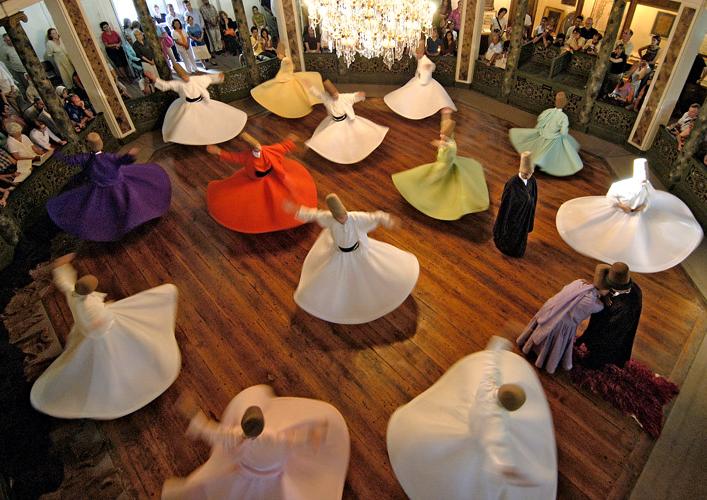 🇹🇷 Turkey and 4 moreSufi whirlingSemazen
A spinning meditation practiced by Sufi dervishes to reach spiritual connection through music and movement.Rite · Speaking with spirits and the dead · Change and initiation Living
🇹🇷 Turkey and 3 moreSufi whirlingSemazen
A spinning meditation practiced by Sufi dervishes to reach spiritual connection with Allah.Tradition · Speaking with spirits and the dead · Love and attraction Living
🇹🇷 Turkey and 4 moreSufi whirlingSemazen
A spinning meditation practiced by Sufi dervishes to reach spiritual connection through music and movement.Rite · Speaking with spirits and the dead · Change and initiation Living
🇹🇷 Turkey and 3 moreSufi whirlingSemazen
A spinning meditation practiced by Sufi dervishes to reach spiritual connection with Allah.Tradition · Speaking with spirits and the dead · Love and attraction Living
 🇹🇷 Turkey and 2 moreHadraحضرة
A collective Sufi ritual of remembrance and chanting to experience Divine PresenceRite · Speaking with spirits and the dead · Power and authority Living
🇸🇦 Saudi Arabia and 2 moreBay'ahبيعة
An oath of loyalty and obedience given to a political or spiritual leader in Islamic traditionRite · Binding and oaths · Power and authority Living
🇹🇷 Turkey and 2 moreHadraحضرة
A collective Sufi ritual of remembrance and chanting to experience Divine PresenceRite · Speaking with spirits and the dead · Power and authority Living
🇸🇦 Saudi Arabia and 2 moreBay'ahبيعة
An oath of loyalty and obedience given to a political or spiritual leader in Islamic traditionRite · Binding and oaths · Power and authority Living
 🇮🇶 Iraq and 3 moreUmayyad tradition of cursing Ali
A state policy to denounce Ali during communal prayers under the Umayyad CaliphateRite · Cursing and harm · Binding and oaths Historical
🇮🇶 Iraq and 3 moreUmayyad tradition of cursing Ali
A state policy to denounce Ali during communal prayers under the Umayyad CaliphateRite · Cursing and harm · Binding and oaths Historical
Photo credits on this page
The small pictures above come from Wikimedia Commons under free licences. Some are cropped to fit.
- Islamic exorcism: Unknown Calligrapher, Public domain, source
- Umayyad tradition of cursing Ali: Anwar Rizvi, CC BY 2.0, source
- Sacred dance: Jorge Barrios, CC BY-SA 3.0, source
- Dhikr: Eugène Baugnies, Public domain, source
- Hadra: Zeinebtakouti, CC BY-SA 4.0, source
- Sama: myself, Public domain, source