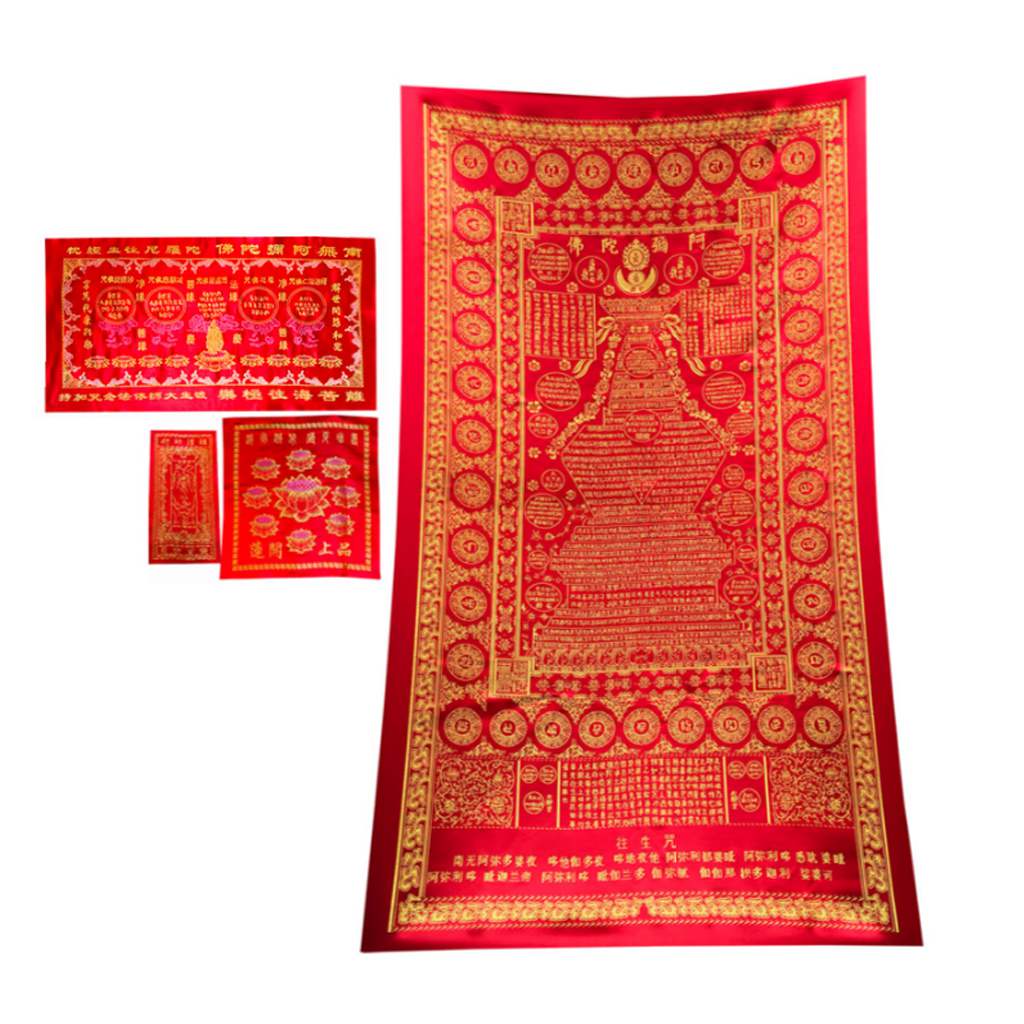
Yantra cloth
In its own language: ผ้ายันต์
Cloth marked with sacred designs, hung in a house to keep harm away
A yantra cloth, or pha yant, is a piece of red, black or white fabric marked with esoteric Buddhist designs called yantra. It is used in Southeast Asia, above all in Thailand and Cambodia, as a spiritual protection for houses and for people, whether living or dead.
- Cloth is red, black or white, marked with esoteric Buddhist designs called yantra
- In Thailand and Cambodia a cloth is raised onto the beams of a newly built house
- Khmer house-protection cloths are commonly decorated with rain quails
- Thai cloths may show Nang Kwak, Thao Kuwen or the dead monk Luang Phor Koon
- Bokator fighters wear shirts made from the cloth, as do some international fighters
What it is
A yantra cloth is a length of fabric, usually red, black or white, covered with esoteric Buddhist designs known as yantra. People in Southeast Asia keep such cloths as spiritual insurance for a household or a single person, and the protection sought is thought to reach the dead as well. The cloths are very common. A psychologist who writes about superstition treats them as an unorthodox strand of Buddhist practice rather than an official one, and some pieces carry imagery whose meaning even readers of the designs find unclear.
How it is done
Making one traditionally is not simply a matter of printing. Ritual actions and khatha writings, that is, inscribed formulae, go together with recitation, and black magic is named as part of the process meant to give the finished piece its power for people who believe in it. Cloth sold through modern marketing may be factory-made and never pass through any of this. Some pieces are sibylline, their sense unsettled even for those familiar with the designs.
Tools and materials
The base is cloth, and the colour is part of it: red, black or white. Onto the fabric go the yantra, esoteric designs of Buddhist origin, and khatha writings, short formulae that are inscribed rather than spoken aloud. Animal imagery appears as well. Among Khmer pieces made for house protection, the rain quail is the usual figure. Thai examples may instead carry a Buddhist divinity, Nang Kwak or Thao Kuwen, or a monk who has died, Luang Phor Koon being one.
Yantra cloth, drawn and placed
- Living
- Revived
- Fading
- Historical
- Legendary
- Performed
- Lineage
- Buddhist yantra tradition
- Timing
- when a house is newly built, and for fighters before a bout
What it is for
Most often the cloth is a guard for a building. It may also be cut and sewn into a shirt for a Bokator fighter, Bokator being a Khmer martial art, to strengthen him in a match, and some of these shirts have been taken up by competitors from outside the region, Thiago Silva among them. In Chinese practice the cloth serves a different end entirely: it is laid over a body after death.
Peoples and places
Thailand and Cambodia are the two countries where the custom is most at home. Khmer pieces for the home tend to be illustrated with rain quails, while Thai pieces more often honour a Buddhist figure or a monk who is remembered after death. Chinese communities use the same kind of decorated fabric in funerary practice. Through Bokator the fighting shirts have travelled abroad with international competitors.
At a glance: who, where and when
What people believe
Behind the cloth sits a world of Buddhist figures and of spirits that can do a household harm. Protection is asked of divinities, of monks remembered after their death, and of the inscribed designs themselves. Evil spirits are the danger a new house is shielded from. Practitioners hold that the object works because the rites and formulae were carried out properly, which is why those rites are held to matter to the result.
How scholars and sceptics see it
Stuart Vyse, a psychologist who writes on superstition, counts the cloths as an unorthodox Buddhist superstition, common as they are. His reading places them among practices that many people use but that formal teaching does not require. Separately, some pieces are described as sibylline: their imagery resists a settled reading, even for people who know the designs well.
Cautions and what is closed
The rites said to give a cloth its value are not always performed. Factory-made pieces reach buyers through ordinary marketing, having skipped the rituals, the recitation and the formulae, and nothing in the fabric itself shows the difference. What the cloth is held to do rests on belief. Black magic is named as part of the traditional process of preparation.
Today
The cloth has not stayed local. Shirts made from it are worn by Bokator competitors and have become popular with international fighters, Thiago Silva being one named example. At the same time, factory production supplies a market that never involves a ritual specialist. The same object therefore leads two lives: a ritually prepared protection for a household, and a mass-produced item sold through ordinary marketing.
Questions people ask about Yantra cloth
What is a yantra cloth?
A piece of red, black or white fabric marked with esoteric Buddhist designs called yantra. It is kept in Southeast Asia as a spiritual protection for a house or a person, and in Chinese practice it is also laid over someone who has died.
Where does it come from?
The custom is established in Thailand and Cambodia, and the fabric is also used among Chinese communities for the dead. Khmer and Thai pieces differ in the figures they show, with rain quails common on Khmer house cloths.
What is it used for?
Households hang it for protection, especially when a house is new. In Cambodia and Thailand it is also sewn into shirts for Bokator fighters, and such shirts have been adopted by competitors from abroad, Thiago Silva among them.
Who are the figures shown on it?
Thai cloths may bear Nang Kwak or Thao Kuwen, both named as Buddhist divinities, or a monk who has died, such as Luang Phor Koon. Khmer house cloths more often carry rain quails. Some pieces are described as hard to interpret.
Is it orthodox Buddhist practice?
The psychologist Stuart Vyse describes it as an unorthodox Buddhist superstition, common as the cloths are. The designs and formulae are Buddhist in origin, yet the practice is treated as sitting outside formal teaching.
Good reading and sources
The facts on this page come from the Wikipedia article "Yantra cloth", written by its contributors and used under the CC BY-SA 4.0 licence, and from its Wikidata record (CC0). EveryJaadu rewrote the text in its own words, with AI assistance, and compares every page with the article to make sure no passage is copied. It may be reused under the same CC BY-SA 4.0 licence with a link back.
It may contain mistakes. Names and customs differ from one community to the next, and some knowledge is closed to outsiders and left out here. This page describes belief and practice. It does not say that any of it works, it is not a how-to, and it is not medical advice. If something is wrong, tell us. Last refreshed 2026-10-20.
More from Thailand
All the entries from Thailand 🇹🇭 Thailand and 3 moreThai Buddha amuletsพระเครื่อง (phrakhrueang)
Sacred Buddhist images and relics worn for protection, merit, and fortune in Thailand.Charm · Protection · Luck and prosperity Living
 🇰🇭 Cambodia and 3 moreSak Yantសាក់យ័ន្ត
Sacred geometric tattoos from Southeast Asia believed to grant protection and powerTradition · Protection · Luck and prosperity Living
 🇹🇭 Thailand and 1 morePalad khikปลัดขิก
A Thai phallic amulet believed to bring luck and protectionCharm · Protection · Luck and prosperity Living
 🇹🇭 Thailand and 1 morePra Jiadประเจียด
A Muay Thai armband worn for luck and confidenceCharm · Luck and prosperity · Protection Living
Related elsewhere
All charm 🇪🇬 Egypt and 1 moreSphinx
A composite creature of human head and lion body found in Egyptian and Greek mythBeing · Protection Legendary
 🇪🇬 EgyptCurse
A spoken wish for harm, often backed by ritual or divine authorityBelief · Cursing and harm · Protection Historical
 🇨🇳 China and 5 moreHorseshoe
A curved plate fixed to a horse's hoof for protection, also kept as a charm for fortune.Charm · Protection · Luck and prosperity Living
 🇪🇬 Egypt and 5 moreAmulet
A portable object worn or carried to ward off harm and invite fortuneCharm · Protection · Luck and prosperity Living