
Wheel of the Year
from the metaphor of a wheel representing the cyclical nature of time and seasons
An annual cycle of eight seasonal festivals observed by modern pagans.
The Wheel of the Year is a calendar of eight holidays marking solstices, equinoxes, and their midpoints. British neopagans created this system in the twentieth century by blending Celtic and Anglo-Saxon traditions into a unified spiritual practice.
- Combines four solar and four midpoint festivals
- Popularized by British neopagans in the 1900s
- Draws from Celtic and Anglo-Saxon traditions
- Marks solstices, equinoxes, and cross-quarters
- Includes holidays like Yule, Samhain, and Beltane
What it is
This system organizes the year into eight distinct celebrations. It marks the sun's highest and lowest points, as well as the moments of equal light and dark. Practitioners view these dates as gateways for spiritual connection and communal gathering. The cycle represents a continuous loop of growth and decline, mirroring natural patterns found in agriculture and astronomy.
Where it comes from
The concept emerged in Britain during the mid-twentieth century. Gerald Gardner and Ross Nichols are credited with merging existing folk calendars. They combined four solar stations from Anglo-Saxon tradition with four midpoint festivals from Insular Celtic culture. Influential books like The Golden Bough and The Witch-Cult in Western Europe provided historical context for these seasonal links. The term itself became common in the 1960s to describe this specific eight-part structure.
How it is done
Observances vary widely across different pagan paths. Some groups follow lunar phases, while others stick strictly to solar dates. Celebrations often involve feasting, gift exchange, and decorating homes with evergreens. Specific rituals include dancing around maypoles, blessing bread loaves, and lighting candles. Many practitioners gather at significant sites like Stonehenge or Newgrange to align with ancient astronomical alignments.
Tools and materials
Materials depend on the season and local availability. Evergreen branches such as holly, ivy, and pine symbolize endurance. Bread and grain represent harvest and thanksgiving. Candles mark the balance of light and dark. Maypoles serve as focal points for spring dances. Each item carries symbolic weight related to fertility, protection, or renewal within the cosmology.
Wheel of the Year, drawn and placed
- Living
- Revived
- Fading
- Historical
- Legendary
- Performed
- Lineage
- Modern Paganism and Wicca
- Timing
- quarter days and cross-quarter days
What it is for
Participants seek to honor the changing seasons and acknowledge their place within nature. The festivals provide opportunities for purification, new beginnings, and ancestor veneration. Samhain focuses on remembering the dead, while Imbolc celebrates the first stirrings of spring. The cycle offers a structured way to connect with divine forces and community throughout the year.
Who does it
The practice is primarily household-based but also involves organized covens and druidic orders. Training varies; some learn through initiation, while others adopt the calendar independently. Both men and women participate equally in most modern groups. Leadership roles exist within specific orders, but general observance requires no formal priestly status.
Peoples and places
The tradition is strongest among British neopagans and Wiccans. It draws heavily on Gaelic and Anglo-Saxon heritage. Insular Celtic peoples originally celebrated the midpoint festivals. Anglo-Saxons marked the solar stations. Modern practitioners worldwide adapt these names and customs, though the core structure remains rooted in European folklore and mythology.
At a glance: who, where and when
Who does it
Belief worlds
Occasions


What people believe
Cosmology here emphasizes cyclical time rather than linear progression. The sun is seen as dying and rebirthing annually. Spirits of the departed are believed to be closer during Samhain. Deities like Brigid and Lugh are honored alongside generic goddess and god figures. The universe is viewed as a series of interconnected cycles, where human life mirrors cosmic rhythms.
When it is done
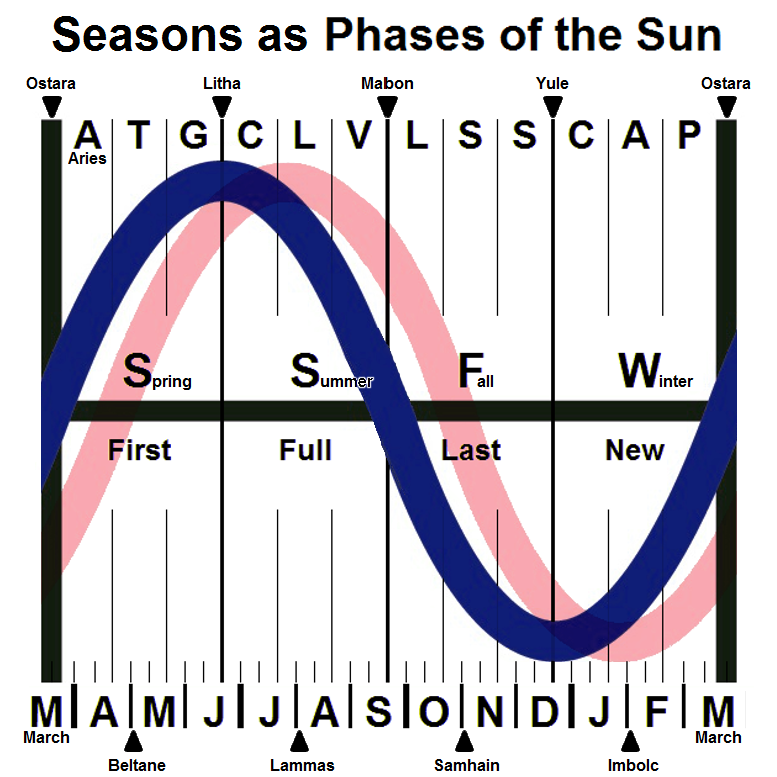
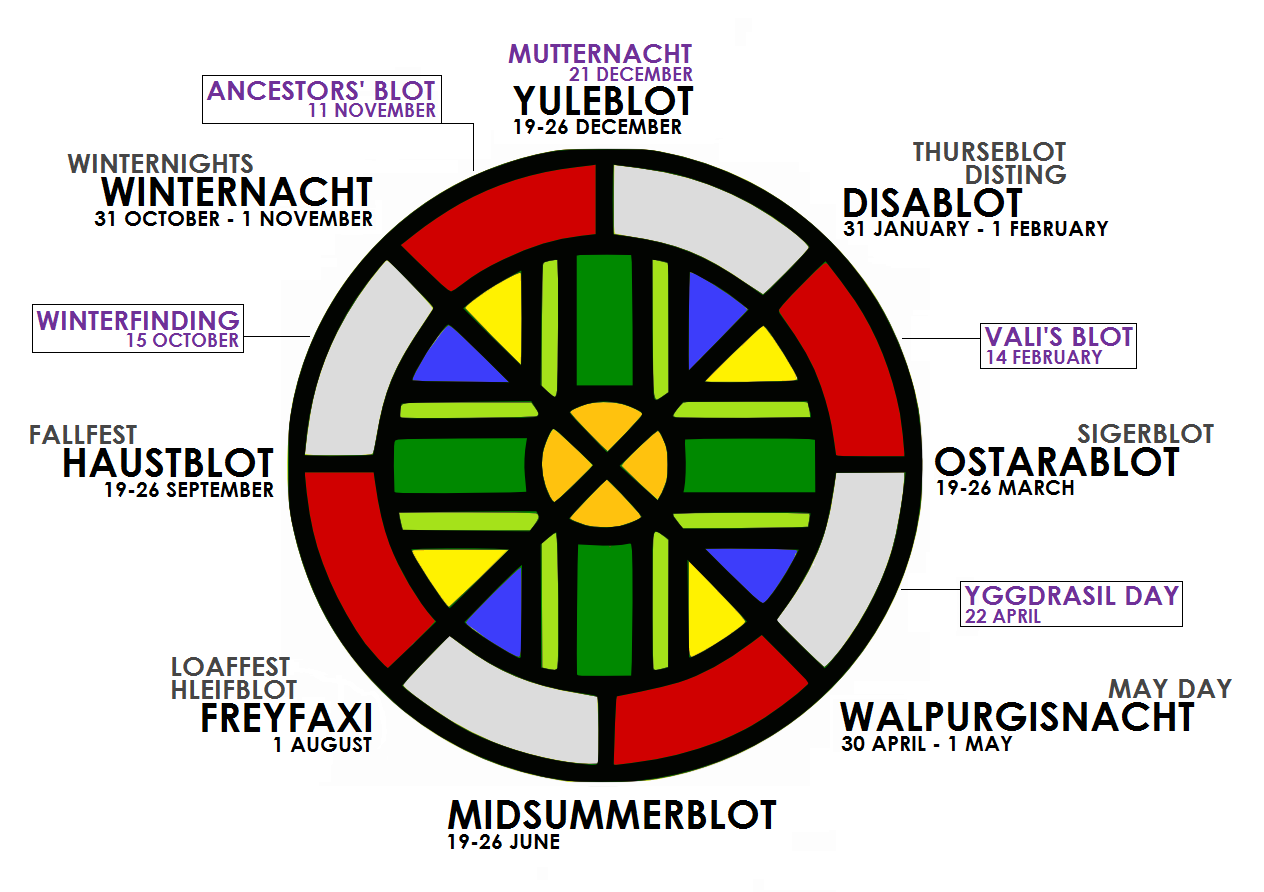
The eight festivals occur at specific solar intervals. Yule falls near December 21. Imbolc is February 1. Ēostre marks the spring equinox. Beltane occurs on May 1. Midsummer is June 21. Lughnasadh is August 1. Mabon marks the autumn equinox. Samhain is November 1. These dates anchor the liturgical year for adherents.
How scholars and sceptics see it
Academics trace the system to early twentieth-century literary works and occult revivals. Historians note the synthesis of disparate European folk traditions. Anthropologists study how these modern rituals reconstruct ancient practices. Critics sometimes view the system as a recent invention lacking deep historical continuity, while supporters argue it preserves valid archaic patterns.
Cautions and what is closed
Some sites like Stonehenge have legal restrictions on large gatherings. Commercialization can dilute the spiritual significance of the holidays. Appropriation of indigenous or non-European traditions by western pagans is a point of contention. There are no known physical dangers inherent in the rituals themselves, though outdoor winter celebrations require safety precautions.
Compare and confuse
The Wheel is often confused with older, purely agricultural calendars. It differs from Christian holy days, though it overlaps with them chronologically. Some compare it to the Jewish High Holy Days or Hindu festivals, but the structural basis is distinctly European. The term sabbat is specific to Wicca, whereas other pagans might use festival or holiday.
Days linked to Wheel of the Year
Questions people ask about Wheel of the Year
What is the Wheel of the Year?
It is an annual cycle of eight festivals used by modern pagans. The holidays mark solstices, equinoxes, and the midpoints between them. This system blends Celtic and Anglo-Saxon traditions into a single spiritual calendar.
Where did this tradition come from?
It originated in Britain during the mid-twentieth century. Neopagans like Gerald Gardner merged existing folk calendars. They combined solar stations with midpoint festivals to create a unified eight-fold cycle.
How many festivals are there?
There are eight main holidays in the cycle. They include Yule, Imbolc, Ostara, Beltane, Litha, Lammas, Mabon, and Samhain. Each marks a specific point in the sun's annual journey.
Who practices the Wheel of the Year?
It is primarily practiced by Wiccans and other modern pagans. The tradition is popular in the United Kingdom and has spread globally. Participants range from solitary practitioners to organized coven members.
Good reading and sources
- Wheel of the Year on WikipediaEncyclopedia
- More photos on Wikimedia CommonsPhotos and video
- Wikidata recordOpen data
The facts on this page come from the Wikipedia article "Wheel of the Year", written by its contributors and used under the CC BY-SA 4.0 licence, and from its Wikidata record (CC0). EveryJaadu rewrote the text in its own words, with AI assistance, and compares every page with the article to make sure no passage is copied. It may be reused under the same CC BY-SA 4.0 licence with a link back.
It may contain mistakes. Names and customs differ from one community to the next, and some knowledge is closed to outsiders and left out here. This page describes belief and practice. It does not say that any of it works, it is not a how-to, and it is not medical advice. If something is wrong, tell us. Last refreshed 2026-10-05.
More from the United Kingdom
All the entries from the United Kingdom 🇬🇧 United KingdomEnochian magic
A Renaissance system of ceremonial magic based on angelic revelations recorded by John Dee and Edward Kelley.Tradition · Speaking with spirits and the dead · Power and authority Living
🇬🇧 United KingdomEnochian magic
A Renaissance system of ceremonial magic based on angelic revelations recorded by John Dee and Edward Kelley.Tradition · Speaking with spirits and the dead · Power and authority Living
 🇫🇷 France and 2 moreÉliphas Lévi
A French writer who shaped modern occult thought and ceremonial magic.Text · Power and authority · Speaking with spirits and the dead Historical
🇫🇷 France and 2 moreÉliphas Lévi
A French writer who shaped modern occult thought and ceremonial magic.Text · Power and authority · Speaking with spirits and the dead Historical
 🇬🇧 United Kingdom and 5 moreAleister Crowley
English occultist and founder of the religion of ThelemaText · Power and authority · Change and initiation Living
🇬🇧 United Kingdom and 5 moreAleister Crowley
English occultist and founder of the religion of ThelemaText · Power and authority · Change and initiation Living
 🇬🇧 United Kingdom and 4 moreCorn dolly
A woven straw figure made from the last sheaf of a European harvest to house the crop spirit.Tradition · Protection · Speaking with spirits and the dead Revived
🇬🇧 United Kingdom and 4 moreCorn dolly
A woven straw figure made from the last sheaf of a European harvest to house the crop spirit.Tradition · Protection · Speaking with spirits and the dead Revived
Related elsewhere
All tradition 🇮🇳 India and 2 moreYantraयन्त्र
A geometric diagram from Indian traditions used for worship and meditationTradition · Protection · Speaking with spirits and the dead Living
🇮🇳 India and 2 moreYantraयन्त्र
A geometric diagram from Indian traditions used for worship and meditationTradition · Protection · Speaking with spirits and the dead Living
 🇮🇳 India and 1 moreMantraमन्त्रम्
A sacred sound or phrase repeated to focus the mind and invoke spiritual powerText · Speaking with spirits and the dead · Power and authority Living
🇮🇳 IndiaKeśin
A Vedic hymn describing long-haired ascetics who travel on the wind and share a cup with Rudra.Tradition · Power and authority · Wonder and entertainment Historical
🇮🇳 India and 1 moreMantraमन्त्रम्
A sacred sound or phrase repeated to focus the mind and invoke spiritual powerText · Speaking with spirits and the dead · Power and authority Living
🇮🇳 IndiaKeśin
A Vedic hymn describing long-haired ascetics who travel on the wind and share a cup with Rudra.Tradition · Power and authority · Wonder and entertainment Historical
 🇮🇱 IsraelSeder hishtalshelusסדר השתלשלות
A Kabbalistic cosmology mapping the descent of divine light through spiritual realms to the physical world.Belief · Power and authority · Wonder and entertainment Living
🇮🇱 IsraelSeder hishtalshelusסדר השתלשלות
A Kabbalistic cosmology mapping the descent of divine light through spiritual realms to the physical world.Belief · Power and authority · Wonder and entertainment Living