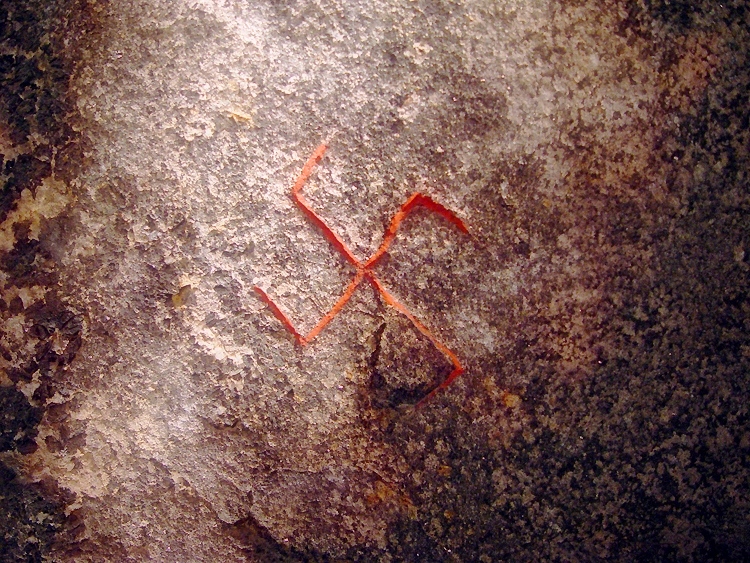
Swastika (Germanic Iron Age)
from Sanskrit swastika, adopted into English usage by the late nineteenth century
A four-armed symbol found on Germanic artefacts from the Migration to Viking periods.
The swastika appears frequently on Germanic Iron Age objects across Scandinavia and Central Europe. Scholars interpret it as a sacred sign linked to thunder gods or solar cycles in pre-Christian belief systems.
- Found on Germanic Iron Age artefacts from the 3rd to 9th centuries.
- Also known as gammadion, fylfot, or crux gothica in older texts.
- Appears on bracteates, image stones, and funerary urns.
- Scholars link it to Thor, Odin, or solar deities.
- Present in Anglo-Saxon graves in England and sites across Scandinavia.
What it is
The swastika is a rotational symbol with four arms that recurs on Germanic Iron Age artefacts. It spans the Migration period to the Viking Age in Scandinavia. The design appears left-facing or right-facing, sometimes with attached feet. It sits alongside other rotational symbols like the triskele. Scholars view it as a significant marker within pre-Christian material culture.
Where it comes from
The motif dates back to the Neolithic era across various cultures. In the Germanic context, it appears in Elder Futhark inscriptions from the third century. It remains visible on Viking Age image stones into the ninth century. The term swastika entered English vocabulary in the eighteen-seventies via Hindu and Buddhist studies. By the eighteen-nineties, it was used for cross-cultural comparisons of the symbol.
How it is done
Artefacts display the symbol carved or stamped onto metal and stone. Bracteates often place the mark next to a human head above an animal. Runic inscriptions sometimes incorporate the shape directly. The direction of reading runes is right-to-left, requiring mirroring for transcription. Some items show careful artistic rendering, suggesting ritual importance.
Tools and materials
Gold bracteates are common carriers of the design. Image stones and spearheads also bear the mark. Funerary urns from Anglo-Saxon cemeteries feature the symbol prominently. Swords and belt fittings include the motif. These materials link the sign to both daily life and burial rites.
Swastika (Germanic Iron Age), drawn and placed
- Living
- Revived
- Fading
- Historical
- Legendary
- Performed
- Lineage
- Germanic Iron Age tradition
- Timing
- during the Migration period through the Viking Age
What it is for
The symbol likely held sacral meaning for its makers. It may represent Thor’s hammer or connect to solar deities. Hilda Ellis Davidson argued it served as a funerary sign. Its presence on cremation urns supports this protective or commemorative role. The association with Odin or Woden appears in bracteate imagery.
Who does it
Modern scholars analyze these objects to understand pagan beliefs. Hilda Ellis Davidson interpreted the runic evidence. Researchers study the placement of the symbol on graves. The analysis focuses on religious symbolism rather than active practice. No living practitioners perform rites using this specific historical form.
Peoples and places
The symbol appears in Sweden, Denmark, Poland, Belarus, and England. The Vendel era in Sweden shows early examples. The Przeworsk culture in Poland produced second-century urns. Etruscans issued medallions with the design in late antiquity. Anglo-Saxon graves in Kent and East Anglia contain numerous examples.
At a glance: who, where and when
Who does it
Belief worlds
Occasions


What people believe
Pre-Christian Germanic groups associated the mark with divine power. Some links suggest a connection to Thor and thunder. Others point to Indo-European solar traditions. The four-fold symmetry may echo sun worship. The symbol’s use in burials implies a belief in its spiritual efficacy for the dead.
When it is done
The symbol appears on objects spanning several centuries. It is found in contexts related to death and burial. Cremation urns and grave goods feature the design. There is no specific festival tied to its creation. Its use aligns with the lifecycle events of the communities that made them.
How scholars and sceptics see it
Hilda Ellis Davidson proposed the Thor connection. She cited many examples from Anglo-Saxon pagan graves. Researchers note the care taken in depicting the symbol. This suggests special significance beyond decoration. The Sæbø sword inscription provides further evidence of its religious role.
Cautions and what is closed
The symbol has been misused in later history. Modern audiences must distinguish this ancient Germanic sign from twentieth-century political appropriations. Focus remains on archaeological and historical interpretation.
Compare and confuse
The swastika is related to the triskele and tetraskele. These symbols share rotational symmetry. The Kolovrat and Valknut appear in similar cultural contexts. Older literature used names like gammadion or crux gothica. These terms reflect different scholarly interpretations of the same shape.
Law and persecution
The focus is purely on historical and archaeological analysis. The symbol’s status in modern law is outside the scope of this entry.
Questions people ask about Swastika (Germanic Iron Age)
What is the swastika in Germanic archaeology?
It is a four-armed rotational symbol found on Iron Age artefacts. It appears on bracteates, stones, and urns across Scandinavia and Central Europe. Scholars view it as a sacred sign from the pre-Christian era.
Where did the name swastika come from?
The word comes from Sanskrit. It entered English usage in the 1870s through studies of Hindu and Buddhist traditions. By the 1890s, it was used to describe similar symbols in European contexts.
What does the symbol mean in Germanic culture?
Scholars believe it had sacral meaning. Some link it to Thor’s hammer or solar deities. Its frequent appearance in graves suggests it played a role in funerary rites and beliefs about the afterlife.
How is it different from other rotational symbols?
It is closely related to the triskele, which has three arms. When viewed as a four-fold analogue, it is sometimes called a tetraskele. Both symbols share rotational symmetry but differ in arm count.
Good reading and sources
- Swastika (Germanic Iron Age) on WikipediaEncyclopedia
- More photos on Wikimedia CommonsPhotos and video
- Wikidata recordOpen data
The facts on this page come from the Wikipedia article "Swastika (Germanic Iron Age)", written by its contributors and used under the CC BY-SA 4.0 licence, and from its Wikidata record (CC0). EveryJaadu rewrote the text in its own words, with AI assistance, and compares every page with the article to make sure no passage is copied. It may be reused under the same CC BY-SA 4.0 licence with a link back.
It may contain mistakes. Names and customs differ from one community to the next, and some knowledge is closed to outsiders and left out here. This page describes belief and practice. It does not say that any of it works, it is not a how-to, and it is not medical advice. If something is wrong, tell us. Last refreshed 2026-10-09.
More from Sweden
All the entries from Sweden 🇸🇪 SwedenMora witch trial
A 1669 Swedish mass execution driven by child testimony and European hysteriaBelief · Cursing and harm Historical
🇸🇪 SwedenMora witch trial
A 1669 Swedish mass execution driven by child testimony and European hysteriaBelief · Cursing and harm Historical
 🇸🇪 SwedenWitch trials in Denmark
A history of legal executions and local panics against sorcery in early modern Denmark.Belief · Cursing and harm Historical
🇸🇪 SwedenWitch trials in Denmark
A history of legal executions and local panics against sorcery in early modern Denmark.Belief · Cursing and harm Historical
 🇸🇪 SwedenTorsåker witch trials
The largest mass execution of witches in Swedish history, carried out in a single day.Belief · Cursing and harm Historical
🇸🇪 SwedenTorsåker witch trials
The largest mass execution of witches in Swedish history, carried out in a single day.Belief · Cursing and harm Historical
Related elsewhere
All belief 🇮🇳 India and 5 moreAstrology
A divinatory practice that reads human fate through the positions of celestial bodies.Belief · Seeing and foretelling · Luck and prosperity Living
🇮🇳 India and 5 moreAstrology
A divinatory practice that reads human fate through the positions of celestial bodies.Belief · Seeing and foretelling · Luck and prosperity Living
 🇮🇳 India and 2 morePalmistry
A divination method that interprets the lines and shapes of the hand to predict fate or reveal character.Oracle · Seeing and foretelling · Power and authority Living
🇮🇳 India and 2 morePalmistry
A divination method that interprets the lines and shapes of the hand to predict fate or reveal character.Oracle · Seeing and foretelling · Power and authority Living
 🇨🇳 China and 3 moreChinese dragon龍
A legendary water deity and imperial symbol in East Asian cultureBeing · Protection · Luck and prosperity Historical
🇨🇳 China and 3 moreChinese dragon龍
A legendary water deity and imperial symbol in East Asian cultureBeing · Protection · Luck and prosperity Historical
 🇬🇹 Guatemala and 1 moreMaya mythology
The reconstructed tales of the Maya people about gods, heroes, and the creation of the world.Tradition · Seeing and foretelling · Power and authority Historical
🇬🇹 Guatemala and 1 moreMaya mythology
The reconstructed tales of the Maya people about gods, heroes, and the creation of the world.Tradition · Seeing and foretelling · Power and authority Historical