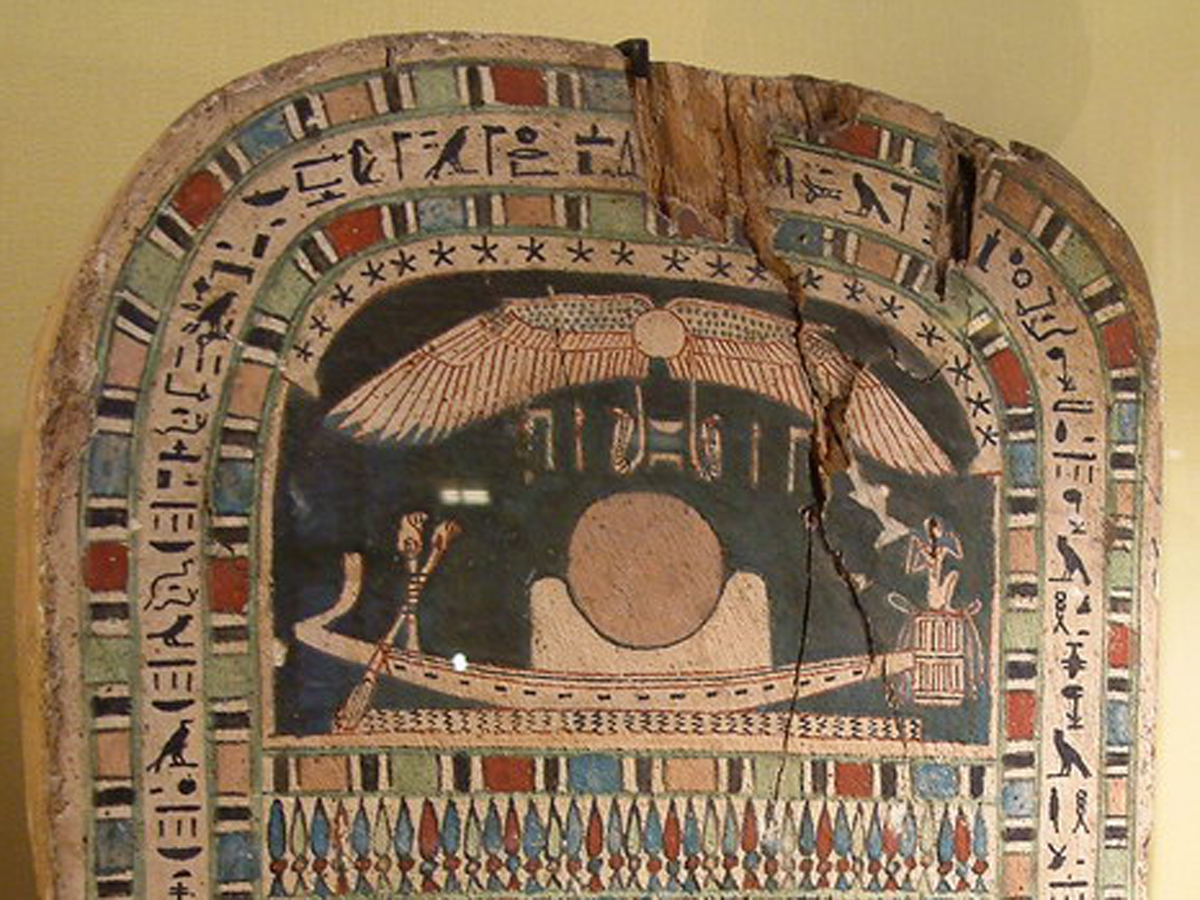
Solar barque
The mythological vessels used by the sun god Ra to travel across the sky and through the underworld in ancient Egypt.
Ancient Egyptian mythology describes two divine ships used by the sun god Ra. The Mandjet carried him across the sky during daylight, while the Mesektet guided his journey through the underworld at night. These vessels symbolized the daily cycle of death and rebirth.
- Ra used the Mandjet boat during the day and Mesektet at night.
- The Khufu ship was buried at Giza for the pharaoh's afterlife.
- Ra battled the serpent Apophis every night in the underworld.
- The journey established the twelve hours of day and night.
- The pharaoh was seen as an earthly representation of Ra.
What it is
The solar barques were sacred vessels in ancient Egyptian belief, serving as the transport for the sun god Ra. Two distinct boats defined his daily path. The Mandjet, also known as the Boat of Millions of Years, carried Ra across the heavens during the day. The Mesektet guided him through the darkness of the underworld at night. These ships represented the eternal cycle of light and dark, linking the visible world with the hidden realm of the dead.
Where it comes from
The concept originates from ancient Egyptian cosmology, where the sun god was central to creation and order. Myth stated that Ra eventually grew weary of ruling on earth and moved to the skies. His journey established the structure of time, with each hour of the day and night overseen by protective deities. The horizon acted as a gateway between the sky and the Duat, the subterranean world where the sun traveled along a celestial Nile.
How it is done
Ra traveled in different forms depending on the time. During daylight, he sailed the Mandjet in a falcon-headed appearance, marking the growth and decline of the sun. At sunset, he passed through the western horizon into the Mesektet, appearing ram-headed to navigate the twelve gates of the underworld. Each night, he battled the chaos serpent Apophis before emerging at dawn to restart the cycle.
Tools and materials
The primary tools were the two wooden vessels themselves, constructed to mirror royal barges. The Mandjet and Mesektet were not physical objects for humans but divine instruments. Their design reflected the pharaoh’s own burial ships, such as the Khufu ship found at Giza. These royal boats were buried with kings to assist their souls in the afterlife, mirroring the god’s journey.
Solar barque, drawn and placed
- Living
- Revived
- Fading
- Historical
- Legendary
- Performed
- Lineage
- Egyptian mythology
What it is for
The barques ensured the continuation of the cosmic order. By carrying Ra through the sky and underworld, they provided light to the world and guaranteed the sunrise. For the deceased pharaoh, the solar barque offered a model for resurrection. Kings were buried with replica ships to join the sun god’s nightly voyage, securing their own rebirth and place among the stars.
Who does it
No living practitioners perform rituals with these specific vessels today. The belief was maintained by the priesthood and the royal court of ancient Egypt. The pharaoh, as the earthly representative of Ra, utilized the symbolism of the solar barque in funerary rites. Artisans crafted physical replicas for tombs, ensuring the king had the necessary means for his spiritual journey.
Peoples and places
This tradition is unique to ancient Egypt. It formed a core part of the state religion and royal ideology. The imagery appears extensively in mortuary texts and temple decorations. The practice declined with the fall of the pharaonic state, leaving behind archaeological evidence like the Khufu ship and textual records in tombs.
At a glance: who, where and when
Peoples
Belief worlds


What people believe
Egyptians believed the universe operated through Ma’at, or balance. Ra’s journey maintained this balance against the chaos represented by Apophis. The sun’s daily death and rebirth were literal events in their worldview. The underworld was a real place with physical geography, including rivers and gates, which the sun god navigated safely through divine power.
When it is done
The barques were associated with the daily cycle rather than specific festivals. Each hour of the day and night corresponded to a stage of Ra’s journey. The transition at sunset and sunrise marked critical moments in the cosmic rhythm. These cycles influenced religious observances and the timing of temple rituals throughout the year.
How scholars and sceptics see it
Historians view the solar barques as symbols of natural phenomena and political authority. Anthropologists note how the myth reinforced the pharaoh’s divine right to rule. The discovery of the Khufu ship provides insight into ancient shipbuilding techniques and religious practices. Scholars study the texts to understand how Egyptians conceptualized time, death, and the cosmos.
Cautions and what is closed
The myth describes violent encounters with Apophis, but these are symbolic struggles against chaos. No physical harm is associated with the belief itself. Modern interest focuses on archaeology and history. There are no risks related to practicing this tradition, as it belongs to a closed historical religion.
Compare and confuse
The solar barque is often compared to other mythological boats, such as Charon’s ferry in Greek tradition. However, the Egyptian version is tied to a daily renewal process rather than a one-way passage. It differs from the Trundholm sun chariot, which represents solar movement without the underworld journey. Both reflect ancient attempts to explain the sun’s path.
Questions people ask about Solar barque
What are the solar barques?
They are two mythological ships in ancient Egyptian religion. The Mandjet carried the sun god Ra across the sky by day, while the Mesektet guided him through the underworld at night.
Why did Ra need boats?
Myth states Ra became too old to rule on earth and moved to the skies. The boats allowed him to travel across the heavens and navigate the subterranean Nile in the Duat.
Are there real examples of these ships?
Yes, the Khufu ship was built and buried at Giza. It served as a physical model for the pharaoh’s journey to the afterlife, mirroring the god’s solar barque.
Who uses these beliefs today?
The tradition is historical and belongs to ancient Egypt. It is studied by scholars and historians, but no living community practices these specific rituals as a religion.
Good reading and sources
- Solar barque on WikipediaEncyclopedia
- More photos on Wikimedia CommonsPhotos and video
- Wikidata recordOpen data
The facts on this page come from the Wikipedia article "Solar barque", written by its contributors and used under the CC BY-SA 4.0 licence, and from its Wikidata record (CC0). EveryJaadu rewrote the text in its own words, with AI assistance, and compares every page with the article to make sure no passage is copied. It may be reused under the same CC BY-SA 4.0 licence with a link back.
It may contain mistakes. Names and customs differ from one community to the next, and some knowledge is closed to outsiders and left out here. This page describes belief and practice. It does not say that any of it works, it is not a how-to, and it is not medical advice. If something is wrong, tell us. Last refreshed 2026-10-14.
More from Egypt
All the entries from Egypt 🇪🇬 Egypt and 1 moreLilithלִילִית
A feminine figure from Mesopotamian and Jewish mythology, often depicted as a night demon or spirit.Being · Cursing and harm Legendary
🇪🇬 Egypt and 1 moreLilithלִילִית
A feminine figure from Mesopotamian and Jewish mythology, often depicted as a night demon or spirit.Being · Cursing and harm Legendary
 🇪🇬 EgyptAnubis𓇋𓈖𓊪𓃣
The jackal-headed god who guides souls and oversees mummification in ancient Egypt.Being · Protection · Speaking with spirits and the dead Historical
🇪🇬 EgyptAnubis𓇋𓈖𓊪𓃣
The jackal-headed god who guides souls and oversees mummification in ancient Egypt.Being · Protection · Speaking with spirits and the dead Historical
 🇪🇬 EgyptImhotepỉỉ-m-ḥtp
An ancient Egyptian architect deified as a god of healing and wisdomBeing · Healing · Power and authority Historical
🇪🇬 EgyptImhotepỉỉ-m-ḥtp
An ancient Egyptian architect deified as a god of healing and wisdomBeing · Healing · Power and authority Historical
 🇪🇬 Egypt and 2 moreIsisꜣst (Egyptian)
Egyptian goddess of magic, mourning and kingship, mother of HorusBeing · Protection · Healing Historical
🇪🇬 Egypt and 2 moreIsisꜣst (Egyptian)
Egyptian goddess of magic, mourning and kingship, mother of HorusBeing · Protection · Healing Historical
Related elsewhere
All being 🇫🇷 France and 2 moreKing ArthurBrenin Arthur
A legendary British king and folk hero of medieval literature and Welsh mythologyFigure · Power and authority · Wonder and entertainment Legendary
🇫🇷 France and 2 moreKing ArthurBrenin Arthur
A legendary British king and folk hero of medieval literature and Welsh mythologyFigure · Power and authority · Wonder and entertainment Legendary
 🇫🇷 FranceHoly GrailSaint Graal
A cup or stone from Arthurian legend with miraculous powersFigure · Healing · Luck and prosperity Legendary
🇫🇷 FranceHoly GrailSaint Graal
A cup or stone from Arthurian legend with miraculous powersFigure · Healing · Luck and prosperity Legendary
 🇲🇽 Mexico and 2 moreAlebrije
Brightly painted Mexican sculptures of fantastical creatures, made from paper or woodTradition · Protection · Wonder and entertainment Living
🇬🇧 United KingdomGreen Children of Woolpit
A medieval English legend about two green-skinned siblings who appeared in a Suffolk village.Figure · Wonder and entertainment Legendary
🇲🇽 Mexico and 2 moreAlebrije
Brightly painted Mexican sculptures of fantastical creatures, made from paper or woodTradition · Protection · Wonder and entertainment Living
🇬🇧 United KingdomGreen Children of Woolpit
A medieval English legend about two green-skinned siblings who appeared in a Suffolk village.Figure · Wonder and entertainment Legendary