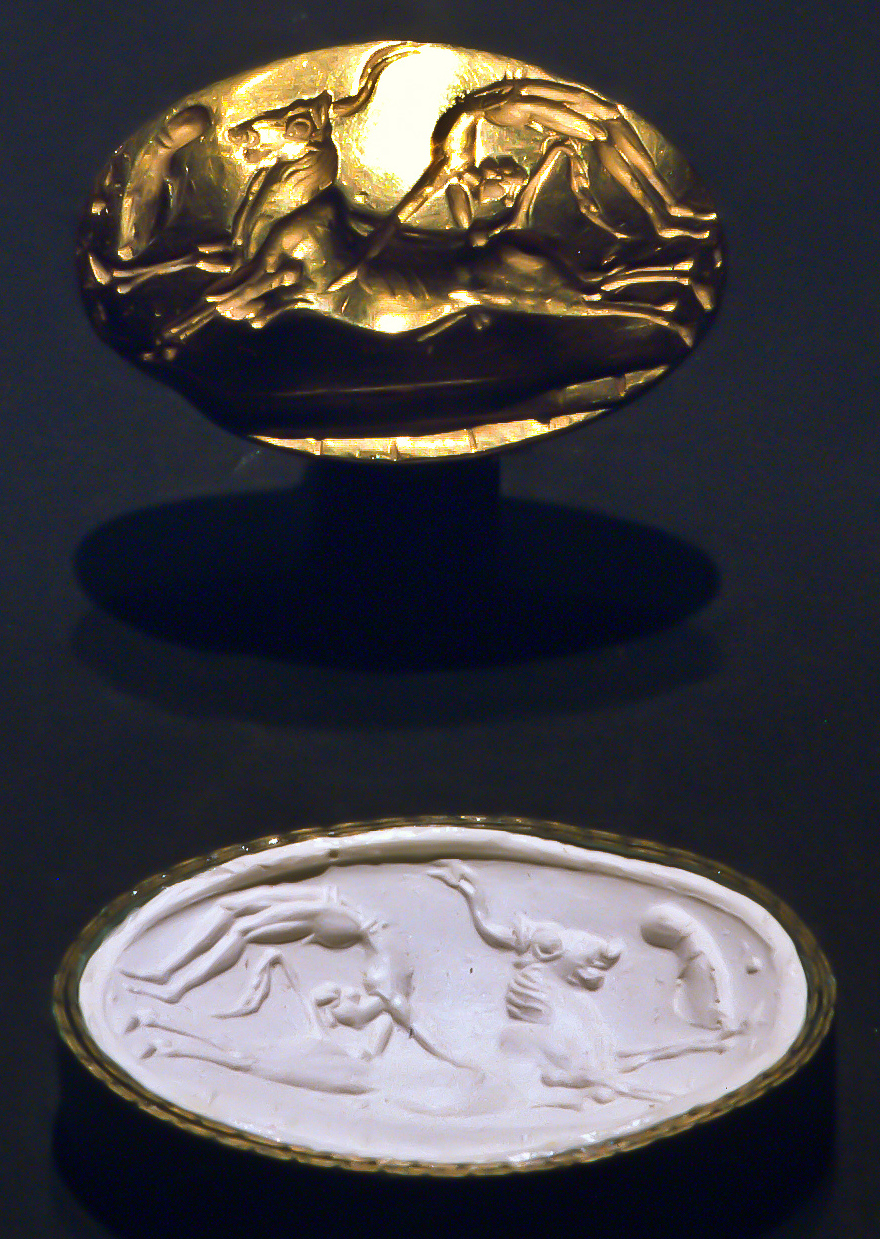
Minoan sealstones
Carved gemstones and amulets from Bronze Age Crete used for identification and ritual
Minoan sealstones are carved gems worn as personal amulets in the Minoan civilization of Bronze Age Crete. They served to identify documents and objects, while some were believed to hold magical power or serve as protective talismans.
- Found in quantity at Knossos, Malia, and Phaistos
- Talismanic seals were likely carried as protective amulets
- Griffin Warrior Tomb yielded over 50 Minoan-style seals
- Used rotary drills to carve harder stones in Middle Minoan period
- Many seals pierced for wearing on neck or wrist strings
What it is
Minoan sealstones are small, carved objects produced in the Bronze Age civilization of Crete. They functioned as impression seals for identifying documents and goods, but their pocket-sized design also allowed them to be worn as personal amulets. Many examples resemble Egyptian scarabs, though they often featured unique shapes like lentoid or prism forms with multiple faces. Beyond administrative use, these stones served as portable markers of status and identity within Minoan society.
Where it comes from
These artifacts originated in the Minoan civilization, emerging from Early Minoan II onwards. While early versions were likely made of perishable wood, surviving examples date to later periods using ivory and soft stone. The introduction of fast rotary drills during the Middle Minoan period allowed artisans to carve harder materials. The tradition spread across the Aegean, with many finds appearing in Mycenaean contexts, suggesting either export from Crete or work by Cretan-trained artists on the Greek mainland.
How it is done
Artisans carved intricate designs into gemstones, metal rings, or ivory using rotary drills and fine tools. Seals were often pierced to allow wearing on strings around the neck or wrist. Some featured bold, deeply cut motifs executed in a brisk technique, particularly those classified as talismanic. These specific stones were often too deeply engraved to function effectively as sealing devices, indicating their primary role was carried as protective charms rather than administrative tools.
Tools and materials
The primary materials included hard stones, gold, and ivory. Tools such as fast rotary drills enabled the carving of complex details into difficult materials. Designs ranged from geometric patterns and plant motifs to figurative scenes of animals, humans, and mythological creatures like griffins and sphinxes. Some seals incorporated Minoan hieroglyphs or abstract patterns, while others depicted dynamic scenes such as bull-leaping or divine figures.
Minoan sealstones, drawn and placed
- Living
- Revived
- Fading
- Historical
- Legendary
- Performed
What it is for
Sealstones served dual purposes: practical identification and spiritual protection. Administratively, they verified ownership and authenticity of goods. Spiritually, certain 'talismanic seals' were believed to possess magical import, acting as amulets for the wearer. Their presence in elite burials suggests they held significant value as markers of prestige and possibly guardianship in the afterlife, worn like charm bracelets by the deceased.
Who does it
The makers were skilled artisans and seal-carvers, often working in specialized workshops found at sites like Malia. Users included household members who wore them as jewelry and officials who used them for documentation. In Mycenaean contexts, women were notably buried with multi-figure seals, treating them as ornamental jewelry rather than functional tools. The craftsmanship varied widely, from crude engravings to exceptionally fine gems like the Pylos Combat Agate.
Peoples and places
The Minoan civilization of Crete created these objects, which subsequently influenced neighboring cultures. Finds in Mycenaean Greece, such as at Mycenae and Vaphio, show that mainland elites adopted Minoan styles. The Griffin Warrior Tomb at Pylos contained over fifty Minoan-style seals, highlighting the high regard for Cretan craftsmanship.
At a glance: who, where and when
Who does it
Peoples


What people believe
Some scholars interpret specific groups of seals, particularly those with deep cuts and fantastical imagery, as having magical functions. Designs featuring hybrid monsters, goddesses, and exotic creatures may have been intended to invoke spiritual protection or power. The whimsical fantasy elements, such as 'Eagle Ladies,' suggest a belief system where art served not just aesthetic or administrative roles but also acted as conduits for supernatural forces or talismanic energy.
How scholars and sceptics see it
Archaeologists study these seals to understand trade, artistic influence, and social hierarchy. Disputes exist regarding the origin of mainland finds, with experts debating whether pieces were made in Crete or locally imitated. Sinclair Hood noted distinctions between finer Cretan work and cruder mainland copies before the conquest of Crete. Modern discoveries, like the Griffin Warrior Tomb, continue to refine understanding of how Minoan art was perceived and utilized by non-Minoan elites.
Compare and confuse
Minoan seals share similarities with Egyptian scaraboids, particularly in size and portability, though Minoan forms often featured multiple faces. Unlike later signet rings focused solely on signatures, Minoan examples displayed a wide range of artistic subjects. They differ from simple amulets by combining utility with art, serving both as tools for sealing clay and as wearable jewelry reflecting personal or social identity.
Today
Today, Minoan sealstones are preserved in museums and archaeological collections as key artifacts of Bronze Age history. They provide insight into Minoan artistry, technology, and interactions with neighboring civilizations. The discovery of intact tombs containing these seals continues to offer new data on their production, distribution, and the cultural significance they held for ancient peoples.
Questions people ask about Minoan sealstones
What were Minoan sealstones used for?
They served as impression seals for identifying documents and goods, while also functioning as personal amulets worn around the neck or wrist for protection and status.
Where did Minoan sealstones originate?
They originated in the Minoan civilization of Bronze Age Crete, with major finds at sites like Knossos, Malia, and Phaistos, influencing neighboring Mycenaean cultures.
Were Minoan seals considered magical?
Some 'talismanic seals' with deep cuts and fantastical imagery are believed to have had magical functions, acting as protective charms rather than just administrative tools.
How were Minoan seals made?
Artisans carved gemstones, gold, and ivory using fast rotary drills, creating intricate designs ranging from geometric patterns to mythological scenes like bull-leaping.
Good reading and sources
- Minoan seals on WikipediaEncyclopedia
- More photos on Wikimedia CommonsPhotos and video
- Wikidata recordOpen data
The facts on this page come from the Wikipedia article "Minoan seals", written by its contributors and used under the CC BY-SA 4.0 licence, and from its Wikidata record (CC0). EveryJaadu rewrote the text in its own words, with AI assistance, and compares every page with the article to make sure no passage is copied. It may be reused under the same CC BY-SA 4.0 licence with a link back.
It may contain mistakes. Names and customs differ from one community to the next, and some knowledge is closed to outsiders and left out here. This page describes belief and practice. It does not say that any of it works, it is not a how-to, and it is not medical advice. If something is wrong, tell us. Last refreshed 2026-10-08.
More from Greece
All the entries from Greece 🇮🇹 Italy and 5 moreFig sign
A hand gesture used to ward off the evil eye or as an insult in many culturesBelief · Protection · Cursing and harm Living
🇮🇹 Italy and 5 moreFig sign
A hand gesture used to ward off the evil eye or as an insult in many culturesBelief · Protection · Cursing and harm Living
 🇮🇹 Italy and 1 morePietro d'Abano
A medieval physician and astrologer accused of heresy and magic.Text · Healing · Wonder and entertainment Historical
🇮🇹 Italy and 1 morePietro d'Abano
A medieval physician and astrologer accused of heresy and magic.Text · Healing · Wonder and entertainment Historical
 🇮🇹 Italy and 5 moreRelic
An object or body part kept to honor a holy person and mark their connection to the divineCharm · Protection · Healing Living
🇮🇹 Italy and 5 moreRelic
An object or body part kept to honor a holy person and mark their connection to the divineCharm · Protection · Healing Living
 🇬🇷 Greece and 2 moreCurse tabletκατάδεσμος
A lead sheet inscribed with a binding curse in the Greco-Roman worldCharm · Cursing and harm · Love and attraction Historical
🇬🇷 Greece and 2 moreCurse tabletκατάδεσμος
A lead sheet inscribed with a binding curse in the Greco-Roman worldCharm · Cursing and harm · Love and attraction Historical
Related elsewhere
All charm 🇨🇳 China and 3 moreChinese dragon龍
A legendary water deity and imperial symbol in East Asian cultureBeing · Protection · Luck and prosperity Historical
🇨🇳 China and 3 moreChinese dragon龍
A legendary water deity and imperial symbol in East Asian cultureBeing · Protection · Luck and prosperity Historical
 🇮🇳 India and 1 moreYoginiयोगिनी
A female master of yoga and tantra, or a fierce goddess aspect in Indian temples.Tradition · Power and authority · Protection Historical
🇮🇳 India and 1 moreYoginiयोगिनी
A female master of yoga and tantra, or a fierce goddess aspect in Indian temples.Tradition · Power and authority · Protection Historical
 🇮🇳 IndiaTaraतारा (Sanskrit), তারা (Bengali)
A fierce Hindu goddess of protection and wisdom, central to the Mahavidya tradition.Being · Protection · Power and authority Living
🇮🇳 IndiaTaraतारा (Sanskrit), তারা (Bengali)
A fierce Hindu goddess of protection and wisdom, central to the Mahavidya tradition.Being · Protection · Power and authority Living
 🇨🇳 China and 2 moreEight Immortals八仙
Eight legendary Taoist figures of China, each with a power and a vesselFigure · Protection · Healing Living
🇨🇳 China and 2 moreEight Immortals八仙
Eight legendary Taoist figures of China, each with a power and a vesselFigure · Protection · Healing Living