
Mandala
In its own language: मण्डल
from Sanskrit maṇḍala, meaning 'circle'
A sacred geometric design used in Indian religions for meditation and spiritual mapping.
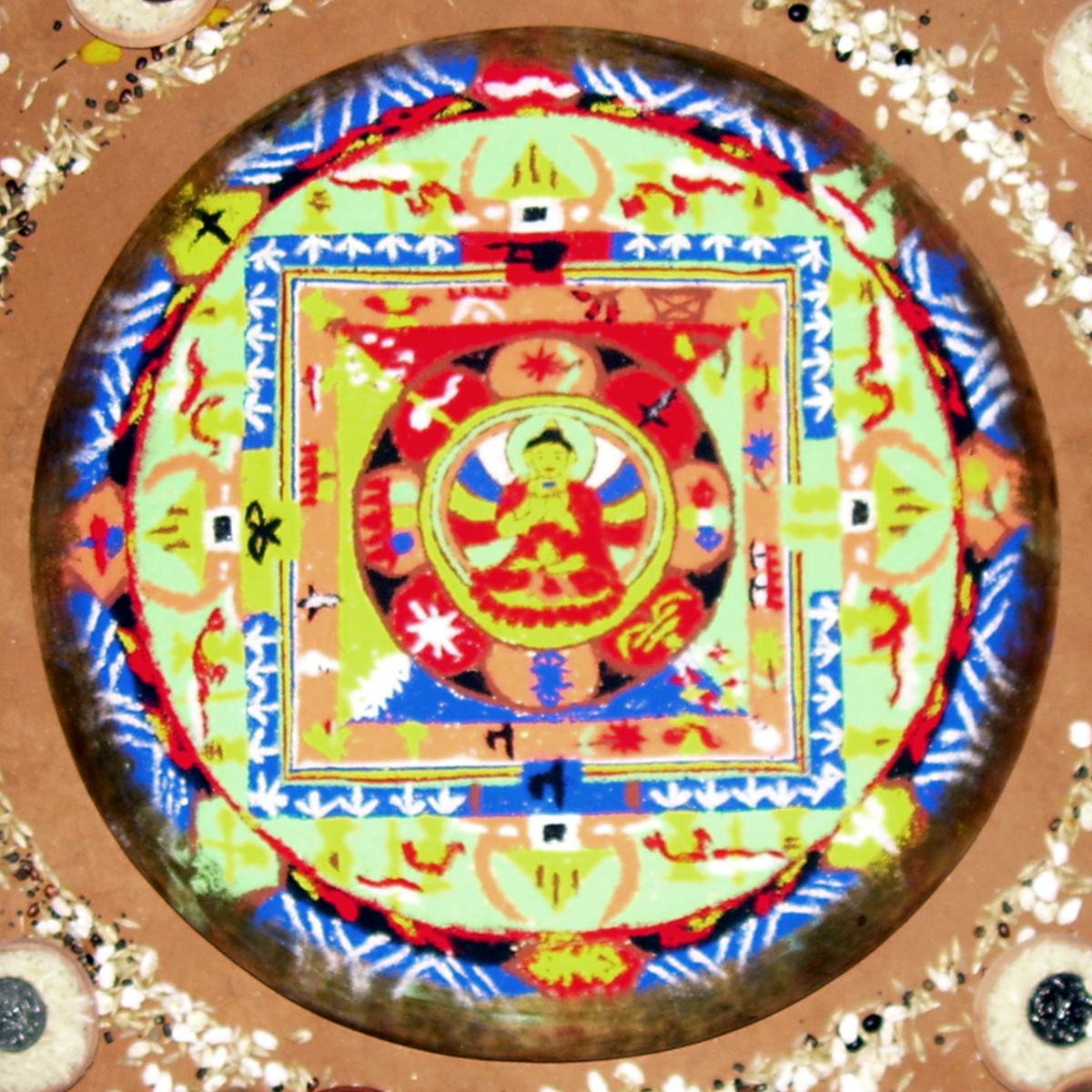
Originating in India, a mandala is a symbolic diagram of the universe or a deity's palace. Practitioners use it to focus attention, establish sacred space, and aid in trance induction across Hindu, Buddhist, and Jain traditions.
- Originates from Sanskrit for 'circle' and appears in the Rigveda.
- Sand mandalas are destroyed to symbolize impermanence.
- Yantras in Hinduism use squares and gates for deity invocation.
- Shingon Buddhism uses flower-throwing rituals for initiation.
- Mount Meru often sits at the center of cosmological maps.
What it is
A mandala serves as a visual map of spiritual realities. In Hinduism, it often appears as a yantra, a square with gates surrounding a central point. Buddhist traditions use complex diagrams to represent pure lands or the nature of an enlightened mind. These designs help practitioners navigate inner states and connect with divine forces through focused contemplation.
Where it comes from
The term appears in the Rigveda, referring to sections of the text. Vedic rituals have utilized mandalas like the Navagraha design continuously. The concept evolved within Indian religious thought, spreading to East Asia via trade and missionary routes. Tibetan and Japanese schools developed distinct variations, such as sand paintings and hanging scrolls, adapting the core geometry to local ritual needs.
How it is done
Practitioners visualize the mandala during meditation, internalizing its details until the image becomes vivid and accessible at will. In Vajrayana Buddhism, monks may construct intricate sand mandalas using colored grains poured from copper tools. Once completed, these temporary works are ritually swept away into flowing water to symbolize the transient nature of existence.
Tools and materials
Materials vary by tradition. Yantras use limited color palettes and geometric lines. Sand mandalas require powdered stones and gems. Shingon and Nichiren schools employ paper scrolls or wooden tablets inscribed with characters. Silk tapestries with gilded elements create three-dimensional effects in some Buddhist depictions.
Mandala, drawn and placed
- Living
- Revived
- Fading
- Historical
- Legendary
- Performed
- Lineage
- Indian religions
- Timing
- during meditation and initiation rituals
What it is for
Mandalas act as guides for spiritual development. They map the abode of deities or the structure of the cosmos, centering on Mount Meru. Practitioners seek protection from confusion and external chaos. The designs also serve as offerings, symbolically presenting the universe to Buddhas to accumulate merit and deepen understanding of purity.
Who does it
Hindu tantric adepts use yantras as central focal points for sadhana. Buddhist monks undergo years of training to create sand mandalas. Shingon initiates participate in rituals where flowers are thrown onto diagrams to determine their tutelary deity. Laypeople may use simple scrolls for home altars, reflecting the accessibility of certain forms.
Peoples and places
Hindus, Jains, and Buddhists across South and East Asia utilize these designs. Indian origins spread to Nepal, Tibet, China, and Japan. Shingon Buddhism in Japan emphasizes specific realm mandalas. Nichiren sects focus on calligraphic scrolls. Theravada texts describe various disciple and deity arrangements, showing regional diversity in application and symbolism.
At a glance: who, where and when


What people believe
The mandala represents the unity of outer cosmos and inner consciousness. Symbols resonate with subtle bodies and human experience. Deities in these maps embody mental states on the path to awakening. The destruction of sand mandalas reinforces beliefs in impermanence and non-attachment, teaching that essence returns to elemental forces rather than ending in death.
When it is done
Usage occurs during daily meditation and specific initiation ceremonies. The Kechien Kanjō ritual in Shingon Buddhism involves new students interacting with mandalas. Sand mandalas are created and destroyed over days or weeks, often tied to specific festival cycles or monastic schedules, though exact dates vary by lineage.
How scholars and sceptics see it
Researchers view mandalas as instructional charts of spiritual experience. Scholars note their function as revelatory symbols of cosmic truths. Psychological interpretations link the geometry to the synthesis of macrocosm and microcosm. Historical analysis traces the evolution from Vedic textual references to elaborate artistic and ritual objects across diverse Asian cultures.
Cautions and what is closed
Some traditions restrict access to advanced mandalas, requiring formal initiation. The creation of sand mandalas demands rigorous discipline and years of study. Misuse or disrespect of sacred diagrams is considered harmful in traditional contexts. Outsiders are generally not permitted to perform the most esoteric rituals associated with these powerful visual tools.
Compare and confuse
Mandalas differ from yantras in complexity and color usage, though both serve meditative purposes. The Gohonzon of Nichiren Buddhism replaces geometric patterns with calligraphy. Pure Land mandalas function as teaching aids rather than meditation objects. These variations highlight how different sects adapt the core concept of sacred geometry to their specific theological needs.
Questions people ask about Mandala
What is a mandala?
A mandala is a sacred geometric diagram originating in India. It maps spiritual realms, deities, or the cosmos. Practitioners use it for meditation, focusing attention, and establishing a connection with divine forces through visual contemplation.
Where did mandalas originate?
Mandalas originated in ancient India. The term appears in the Rigveda. The practice spread to Nepal, Tibet, China, and Japan, evolving into distinct forms like yantras in Hinduism and sand paintings in Vajrayana Buddhism.
Why are sand mandalas destroyed?
Sand mandalas are ritually destroyed to teach impermanence. Sweeping the sand into water symbolizes that all things return to elemental forces. This practice reinforces the Buddhist belief in non-attachment and the transient nature of life.
How do Hindus use mandalas?
Hindus often use yantras, a type of mandala. These geometric designs invoke deities and serve as focal points for tantric rituals. They represent the deity's abode and help practitioners achieve spiritual union through precise symbolic visualization.
Good reading and sources
- Mandala on WikipediaEncyclopedia
- More photos on Wikimedia CommonsPhotos and video
- Wikidata recordOpen data
The facts on this page come from the Wikipedia article "Mandala", written by its contributors and used under the CC BY-SA 4.0 licence, and from its Wikidata record (CC0). EveryJaadu rewrote the text in its own words, with AI assistance, and compares every page with the article to make sure no passage is copied. It may be reused under the same CC BY-SA 4.0 licence with a link back.
It may contain mistakes. Names and customs differ from one community to the next, and some knowledge is closed to outsiders and left out here. This page describes belief and practice. It does not say that any of it works, it is not a how-to, and it is not medical advice. If something is wrong, tell us. Last refreshed 2026-10-05.
More from India
All the entries from India 🇮🇳 IndiaChakraचक्र
Meditation points in the subtle body used in Hindu and Buddhist yogaTradition · Speaking with spirits and the dead · Change and initiation Living
🇮🇳 IndiaChakraचक्र
Meditation points in the subtle body used in Hindu and Buddhist yogaTradition · Speaking with spirits and the dead · Change and initiation Living
 🇮🇳 IndiaMahakaleshwar JyotirlingaMahākāleśvara
A sacred Shiva shrine in Ujjain, India, known for its south-facing idol and ancient origins.Tradition · Protection · Power and authority Living
🇮🇳 IndiaMahakaleshwar JyotirlingaMahākāleśvara
A sacred Shiva shrine in Ujjain, India, known for its south-facing idol and ancient origins.Tradition · Protection · Power and authority Living
 🇮🇳 India and 5 moreKolamகோலம்
A daily geometric floor drawing made with rice flour at the home entrance in South IndiaTradition · Protection · Luck and prosperity Living
🇮🇳 India and 5 moreKolamகோலம்
A daily geometric floor drawing made with rice flour at the home entrance in South IndiaTradition · Protection · Luck and prosperity Living
 🇮🇳 India and 5 moreHoliहोली
A Hindu spring festival marked by coloured powders and bonfires to celebrate love and virtue.Tradition · Love and attraction · Cursing and harm Living
🇮🇳 India and 5 moreHoliहोली
A Hindu spring festival marked by coloured powders and bonfires to celebrate love and virtue.Tradition · Love and attraction · Cursing and harm Living
Related elsewhere
All tradition 🇸🇩 Sudan and 5 moreIncense
Aromatic plant materials burned to release fragrant smoke for ritual, scent, or timekeeping.Substance · Protection · Speaking with spirits and the dead Living
🇸🇩 Sudan and 5 moreIncense
Aromatic plant materials burned to release fragrant smoke for ritual, scent, or timekeeping.Substance · Protection · Speaking with spirits and the dead Living
 🇪🇸 Spain and 5 moreSt John's Eve
A Christian vigil marked by bonfires and plant gathering on the summer solstice eveRite · Protection · Speaking with spirits and the dead Living
🇳🇴 NorwayEsbat
A monthly Wiccan ritual held at the full or new moon for worship and community.Rite · Speaking with spirits and the dead · Love and attraction Living
🇪🇸 Spain and 5 moreSt John's Eve
A Christian vigil marked by bonfires and plant gathering on the summer solstice eveRite · Protection · Speaking with spirits and the dead Living
🇳🇴 NorwayEsbat
A monthly Wiccan ritual held at the full or new moon for worship and community.Rite · Speaking with spirits and the dead · Love and attraction Living
 🇬🇷 GreeceKykeonκυκεών
An Ancient Greek ritual drink linked to the Eleusinian Mysteries and peasant lifeSubstance · Speaking with spirits and the dead · Wonder and entertainment Historical
🇬🇷 GreeceKykeonκυκεών
An Ancient Greek ritual drink linked to the Eleusinian Mysteries and peasant lifeSubstance · Speaking with spirits and the dead · Wonder and entertainment Historical