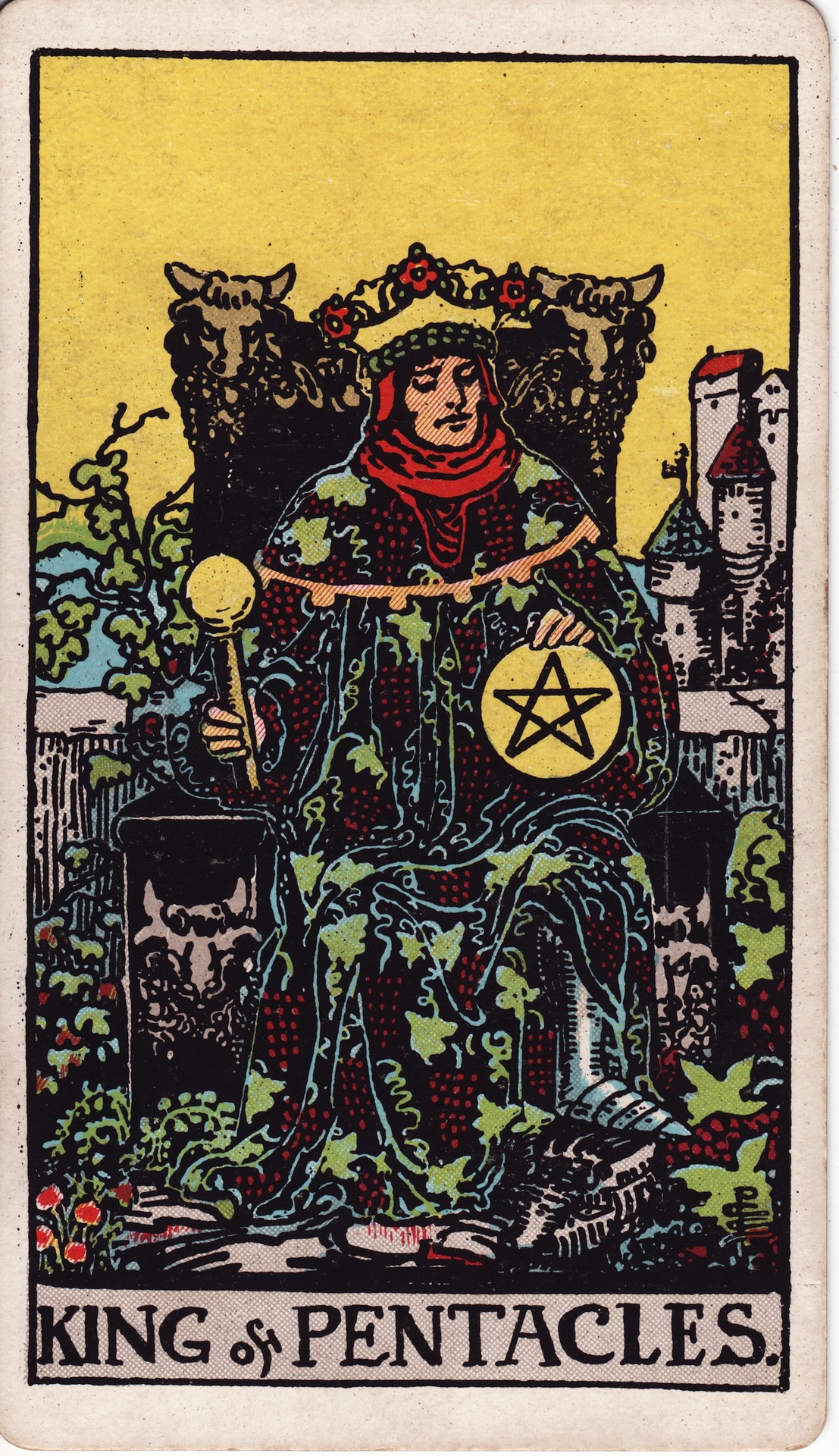
King of Coins
A tarot king of coins, read as a man of wealth, business sense and social standing
This king of the coin suit appears in Italian, Spanish and tarot decks, and readers count it among the Minor Arcana. Across much of Europe the deck serves for card games, while in English-speaking lands it is mainly a fortune-telling tool, this card standing for a man of means.
- Royal card of the coin suit in Italian, Spanish and tarot decks
- Tarot readers place it in the Minor Arcana
- A game card across much of Europe; a fortune-telling card in English-speaking lands
- Rider–Waite art: a black throne with a golden bull, grapes and a castle behind
- Read as a man of wealth and standing; riches only if other cards agree
What it is
The King of Coins is the king of the coin suit in Latin-suited decks, the card family that Italy, Spain and tarot share. Like the other court cards, the human figures of a pack, it is filed by tarot readers under the Minor Arcana, the lower part of their deck. Its working life splits in two. Across much of Europe the cards are dealt out for games; where English is spoken those games never took hold, so the deck serves mainly for fortune-telling. In a reading the king cuts a solid figure: a seasoned man with money, practical sense and social weight.
How it is done
In fortune-telling the card is read through the company it keeps. Drawn on its own, it is said to point to a person rather than a purse: someone of standing may be entering the querent's life, the person the reading is for, or may already be part of it. Only when the cards beside it echo the theme does a reader take it as a sign of money on the way. The king's own traits colour the message. He reads as a shrewd operator who knows how society works, and his presence is taken to hint that such know-how could help the querent toward wealth or respect.
Tools and materials
The picture many readers know comes from the Rider–Waite deck, an illustrated tarot pack. There the king sits on a throne painted black, with a golden bull set into it. Grapes decorate his clothing, and a castle stands behind him. The scene suits the character readers give the card: a seated ruler with property at his back and the good things of the table about him, an image of comfort and command. Each deck draws its own version, since every pack supplies fresh artwork for the coin-suit royalty.
King of Coins, drawn and placed
- Living
- Revived
- Fading
- Historical
- Legendary
- Performed
- Lineage
- Latin-suited playing cards; tarot's Minor Arcana
What it is for
In readings the card stands for a seasoned man of affairs: smooth in manner, sound on practical matters, fond of the pleasures money buys and careful to be seen doing well by his neighbours. It can shade darker, into stinginess with coins or an ego so large that the querent would rather stay on his good side. The card is read as a potential ally too, one who could pass on the practical and social savvy a querent needs on the way to wealth or respectability. Riches for the querent are not automatic, though: other cards must echo the theme before money is read into it.
Peoples and places
The coin-suit kings come from the card families of Italy and Spain, and tarot belongs to that same Latin line. In much of Europe these packs live as game cards, dealt out for play. English-speaking countries took the other path: with the games never catching on there, the tarot deck found its chief work in fortune-telling. That split decides who handles the card. In one country it passes between players over a game table; in another it lies before a reader and the querent who has come with a question.
At a glance: who, where and when
Who does it
Compare and confuse
Tarot readers also call this card the King of Pentacles, pentacles being the tarot name for the coin suit. It is one king among the court figures of its suit, and its message follows the rule readers apply to all of them: a court card can stand for an actual person of that rank and temper. Italian and Spanish packs carry the same king under their own customs, where his job is to help play a hand rather than answer a question.
Today
Both halves of the card's life carry on. Tarot packs are still dealt out in games across a wide sweep of Europe, which keeps the coin-suit king in circulation as a playing card. In English-speaking countries the same deck works mainly as a divination tool, and the king's portrait as a man of wealth and standing belongs to that side of the split. The Rider–Waite pack, with its black throne, golden bull and castle, gives the card one of its lasting images.
Questions people ask about King of Coins
What is the King of Coins?
It is the king of the coin suit in Latin-suited playing cards, a family that takes in the Italian, Spanish and tarot decks. Readers count it among the Minor Arcana, the lower part of the tarot pack, and read it as a figure of wealth, practical sense and social standing.
Where does the card come from?
It belongs to the Latin-suited families of Italy and Spain, and to tarot, which shares that coin-suit line. Its fortune-telling role grew up chiefly in English-speaking countries, where the European tarot games never became widely known.
What kind of man does the card show?
Readers see a settled man of affairs: diplomatic in business, full of practical sense, fond of pleasures and of being seen to do well, though at times stingy and puffed up about his own importance. He may also stand for someone like this in the querent's life.
Does the card always mean money is coming?
Readers say not on its own. The card points to a person of stature rather than a sum of money, and only when the cards drawn alongside support the theme do they read riches into it for the querent.
What is on the card's face?
In the Rider–Waite tarot pack the king sits on a black throne with a golden bull set into it. Grapes decorate his clothing and a castle stands behind him, a scene readers take to match the comfort and command they find in him.
Good reading and sources
- King of Coins on WikipediaEncyclopedia
- More photos on Wikimedia CommonsPhotos and video
- Wikidata recordOpen data
The facts on this page come from the Wikipedia article "King of Coins", written by its contributors and used under the CC BY-SA 4.0 licence, and from its Wikidata record (CC0). EveryJaadu rewrote the text in its own words, with AI assistance, and compares every page with the article to make sure no passage is copied. It may be reused under the same CC BY-SA 4.0 licence with a link back.
It may contain mistakes. Names and customs differ from one community to the next, and some knowledge is closed to outsiders and left out here. This page describes belief and practice. It does not say that any of it works, it is not a how-to, and it is not medical advice. If something is wrong, tell us. Last refreshed 2026-10-19.
More from Italy
All the entries from Italy 🇬🇷 Greece and 3 moreOracle
A person or site believed to channel divine insight and predict the future.Oracle · Seeing and foretelling · Power and authority Historical
 🇮🇹 ItalySanctuary of Fortuna Primigenia
A vast Roman sanctuary complex in Palestrina that housed an oracle and a temple to the goddess of fate.Tradition · Seeing and foretelling · Protection Historical
🇮🇹 ItalySmorfia
A Neapolitan dream book that turns visions into lottery numbersOracle · Luck and prosperity Living
 🇮🇹 ItalyKnight of Coins
A tarot court card read as a serious young man, drawn on questions of work and home.Oracle · Seeing and foretelling Living
Related elsewhere
All oracle 🇮🇶 Iraq and 4 moreAstrology
A system of divination that links human affairs to the positions of celestial bodiesTradition · Seeing and foretelling · Luck and prosperity Living
 🇺🇸 United States and 4 moreFortune-telling
A practice of predicting future events or personal details through various methods and tools.Rite · Seeing and foretelling · Power and authority Living
 🇮🇳 IndiaHindu astrologyज्योतिष (Jyotiṣa)
A traditional Hindu system of astrology and timekeeping rooted in the VedasTradition · Seeing and foretelling · Luck and prosperity Living
 🇮🇳 India and 5 moreCowrie
A sea snail shell used as currency, divination tool, and charm across many culturesSubstance · Seeing and foretelling · Luck and prosperity Living