
Bullet catch
A stage illusion where a magician appears to catch a fired bullet in their mouth or hand
The bullet catch is a dangerous stage magic illusion in which a performer appears to stop a live projectile. It originated in early modern Europe and became a staple of theatrical magic in the nineteenth century. The act relies on deception and specialized equipment rather than supernatural power.
- One of the earliest records appears in a 1586 French text
- John Henry Anderson popularized the trick in the 1840s
- Chung Ling Soo died performing the illusion in 1918
- Wax bullets and modified guns are common methods
- The act is considered highly dangerous by magicians
What it is
The bullet catch is a classic stage illusion where a magician appears to intercept a bullet fired directly at them. The projectile is typically caught in the mouth, though variations exist where it is held in the hand or balanced on an object like a plate. The effect creates a powerful sense of danger and impossibility for the audience. It is not a feat of physical strength or supernatural invulnerability, but a carefully constructed piece of theatrical entertainment that relies on misdirection and hidden mechanics.
Where it comes from
Early records of the trick appear in sixteenth-century texts, such as Jean Chassanion's work from 1586. These accounts often confused sleight of hand with black magic, suggesting the performer was protected by curses. By the eighteenth century, street performers developed various versions of the stunt. Philip Astley claimed to invent the trick in 1762, but earlier publications by Thomas Denton and Henri Decremps described similar methods. The illusion entered mainstream theatre through John Henry Anderson in the mid-nineteenth century, who popularized it across Britain and America.
Tools and materials
The illusion requires specific props to function. A firearm is used, often modified with magnets, tubes, or mechanisms to hold ammunition. Wax bullets serve as safe substitutes for live rounds. A pane of glass is placed between the shooter and the magician to demonstrate that a projectile has been fired. Performers may use metal cups or plates to display the caught bullet. Protective gear, such as dentures or glasses, is sometimes worn by daring practitioners to minimize injury risk during malfunctions.
Bullet catch, drawn and placed
- Living
- Revived
- Fading
- Historical
- Legendary
- Performed
- Lineage
- stage magic
What it is for
The primary purpose of the bullet catch is to entertain audiences through the presentation of extreme danger. Magicians use the act to build suspense and showcase their skill in handling risky situations. The illusion plays on the viewer's fear of death and their fascination with impossible feats. It is performed in theatres, television shows, and variety circuits as a highlight act. The danger is part of the spectacle, designed to impress viewers with the performer's apparent bravery and control over lethal forces.
Who does it
Stage magicians and variety entertainers perform this illusion. Practitioners must master complex mechanical devices and precise timing to avoid injury. Training involves learning how to rig firearms and handle prop ammunition safely. Many famous magicians, including John Henry Anderson and Dorothy Dietrich, have incorporated the trick into their repertoires. The role requires significant preparation and rehearsal to ensure the safety of both the performer and the crew. Few modern magicians attempt the act due to its high risk profile.
Peoples and places
The bullet catch has been performed globally, with notable history in Europe, North America, and Australia. John Henry Anderson toured extensively in Britain and the United States, bringing the trick to wide audiences. Indian jugglers advertised the stunt in London and Dublin in the early nineteenth century. American magicians like Theodore Annemann and Harry Houdini were associated with the act, though Houdini ultimately declined to perform it. The illusion remains a recognizable part of Western stage magic tradition.
At a glance: who, where and when
Who does it
What people believe
Historical accounts sometimes attributed the success of the bullet catch to supernatural protection or black magic. Sixteenth-century observers believed performers were invulnerable due to curses or divine intervention. Modern audiences understand the trick as a mechanical deception, yet the presentation maintains an aura of mystique. The legend of a curse surrounding the act persists among some performers, who claim that attempting the trick invites disaster. This narrative adds dramatic weight to the performance, even though the danger is purely physical.
When it is done
The bullet catch is not tied to specific religious festivals or seasonal events. It is performed as a standalone act within variety shows, theatre productions, and television specials. Magicians schedule the trick based on venue availability and audience demand. There are no traditional calendar dates associated with the illusion. It serves as a general entertainment feature rather than a ritual observance tied to time of year or life cycle events.
How scholars and sceptics see it
Scholars of magic and history view the bullet catch as a significant example of theatrical deception. Researchers analyze historical texts to trace the evolution of the trick from street performance to professional theatre. Anthropologists study how the illusion reflects cultural attitudes toward danger and technology. Historians note the transition from beliefs in magical protection to understanding of mechanical sleight of hand. The act provides insight into the development of stage magic as a respected art form.
Cautions and what is closed
The bullet catch is one of the most dangerous illusions in magic history. Several performers have suffered serious injuries or death due to equipment failure. Chung Ling Soo died in 1918 when a modified musket malfunctioned and fired a live round. Other magicians have reported being shot or sustaining permanent damage. The risk of accidental discharge makes the act extremely hazardous. Many professionals avoid performing it today due to these documented fatalities and the potential for fatal errors.
Compare and confuse
The bullet catch is often confused with feats of actual durability or supernatural immunity. Unlike simple card tricks, it involves real weapons and projectiles. It differs from other danger acts by focusing specifically on intercepting a flying object. Some compare it to sword swallowing, though the mechanics are entirely different. The trick shares lineage with other nineteenth-century gun illusions but stands out for its direct confrontation with lethal force. Variations include catching bullets in hands or on plates, expanding the visual impact beyond the mouth.
Questions people ask about Bullet catch
What is the bullet catch?
It is a stage magic illusion where a performer appears to catch a bullet fired at them. The act uses deception and special props to create the appearance of stopping a live projectile safely.
Where did the bullet catch originate?
The trick has roots in sixteenth-century Europe, with early mentions in French and English texts. It evolved through street performances before becoming a staple of professional theatre in the nineteenth century.
How do magicians perform the bullet catch safely?
Performers use wax bullets, modified firearms, or magnetic rams to hide the real projectile. Misdirection and careful rigging allow the magician to produce the bullet without being harmed by the firing weapon.
Has anyone been hurt doing the bullet catch?
Yes, the act has caused injuries and deaths. Chung Ling Soo died in 1918 from a malfunctioning gun. Other magicians have reported being shot or sustaining lasting damage from equipment failures.
Good reading and sources
The facts on this page come from the Wikipedia article "Bullet catch", written by its contributors and used under the CC BY-SA 4.0 licence, and from its Wikidata record (CC0). EveryJaadu rewrote the text in its own words, with AI assistance, and compares every page with the article to make sure no passage is copied. It may be reused under the same CC BY-SA 4.0 licence with a link back.
It may contain mistakes. Names and customs differ from one community to the next, and some knowledge is closed to outsiders and left out here. This page describes belief and practice. It does not say that any of it works, it is not a how-to, and it is not medical advice. If something is wrong, tell us. Last refreshed 2026-10-06.
More from the United States
All the entries from the United States 🇫🇷 France and 3 moreAlexander Herrmann
A 19th-century magician known for sleight of hand and card throwingIllusion · Wonder and entertainment Historical
🇫🇷 France and 3 moreAlexander Herrmann
A 19th-century magician known for sleight of hand and card throwingIllusion · Wonder and entertainment Historical
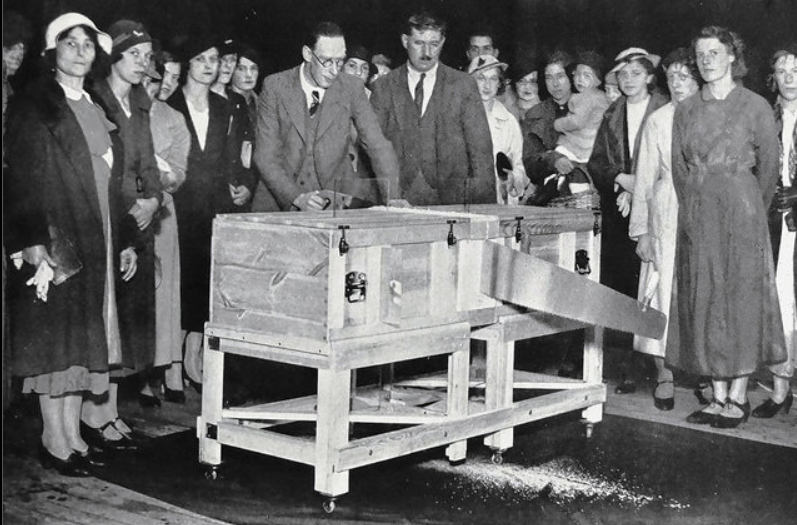 🇬🇧 United Kingdom and 1 moreSawing a woman in half
A stage illusion where an assistant appears to be cut into pieces inside a box or on a tableIllusion · Wonder and entertainment Living
🇬🇧 United Kingdom and 1 moreSawing a woman in half
A stage illusion where an assistant appears to be cut into pieces inside a box or on a tableIllusion · Wonder and entertainment Living
 🇬🇷 Greece and 1 moreShell game
A street swindle using covered containers to hide a marker while taking betsIllusion · Cursing and harm · Luck and prosperity Living
🇬🇷 Greece and 1 moreShell game
A street swindle using covered containers to hide a marker while taking betsIllusion · Cursing and harm · Luck and prosperity Living
Related elsewhere
All illusion 🇪🇬 Egypt and 1 moreSphinx
A mythical hybrid with a human head and lion body, serving as guardian or riddler in Egyptian and Greek traditions.Being · Protection · Wonder and entertainment Legendary
🇷🇺 Russia and 3 moreNart sagaНарты кадджытæ
A collection of epic tales from the North Caucasus about a legendary group of heroes.Text · Wonder and entertainment Historical
🇨🇱 ChileChilean mythology
The myths and legends of Chile, blending indigenous roots with colonial influences.Tradition · Wonder and entertainment Living
🇪🇬 EgyptDjedi
A fictional magician from the Westcar Papyrus who resurrects animals and foretells a king's lineage.Figure · Seeing and foretelling · Wonder and entertainment Legendary
🇪🇬 Egypt and 1 moreSphinx
A mythical hybrid with a human head and lion body, serving as guardian or riddler in Egyptian and Greek traditions.Being · Protection · Wonder and entertainment Legendary
🇷🇺 Russia and 3 moreNart sagaНарты кадджытæ
A collection of epic tales from the North Caucasus about a legendary group of heroes.Text · Wonder and entertainment Historical
🇨🇱 ChileChilean mythology
The myths and legends of Chile, blending indigenous roots with colonial influences.Tradition · Wonder and entertainment Living
🇪🇬 EgyptDjedi
A fictional magician from the Westcar Papyrus who resurrects animals and foretells a king's lineage.Figure · Seeing and foretelling · Wonder and entertainment Legendary