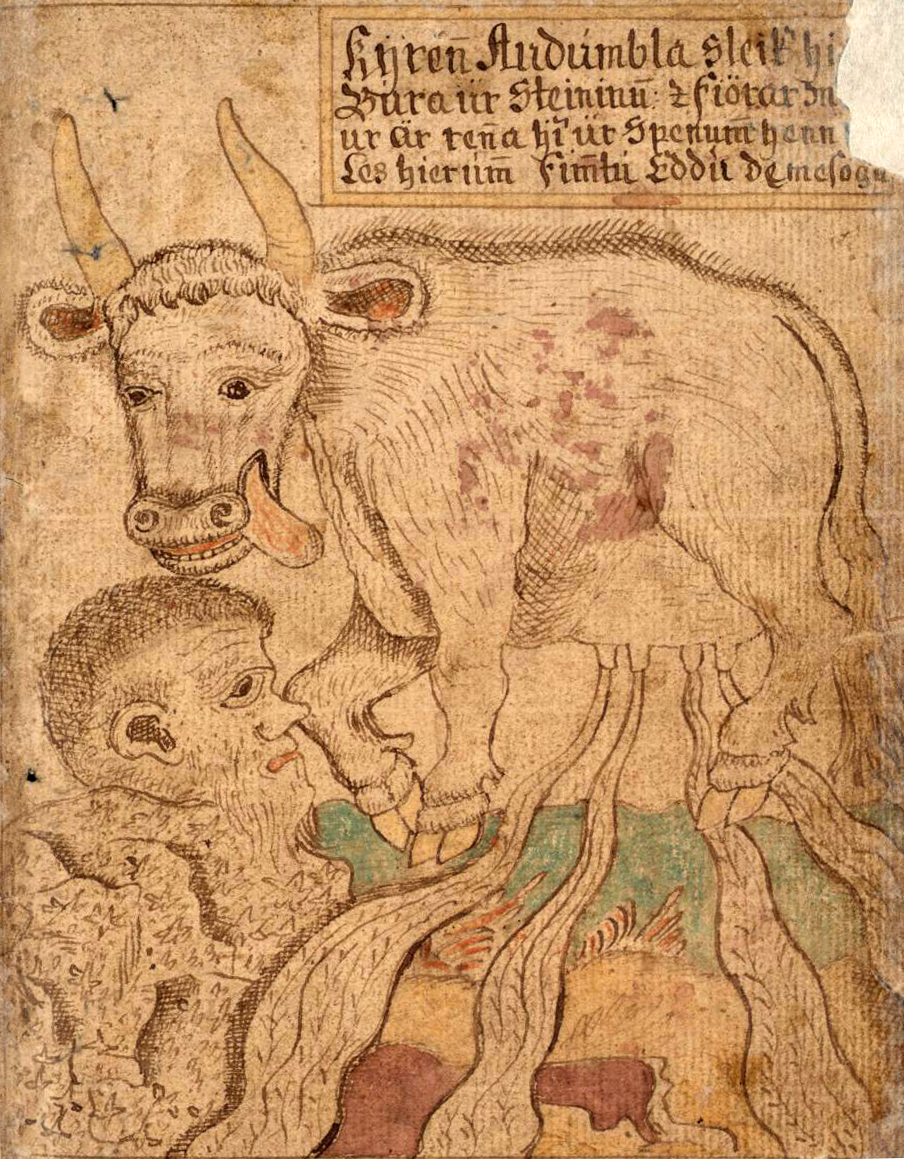
Auðumbla
from Old Norse auðr 'riches' and *humala 'hornless', meaning rich hornless cow
A primeval cow in Norse mythology that nourished the first giant and revealed the first god.
Auðumbla is a primordial cow from Norse mythology. She fed the frost giant Ymir with her milk while licking salt from ice rocks to free Búri, the ancestor of the gods. The story appears only in the 13th-century Prose Edda by Snorri Sturluson.
- Primeval cow in Norse mythology
- Fed the giant Ymir with her milk
- Licked salt ice to reveal god Búri
- Appears only in Snorri's Prose Edda
- Name means rich hornless cow
What it is
Auðumbla is a primeval cow in Norse mythology. She exists at the beginning of time alongside the frost giant Ymir. Her role is central to the creation narrative. She provides milk for Ymir to drink. In return, she sustains herself by licking salt from frozen rocks. This act reveals Búri, the grandfather of the gods. Scholars view her as part of an early Germanic mythological layer. She connects the giants and the gods through nourishment and birth.
Where it comes from
The creature appears solely in the Prose Edda. This text was written in the 13th century by Snorri Sturluson. He was an Icelandic scholar. The work preserves older oral traditions. Scholars believe Auðumbla stems from a very early stratum of Germanic mythology. She belongs to a broader complex of primordial bovine figures. These include cow-associated goddesses found in other cultures. The name suggests a hornless cow rich in milk. Some interpretations link it to fate or desolation.
Tools and materials
She uses her teats to produce four rivers of milk. Ymir feeds on this milk. She licks salty rime stones for her own sustenance. The salt acts as her food source. Over three days, her licking frees Búri from the ice. First his hair emerges, then his head, and finally his entire body. This process establishes the lineage of the Æsir gods.
Auðumbla, drawn and placed
- Living
- Revived
- Fading
- Historical
- Legendary
- Performed
- Lineage
- Norse mythology
What it is for
Her purpose is foundational to the cosmos. She nourishes Ymir, the ancestor of all giants. Simultaneously, she brings forth Búri, the progenitor of the Æsir. John Lindow notes she unites warring groups in the mythology. Rudolf Simek compares her to other cow deities. These include Egyptian Hathor and Greek Hera. Her actions bridge the gap between chaos and divine order.
Who does it
No living practitioners perform rites for Auðumbla. She is a figure of legend and ancient belief. Modern interest comes from scholars and historians. They study her role in creation myths. Researchers analyze her linguistic roots and cultural parallels. She is not worshipped but studied as a mythological entity.
Peoples and places
The Norse people are the primary culture associated with her. The Prose Edda records their beliefs. Snorri Sturluson compiled these stories in Iceland. Other cultures have similar bovine figures. Egyptian mythology features Hathor and Mehet-Weret. Zoroastrianism has Gavaevodata. Hindu tradition includes Kamadhenu. These parallels suggest shared Indo-European or global mythic themes.
At a glance: who, where and when
Peoples


What people believe
In Norse cosmology, Auðumbla represents primal fertility. She sustains life through milk. Her licking of ice symbolizes emergence from chaos. Búri’s birth initiates the divine lineage. The myth explains the origin of gods and giants. It reflects a worldview where nature and divinity are intertwined. Cows were valued in Germanic society. Tacitus noted hornless cattle among Germanic peoples. Nerthus was drawn by cattle wagons. These elements inform the myth’s imagery.
How scholars and sceptics see it
John Lindow highlights her unique role in uniting giants and gods. Rudolf Simek points to Roman ethnography by Tacitus. Germania mentions hornless cattle and cow-associated deities. Simek compares Auðumbla to Hathor, Isis, and Hera. These comparisons show a widespread motif of sacred cows. Scholars see her as part of a larger Indo-European pattern. The semantic ambiguity of her name may be intentional. It could mean both riches and desolation.
Compare and confuse
She is compared to Amalthea, the goat that raised Zeus. The Bull of Heaven appears in Sumerian myth. El is a creator bull in Canaanite religion. Gavaevodata is a primordial cow in Zoroastrianism. Heiðrún is a Norse goat producing mead. Kamadhenu is a Hindu wish-fulfilling cow. Hathor and Mehet-Weret are Egyptian cow goddesses. Mithras kills a bull in Roman mystery cults. These figures share traits of nourishment and creation.
Today
Auðumbla lives in academic study and popular culture. Illustrations appear in digital repositories like MyNDIR. Scholars continue to analyze her symbolic meaning. She remains a key figure in Norse cosmogony. No religious communities worship her today. Her story is retold in books and media about mythology. She serves as a reference point for comparative myth studies.
Questions people ask about Auðumbla
What is Auðumbla?
Auðumbla is a primeval cow in Norse mythology. She nourished the giant Ymir and licked salt from ice to free Búri, the first god. Her story is found in the Prose Edda.
Where does the name come from?
The name likely means rich hornless cow. It combines Old Norse words for riches and hornless. Some scholars suggest it could also mean destroyer of the desert.
Is she worshipped today?
No. Auðumbla is a legendary figure from ancient Norse belief. She is studied by scholars and appears in modern retellings of mythology, but not worshipped.
Who wrote about her?
Snorri Sturluson included her in the Prose Edda in the 13th century. He was an Icelandic scholar who recorded older Norse myths.
Good reading and sources
- Auðumbla on WikipediaEncyclopedia
- More photos on Wikimedia CommonsPhotos and video
- Wikidata recordOpen data
The facts on this page come from the Wikipedia article "Auðumbla", written by its contributors and used under the CC BY-SA 4.0 licence, and from its Wikidata record (CC0). EveryJaadu rewrote the text in its own words, with AI assistance, and compares every page with the article to make sure no passage is copied. It may be reused under the same CC BY-SA 4.0 licence with a link back.
It may contain mistakes. Names and customs differ from one community to the next, and some knowledge is closed to outsiders and left out here. This page describes belief and practice. It does not say that any of it works, it is not a how-to, and it is not medical advice. If something is wrong, tell us. Last refreshed 2026-10-11.
More from Egypt
All the entries from Egypt 🇪🇬 Egypt and 1 moreLilithלִילִית
A feminine figure from Mesopotamian and Jewish mythology, often depicted as a night demon or spirit.Being · Cursing and harm Legendary
🇪🇬 Egypt and 1 moreLilithלִילִית
A feminine figure from Mesopotamian and Jewish mythology, often depicted as a night demon or spirit.Being · Cursing and harm Legendary
 🇪🇬 EgyptImhotepỉỉ-m-ḥtp
An ancient Egyptian architect deified as a god of healing and wisdomBeing · Healing · Power and authority Historical
🇪🇬 EgyptImhotepỉỉ-m-ḥtp
An ancient Egyptian architect deified as a god of healing and wisdomBeing · Healing · Power and authority Historical
 🇪🇬 EgyptAnubis𓇋𓈖𓊪𓃣
The jackal-headed god who guides souls and oversees mummification in ancient Egypt.Being · Protection · Speaking with spirits and the dead Historical
🇪🇬 EgyptAnubis𓇋𓈖𓊪𓃣
The jackal-headed god who guides souls and oversees mummification in ancient Egypt.Being · Protection · Speaking with spirits and the dead Historical
 🇪🇬 Egypt and 2 moreIsisꜣst (Egyptian)
Egyptian goddess of magic, mourning and kingship, mother of HorusBeing · Protection · Healing Historical
🇪🇬 Egypt and 2 moreIsisꜣst (Egyptian)
Egyptian goddess of magic, mourning and kingship, mother of HorusBeing · Protection · Healing Historical
Related elsewhere
All being 🇷🇸 Serbia and 5 moreVampire
An undead being from European folklore that feeds on the life force of the living.Being · Cursing and harm Legendary
🇷🇸 Serbia and 5 moreVampire
An undead being from European folklore that feeds on the life force of the living.Being · Cursing and harm Legendary
 🇪🇬 Egypt and 1 moreSphinx
A composite creature of human head and lion body found in Egyptian and Greek mythBeing · Protection Legendary
🇪🇬 Egypt and 1 moreSphinx
A composite creature of human head and lion body found in Egyptian and Greek mythBeing · Protection Legendary
 🇨🇳 China and 3 moreChinese dragon龍
A legendary water deity and imperial symbol in East Asian cultureBeing · Protection · Luck and prosperity Historical
🇬🇧 United KingdomBarghest
A mythical black dog from Northern England that foretells death and haunts the countryside.Being · Seeing and foretelling · Cursing and harm Legendary
🇨🇳 China and 3 moreChinese dragon龍
A legendary water deity and imperial symbol in East Asian cultureBeing · Protection · Luck and prosperity Historical
🇬🇧 United KingdomBarghest
A mythical black dog from Northern England that foretells death and haunts the countryside.Being · Seeing and foretelling · Cursing and harm Legendary