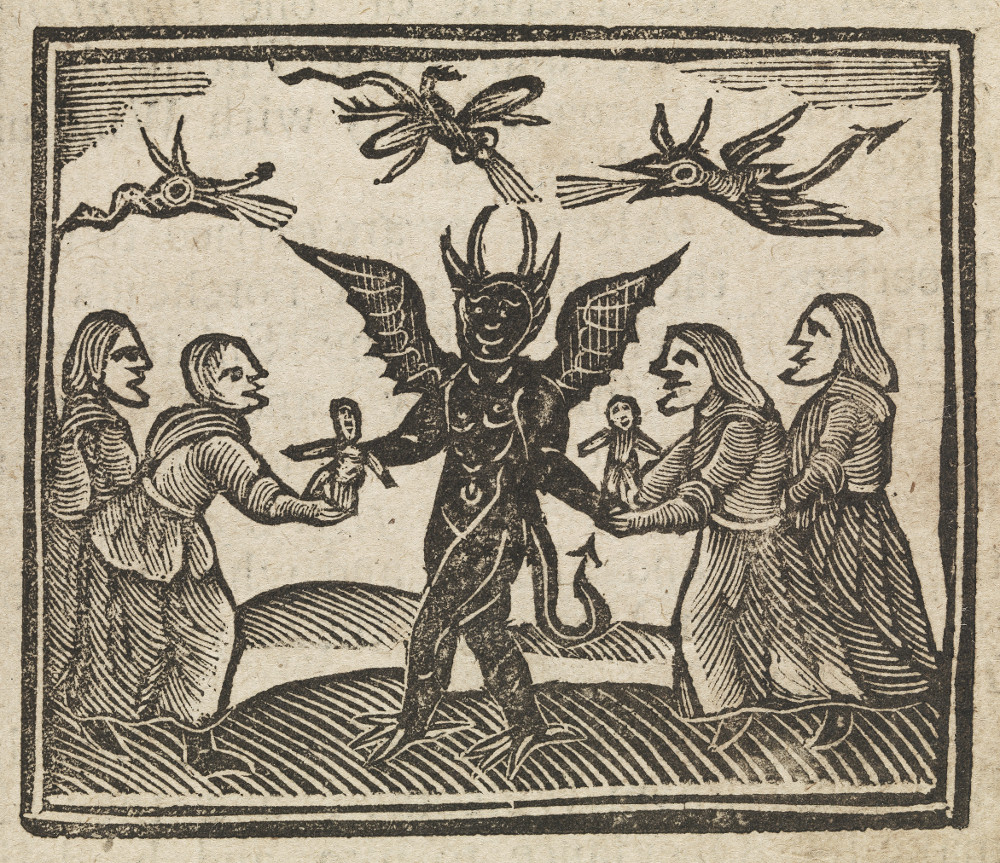
Agnes Sampson was a midwife and folk healer from East Lothian who became the central figure in Scotland's North Berwick witch trials. She was tortured into confessing to raising storms against King James VI and was executed by hanging and burning in January 1591.
- She was known as the Wise Wife of Keith.
- Tortured to reveal a supposed witch's mark.
- Confessed to raising storms against King James VI.
- Executed by hanging and burning in 1591.
- Featured in Judy Chicago's The Dinner Party.
What it is
Agnes Sampson was a Scottish woman known as the Wise Wife of Keith, living in Nether Keith in East Lothian. She worked as a midwife and was respected for her healing abilities. In the early 1590s, she became the primary target of the North Berwick witch trials. These were state-sponsored investigations into alleged sorcery that threatened the monarchy. Sampson is remembered not for her magic, but for her dramatic interrogation and execution under King James VI.
Where it comes from
The trials began after King James VI returned from Denmark in 1590. His voyage had been plagued by severe storms, which Danish officials blamed on witches. James brought this fear back to Scotland and ordered local tribunals to investigate. Sampson was arrested in late 1590. The accusations stemmed from a mix of political anxiety, religious superstition, and personal grudges within the community. Her status as an independent female healer made her vulnerable to these new legal standards.
How it is done
Sampson was imprisoned at Holyrood Palace and subjected to rigorous questioning. When she denied the charges, she was tortured. Her body was shaved, and she was strangled with a rope until a 'witch's mark' was found on her genitals. Once the mark was located, she confessed to various acts of sorcery. These confessions included attending meetings at North Berwick and using animal parts in charms. The details were recorded in contemporary pamphlets and trial records.
Tools and materials
The accusations involved specific ritual objects. Sampson claimed to have sunk a dead cat and human remains into the sea near Leith to create storms. She also mentioned collecting bones and grinding them into powder to ease childbirth pain. Other items included wax images used to curse relatives and a toad offered to the Devil to harm the king. These materials were said to channel supernatural forces.
Agnes Sampson, drawn and placed
- Living
- Revived
- Fading
- Historical
- Legendary
- Performed
What it is for
The confessions described attempts to harm the king and his fleet. Sampson admitted to raising storms to capsize ships and causing infertility. She also claimed to have cursed her father-in-law. These acts were believed to be driven by the Devil, who appeared to her as a black man or a dog. The purpose of these rituals was to exert control over nature and the monarch, reflecting deep fears of political instability.
Who does it
Sampson was a widow with children who lived in poverty. She was chosen as a suspect because of her reputation for healing and her independence. Her interrogations were led by the King himself, who sought direct proof of witchcraft. The process relied on extracting confessions through physical coercion. Her role shifted from a community healer to a condemned criminal in the eyes of the state.
Peoples and places
The trials were primarily a Scottish phenomenon, though they were influenced by Danish events. Sampson's story spread through London pamphlets, reaching English audiences. The English ambassador Robert Bowes reported on her case, noting the inaccuracies in her descriptions of foreign figures. The narrative highlights the cross-border nature of witch-hunting anxieties in Northern Europe during this period.
At a glance: who, where and when


What people believe
The underlying belief system held that the Devil marked his servants with a secret spot on their bodies. This mark could only be revealed through extreme torture. It was thought that witches could conspire with demons to manipulate weather and health. The confession about revealing the King's private wedding night words was seen as proof of demonic knowledge, reinforcing the belief that her power came from hell.
When it is done
Sampson was arrested in the autumn of 1590. Her trial and torture occurred in early January 1591. She was executed on 28 January 1591. The timing coincided with the King's return from Denmark and the subsequent political need to address the perceived threat of storm-witchcraft. The dates are fixed in historical records of the North Berwick proceedings.
How scholars and sceptics see it
Historians note that Sampson's confessions were likely coerced. The timeline of some accusations, such as receiving an image from the Devil, does not align with known events. Scholars point out that her detailed knowledge of the King's private life may have come from eavesdropping rather than magic. The trial is viewed as a key example of how early modern states used witchcraft charges to consolidate royal authority.
Cautions and what is closed
Sampson suffered severe physical abuse during her detention. She was strangled and searched invasively to find the supposed witch's mark. The legal process offered no protection against forced confessions. Her execution involved hanging and burning, a standard penalty for witchcraft in Scotland at the time. The trauma inflicted on her reflects the brutal nature of these judicial inquiries.
Compare and confuse
Sampson is often compared to other victims of the North Berwick trials, such as Barbara Napier. Both women were accused of similar rituals and met similar fates. Her story differs from later witch-hunts in its direct involvement of the monarch. The emphasis on storm-raising was specific to this period, linking domestic sorcery to international politics.
Law and persecution
Witchcraft was illegal in Scotland, punishable by death. The 1563 Act made it a capital offense to practice sorcery. Sampson's trial followed these laws strictly. The King's personal involvement elevated the case above standard local justice. Her execution was funded by the Edinburgh Burgh treasurer, indicating official sanction. The legal framework allowed for torture to extract evidence, which was standard procedure.
Questions people ask about Agnes Sampson
Who was Agnes Sampson?
She was a Scottish midwife and healer from East Lothian, known as the Wise Wife of Keith. She became the central figure in the North Berwick witch trials of the early 1590s.
Why was she accused of witchcraft?
She was accused of raising storms to harm King James VI's ship. The King blamed these storms on witches after his voyage from Denmark, leading to a widespread hunt in Scotland.
How did she die?
Agnes Sampson was executed on 28 January 1591. She was taken to Castlehill in Edinburgh, where she was garroted and then burnt at the stake.
What happened during her interrogation?
She was tortured at Holyrood Palace. Her body was shaved and she was strung up until a 'witch's mark' was found on her genitals, after which she confessed to the charges.
Good reading and sources
- Agnes Sampson on WikipediaEncyclopedia
- More photos on Wikimedia CommonsPhotos and video
- Wikidata recordOpen data
The facts on this page come from the Wikipedia article "Agnes Sampson", written by its contributors and used under the CC BY-SA 4.0 licence, and from its Wikidata record (CC0). EveryJaadu rewrote the text in its own words, with AI assistance, and compares every page with the article to make sure no passage is copied. It may be reused under the same CC BY-SA 4.0 licence with a link back.
It may contain mistakes. Names and customs differ from one community to the next, and some knowledge is closed to outsiders and left out here. This page describes belief and practice. It does not say that any of it works, it is not a how-to, and it is not medical advice. If something is wrong, tell us. Last refreshed 2026-10-06.
More from the United Kingdom
All the entries from the United Kingdom 🇬🇧 United Kingdom and 2 moreKing ArthurBrenin Arthur
A legendary British king and folk hero of medieval literature and Welsh mythologyFigure · Power and authority · Wonder and entertainment Legendary
🇬🇧 United Kingdom and 1 moreBugbear
A medieval English creature used to frighten children into obedienceFigure · Cursing and harm Legendary
🇬🇧 United KingdomGreen Children of Woolpit
A medieval English legend about two green-skinned siblings who appeared in a Suffolk village.Figure · Wonder and entertainment Legendary
🇬🇧 United Kingdom and 2 moreKing ArthurBrenin Arthur
A legendary British king and folk hero of medieval literature and Welsh mythologyFigure · Power and authority · Wonder and entertainment Legendary
🇬🇧 United Kingdom and 1 moreBugbear
A medieval English creature used to frighten children into obedienceFigure · Cursing and harm Legendary
🇬🇧 United KingdomGreen Children of Woolpit
A medieval English legend about two green-skinned siblings who appeared in a Suffolk village.Figure · Wonder and entertainment Legendary
 🇬🇧 United KingdomMatthew Hopkins
The English witch-hunter who led the deadliest wave of executions in Britain.Figure · Cursing and harm Historical
🇬🇧 United KingdomMatthew Hopkins
The English witch-hunter who led the deadliest wave of executions in Britain.Figure · Cursing and harm Historical
Related elsewhere
All figure 🇪🇬 Egypt and 1 moreLilithלִילִית
A feminine figure from Mesopotamian and Jewish mythology, often depicted as a night demon or spirit.Being · Cursing and harm Legendary
🇪🇬 Egypt and 1 moreLilithלִילִית
A feminine figure from Mesopotamian and Jewish mythology, often depicted as a night demon or spirit.Being · Cursing and harm Legendary
 🇨🇳 China and 2 moreEight Immortals八仙
Eight legendary Taoist figures of China, each with a power and a vesselFigure · Protection · Healing Living
🇪🇬 EgyptDjedi
A fictional magician from the Westcar Papyrus who resurrects animals and foretells a king's lineage.Figure · Seeing and foretelling · Wonder and entertainment Legendary
🇬🇧 United KingdomGiles Corey
An English-born farmer pressed to death for refusing to plead during the Salem witch trialsFigure Historical
🇨🇳 China and 2 moreEight Immortals八仙
Eight legendary Taoist figures of China, each with a power and a vesselFigure · Protection · Healing Living
🇪🇬 EgyptDjedi
A fictional magician from the Westcar Papyrus who resurrects animals and foretells a king's lineage.Figure · Seeing and foretelling · Wonder and entertainment Legendary
🇬🇧 United KingdomGiles Corey
An English-born farmer pressed to death for refusing to plead during the Salem witch trialsFigure Historical