Upanayana
In its own language: उपनयन
Sanskrit for 'leading near' or 'bringing close'
A Hindu rite of passage marking a student's initiation into formal education and spiritual discipline.
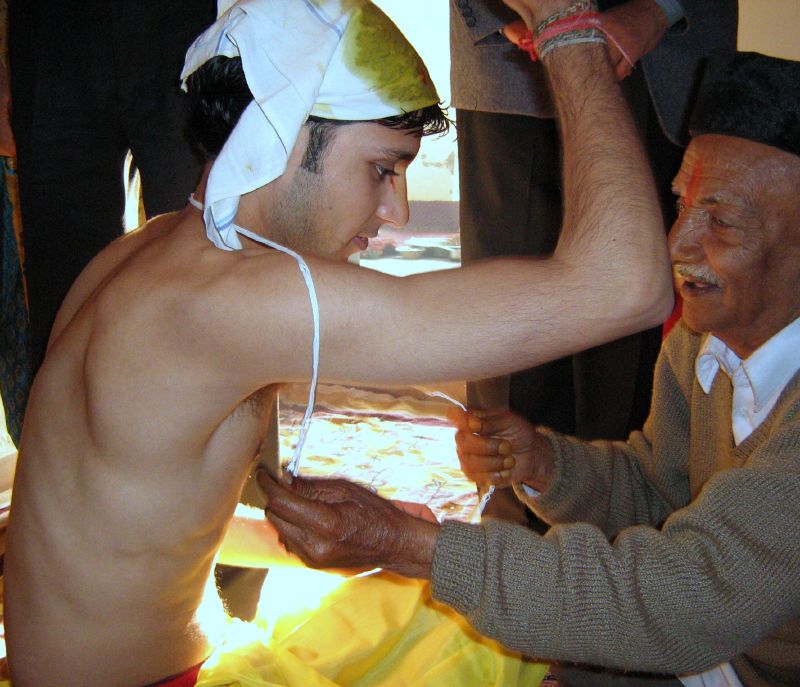
Upanayana is a traditional Hindu sacrament that welcomes a child into the role of a student under a teacher. It marks a second birth, shifting the individual toward a disciplined life focused on learning sacred texts and arts.
- Means 'leading near' a teacher for education
- Marks a spiritual second birth for the student
- Involves wearing a sacred cotton thread
- Traditionally for boys of upper castes
- Now open to all ages and backgrounds
What it is
Upanayana stands as a key ceremony within Hinduism, serving as a formal entry into student life. The term translates to 'leading near,' describing the act of bringing a child close to a teacher for instruction. This event marks a shift from ordinary existence to a structured path of learning. Participants are often called dvija, meaning twice-born, because they undergo a spiritual rebirth alongside their physical one. The rite initiates the brahmacharya stage, a period dedicated to discipline and study. While historically linked to specific social classes, it now represents a broader commitment to knowledge and ethical living.
Where it comes from
The practice appears in ancient Sanskrit texts like the Gṛhyasūtras and Dharmasūtras. Originally, it may have simply marked acceptance into a community. Over time, it evolved into a complex educational ritual. Early Vedic literature viewed it as the start of studentship and the acceptance of a pupil by a preceptor. Later layers added connections to goddesses like Sarasvatī. The ceremony became a permanent fixture during the Upaniṣad period, solidifying its role in Hindu social and religious life.
How it is done
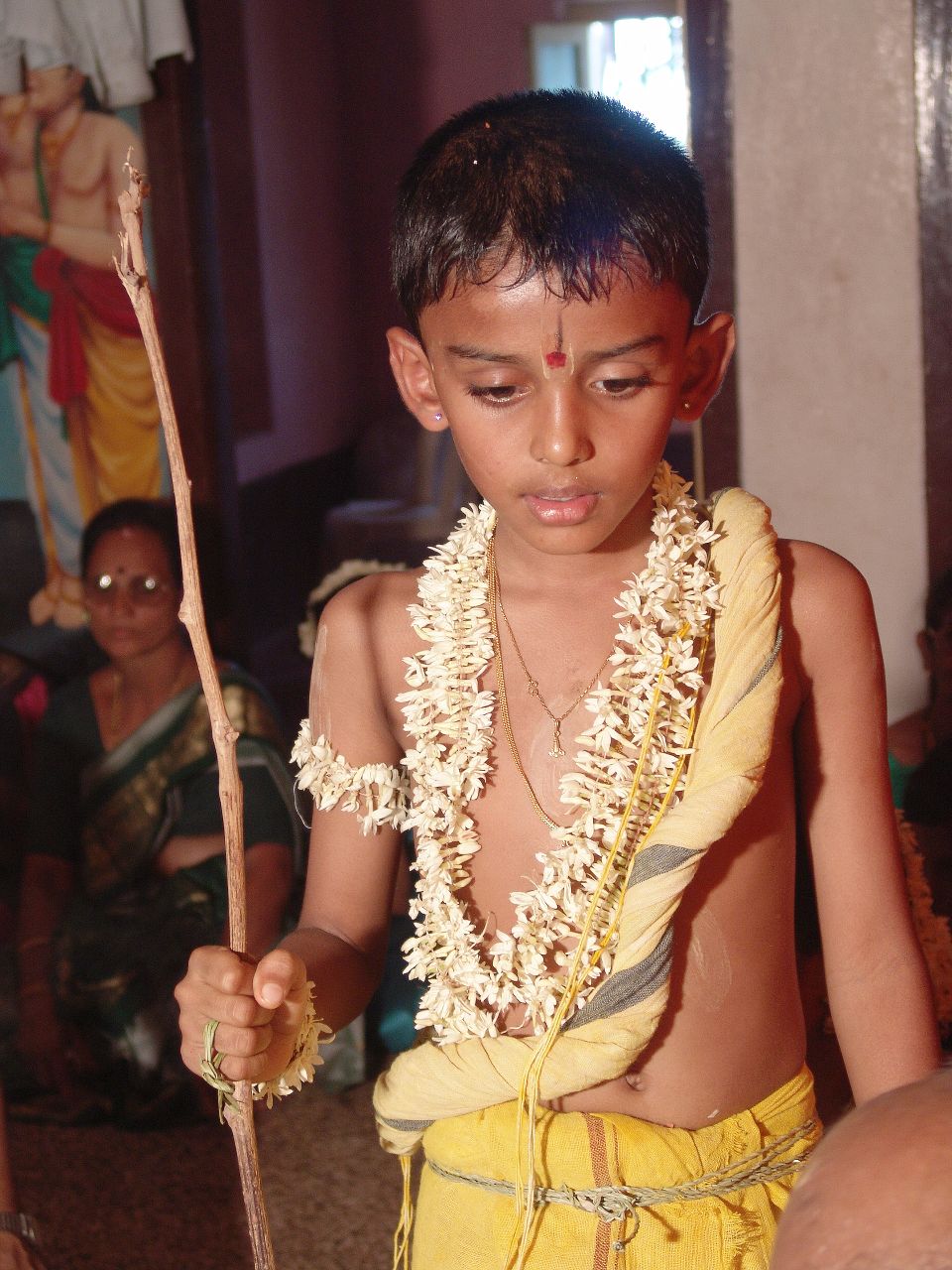
The ceremony involves the family, the child, and the teacher gathering together. A central moment is the recitation of the Gāyatrī Mantra, which signifies the actual spiritual initiation. The teacher accepts the student and provides a sacred thread. The child may also receive a staff and a girdle. These items symbolize the tools of learning and discipline. The ritual often takes place at home or in a gurukula, the traditional school setting. It follows an earlier literacy rite called Vidyārambhaṃ.
Tools and materials
The most visible tool is the yajñopavīta, a sacred thread worn across the body. Traditionally made of three cotton strands, each with nine threads, it replaces older upper garments. Some traditions tie munja grass around the waist, a variation known as Mauñjibandhana. A wooden staff (daṇḍa) and a girdle (mekhala) accompany the thread. These items represent the student's readiness to bear the weight of knowledge and duty.
Upanayana, drawn and placed
- Living
- Revived
- Fading
- Historical
- Legendary
- Performed
- Lineage
- Hindu saṃskāras
- Timing
- before adulthood
What it is for
The rite aims to prepare the individual for a life of study and moral responsibility. It signals the beginning of formal education in Vedas, arts, and crafts. For many, it marks the transition to adulthood and social maturity. The ceremony grants the right to pursue spiritual knowledge. It also establishes a bond between the student and the teacher, ensuring the transmission of wisdom. Families seek it to secure their child's future within the cultural and religious framework.
Who does it
Priests or teachers, known as gurus or acharyas, conduct the ceremony. They guide the student through the rituals and accept them into the lineage of learners. Historically, this was common for males from the Brāhmaṇa, Kṣatriya, and Vaiśya groups. Women from these groups could also undergo the rite if they chose to study. The teacher plays a crucial role as a mentor and spiritual guide throughout the student's journey.
Peoples and places
The tradition is widespread across India and Nepal. Different regions use local names like Janeu in Punjabi or Pūṇūl in Tamil. Age requirements varied by social class in ancient times, typically occurring between ages eight and twelve. Modern practice is more flexible, open to anyone regardless of age or background. The diversity of regional customs reflects the adaptability of the rite across different Hindu communities.
At a glance: who, where and when
Peoples
Belief worlds
Occasions


What people believe
Hindus view Upanayana as a spiritual rebirth. The sacred thread symbolizes a connection to the divine and the duties of the student. It serves as a constant reminder of the pursuit of truth. The concept of dvija highlights the importance of intellectual growth over mere biological birth. The ritual reinforces the belief that education is a sacred duty essential for personal and societal harmony.
When it is done
The ceremony is performed before adulthood reaches. Ancient texts suggested specific ages based on social class, but modern practice allows flexibility. It can occur at any age when formal studies begin. The timing is often chosen to align with auspicious periods, though no single festival dictates it universally. It marks a personal milestone rather than a communal holiday.
How scholars and sceptics see it
Anthropologists see Upanayana as a mechanism for socialization and identity formation. Historians trace its evolution from simple community acceptance to complex educational rites. Scholars note that the strict association with caste has relaxed significantly. The ritual is studied as a key example of how Hinduism structures life stages. Researchers highlight its role in preserving cultural knowledge and ethical values.
Cautions and what is closed
Historically, access to the rite was restricted by social class and gender. Śūdras were traditionally excluded from Vedic studies. Women faced varying degrees of restriction depending on the era and text. Modern interpretations emphasize inclusivity, allowing all individuals to participate. There are no significant health or legal risks associated with the ceremony itself.
Compare and confuse
Upanayana is distinct from Vidyārambhaṃ, which marks early literacy. It is similar to other initiation rites in various traditions but unique in its focus on the guru-student relationship. In some contexts, it is confused with wedding rituals where women may wear the thread. The sacred thread shares symbolic ground with other religious cords but holds specific significance in Hindu student life.
Questions people ask about Upanayana
What does Upanayana mean?
It means 'leading near' in Sanskrit. It describes bringing a student close to a teacher for education and spiritual guidance.
Who performs Upanayana?
It is performed by Hindu families and teachers. Historically for males of certain castes, it is now open to all who wish to begin formal study.
What is the sacred thread?
The yajñopavīta is a cotton thread worn across the body. It symbolizes the student's commitment to learning and spiritual discipline.
When is it done?
It is done before adulthood. While ancient texts specified ages, modern practice allows it at any age when formal education begins.
Good reading and sources
- Encyclopaedia BritannicaArticle
- Correct textbooks or face agitation, say Lingayat mathsThe Hindu, Article
- Upanayana on WikipediaEncyclopedia
- More photos on Wikimedia CommonsPhotos and video
- Wikidata recordOpen data
The facts on this page come from the Wikipedia article "Upanayana", written by its contributors and used under the CC BY-SA 4.0 licence, and from its Wikidata record (CC0). EveryJaadu rewrote the text in its own words, with AI assistance, and compares every page with the article to make sure no passage is copied. It may be reused under the same CC BY-SA 4.0 licence with a link back.
It may contain mistakes. Names and customs differ from one community to the next, and some knowledge is closed to outsiders and left out here. This page describes belief and practice. It does not say that any of it works, it is not a how-to, and it is not medical advice. If something is wrong, tell us. Last refreshed 2026-10-05.
More from India
All the entries from India 🇮🇳 India and 2 moreKalachakraདུས་ཀྱི་འཁོར་ལོ།
A Tibetan Buddhist tantric deity and system of yogic time cyclesTradition · Change and initiation · Speaking with spirits and the dead Living
🇮🇳 India and 2 moreKalachakraདུས་ཀྱི་འཁོར་ལོ།
A Tibetan Buddhist tantric deity and system of yogic time cyclesTradition · Change and initiation · Speaking with spirits and the dead Living
 🇮🇳 IndiaTheyyam
A ritual dance from Kerala where performers embody deities through elaborate costume and songRite · Speaking with spirits and the dead · Protection Living
🇮🇳 IndiaTheyyam
A ritual dance from Kerala where performers embody deities through elaborate costume and songRite · Speaking with spirits and the dead · Protection Living
 🇮🇳 India and 2 moreHomaहोम
A fire ritual found across Asian religions where offerings are burned as a votive exchange with the divine.Rite · Protection · Speaking with spirits and the dead Living
🇮🇳 India and 2 moreHomaहोम
A fire ritual found across Asian religions where offerings are burned as a votive exchange with the divine.Rite · Protection · Speaking with spirits and the dead Living
 🇮🇳 IndiaBhuta KolaBhūta Kōla
A Tulu folk dance and ritual where spirits are channelled into human performersTradition · Protection · Speaking with spirits and the dead Living
🇮🇳 IndiaBhuta KolaBhūta Kōla
A Tulu folk dance and ritual where spirits are channelled into human performersTradition · Protection · Speaking with spirits and the dead Living
Related elsewhere
All rite 🇺🇸 United States and 1 moreMedicine wheel
Circular stone formations built by Indigenous peoples of North America for ceremony and astronomy.Tradition · Speaking with spirits and the dead · Power and authority Living
🇳🇴 NorwayEsbat
A monthly Wiccan ritual held at the full or new moon for worship and community.Rite · Speaking with spirits and the dead · Love and attraction Living
🇺🇸 United States and 1 moreMedicine wheel
Circular stone formations built by Indigenous peoples of North America for ceremony and astronomy.Tradition · Speaking with spirits and the dead · Power and authority Living
🇳🇴 NorwayEsbat
A monthly Wiccan ritual held at the full or new moon for worship and community.Rite · Speaking with spirits and the dead · Love and attraction Living
 🇮🇶 Iraq and 5 moreGrimoire
A textbook containing instructions for spells, rituals, and the creation of magical objects.Text · Protection · Healing Historical
🇮🇶 Iraq and 5 moreGrimoire
A textbook containing instructions for spells, rituals, and the creation of magical objects.Text · Protection · Healing Historical
 🇪🇬 Egypt and 4 moreAnimal sacrifice
The ritual killing of livestock or wild animals as an offering to deitiesRite · Speaking with spirits and the dead · Power and authority Historical
🇪🇬 Egypt and 4 moreAnimal sacrifice
The ritual killing of livestock or wild animals as an offering to deitiesRite · Speaking with spirits and the dead · Power and authority Historical