Ungnyeo
In its own language: 웅녀
Korean 웅녀, written 熊女, literally 'bear woman'
A bear who endures a test, becomes a woman, and mothers Korea's founder
Ungnyeo is a bear who turns into a woman in the Korean creation myth, honoured in Daejongism and in Muism, Korean shamanism. In the story she passes a test set by the heavenly ruler Hwanung, becomes his partner, and gives birth to Dangun, the legendary founder of Korea.
- A bear keeps a hundred-day vigil away from sunlight and becomes a woman after twenty-one days
- She is the mother of Dangun, legendary founder of Korea, and partner of Hwanung
- The oldest telling opens the Samguk Yusa, written by the monk Ilyon in the late 13th century
- Honoured in Daejongism and in Muism, Korean shamanism
- Twenty bulbs and a bundle of mugwort are the only food allowed during the test
What it is
Ungnyeo belongs to the Korean story of national beginnings, and she begins it as an animal: a bear who changes into a woman. In the tale she becomes the partner of Hwanung, the heavenly ruler, and the mother of Dangun, the legendary founder of Korea. She is honoured in Daejongism and in Muism, Korean shamanism. Her name is written 웅녀 in Korean and 熊女 in hanja, and both mean bear woman. Inside the narrative she stands at the meeting point of animal and human life, and her change of form is what allows the founding line to begin.
Where it comes from
The oldest surviving telling opens the Samguk Yusa, a chronicle of the Three Kingdoms period that mixes myth with history and draws mainly on Silla. The Buddhist monk Ilyon wrote it in the late 13th century, while the peninsula was under Mongol rule. Scholars have argued that putting this founding story first carries a quiet political point: since Dangun's name is granted by his divine father, an outside claim to authority is set aside and Korean independence is asserted. The myth is still treated as a source of legitimacy by both North and South Korea and by Korean nationalism.
How it is done
The tale is told rather than performed, yet a trial sits at its centre. A tiger and a bear share a cave and ask Hwanung to make them human. He hands each of them twenty bulbs and a bundle of mugwort, with one condition attached: stay away from sunlight and eat nothing else for a hundred days. Hunger defeats the tiger at roughly twenty days. The bear remains inside, and after twenty-one days she is a woman.
Tools and materials
Two plants carry the test. The first is written san (산), a word used for garlic and for a related local bulb called dallae; the researcher Park Gwang-min argues that the plant meant is mureut, a famine food. Mugwort was long tied to women's reproductive care, taken with food, burned as fumigation, or applied as moxibustion, the burning of dried mugwort on or above the skin. Later Ungnyeo prays beneath a sacred betula tree, the sindansu (신단수).
Ungnyeo, drawn and placed
- Living
- Revived
- Fading
- Historical
- Legendary
- Performed
- Lineage
- Korean foundation myth of Dangun
- Timing
- a hundred days out of sunlight; twenty-one days in the cave
What it is for
For the communities that keep it, the tale accounts for where the Korean people come from and why their line carries both heavenly and earthly blood. Ungnyeo's patience is given as the reason a human body was granted to her, and her wish for a husband and a child answers two of the roles a woman was expected to fill, the third being daughter. Her prayer for a child, made under the tree, is also how the story explains the birth of Dangun.
Who does it
No living office belongs to Ungnyeo; she is a figure of story rather than a role anyone takes up. She is venerated in Daejongism and in Muism, Korean shamanism, and the myth is read by historians of religion as well as by scholars of language. Within the tale the one who acts is Hwanung, who hears both animals, sets the test and later accepts her as his partner. Her own part is endurance, offering and prayer.
Peoples and places
The story belongs to Korea and is told on both sides of the present border, serving as a founding narrative in the North and the South alike. One line of interpretation holds that Ungnyeo stands for an old clan whose totem was the bear, and since Dangun is taken as the ancestor of the Korean people, that clan has been proposed as their real forebears. Ha and Mintz suggest, in their English translation of the Samguk Yusa, that a female figure of this kind points to a matriarchal or at least matrilineal clan.
At a glance: who, where and when
Peoples
What people believe
Behind the story lies a pairing of sky and land. The father's line is Cheonsin (천신), the sky god; the mother's line is Jisin (지신), the land god, and their joining has been read as a political statement as much as a cosmology. The bear is tied to farming: it is a god of the land and an image of the womb that yields crops, which is why bears here are mostly read as female. Ungnyeo has been called a female deity and a totem of Dangun's maternal line.
When it is done
The tale counts its own days: a hundred days of darkness and plain food, a tiger gone at about twenty, a woman made at twenty-one. Its turning points are life events rather than dates, moving from a prayer for a child beneath the sacred betula tree to marriage and then to the birth of Dangun.
How scholars and sceptics see it
Historians read the placing of the myth in the Samguk Yusa as a claim about autonomy under Mongol rule. Anthropologists use the idea of totemism, the belief that a clan is descended from a particular animal, to explain the bear. Writers on gender note that the bear stands for land and fertility, and that Ha and Mintz take a female Ungnyeo as a hint of matrilineal organisation. A later Confucian reading makes her a model of patience, obedience and motherhood.
Cautions and what is closed
The cave diet is often misread. Garlic is not native to Korea, so the bulbs named in the old text are unlikely to be the familiar kind; Park Gwang-min identifies them as mureut. Mugwort's long association with women's health rests on Galenic humoralism, the pre-modern system of four humours, which held the female body to be cold and wet, and East Asian medicine folded this into yin and yang. In Korea it has been eaten with food, used as fumigation and burned near the skin as moxibustion.
Compare and confuse
In Goguryeo tradition a bear-linked figure appears as Susin, though the identification is given with a question mark. Ungnyeo is usually set beside the tiger that fails the same test, and beside Hwanung and Dangun, the three together making up the founding story. The name also appears as 熊女, and in English she is simply the bear woman.
Today
The myth is still cited as a foundation for both Korean states and for nationalist feeling, which keeps Ungnyeo's story in public use. Daejongism and Muism continue to honour her. Scholars keep returning to it: the Samguk Yusa has an English translation with an introduction by Ha and Mintz, and researchers argue over the plants named in the cave test, including Park Gwang-min's paper on Korean political thought.
Questions people ask about Ungnyeo
What is Ungnyeo?
A bear who becomes a woman in the Korean creation myth. She is honoured in Daejongism and in Muism, Korean shamanism. The story makes her the mother of Dangun, the legendary founder of the Korean nation, and her name means bear woman.
Where does the story come from?
Its earliest surviving form opens the Samguk Yusa, a chronicle of Korea's Three Kingdoms period written by the Buddhist monk Ilyon in the late 13th century, while the peninsula was under Mongol rule. The work blends myth with history and draws mainly on Silla.
Why did the bear pass the test and not the tiger?
Hwanung set both animals the same trial: a hundred days away from sunlight, eating only twenty bulbs and a bundle of mugwort. Hunger drove the tiger out after about twenty days. The bear stayed in the cave, and after twenty-one days she took human form.
Who is her child?
Dangun, named in the myth as the founder of Korea. His father is Hwanung, the heavenly ruler, and his mother is Ungnyeo, who stands for the land. For that reason the story is still treated as a source of legitimacy in both North and South Korea.
What do the garlic and mugwort stand for?
The plant written san is a garlic-like bulb, and the researcher Park Gwang-min takes it to be mureut, a famine food. Mugwort was long linked to women's reproductive health in Galenic and East Asian medicine, where female bodies were thought cold and wet.
Good reading and sources
The facts on this page come from the Wikipedia article "Ungnyeo", written by its contributors and used under the CC BY-SA 4.0 licence, and from its Wikidata record (CC0). EveryJaadu rewrote the text in its own words, with AI assistance, and compares every page with the article to make sure no passage is copied. It may be reused under the same CC BY-SA 4.0 licence with a link back.
It may contain mistakes. Names and customs differ from one community to the next, and some knowledge is closed to outsiders and left out here. This page describes belief and practice. It does not say that any of it works, it is not a how-to, and it is not medical advice. If something is wrong, tell us. Last refreshed 2026-10-20.
More from North Korea
All the entries from North Korea 🇰🇷 South Korea and 3 moreKorean shamanism무속
A Korean folk religion centered on ritual specialists who mediate between humans and spiritsTradition · Protection · Healing Living
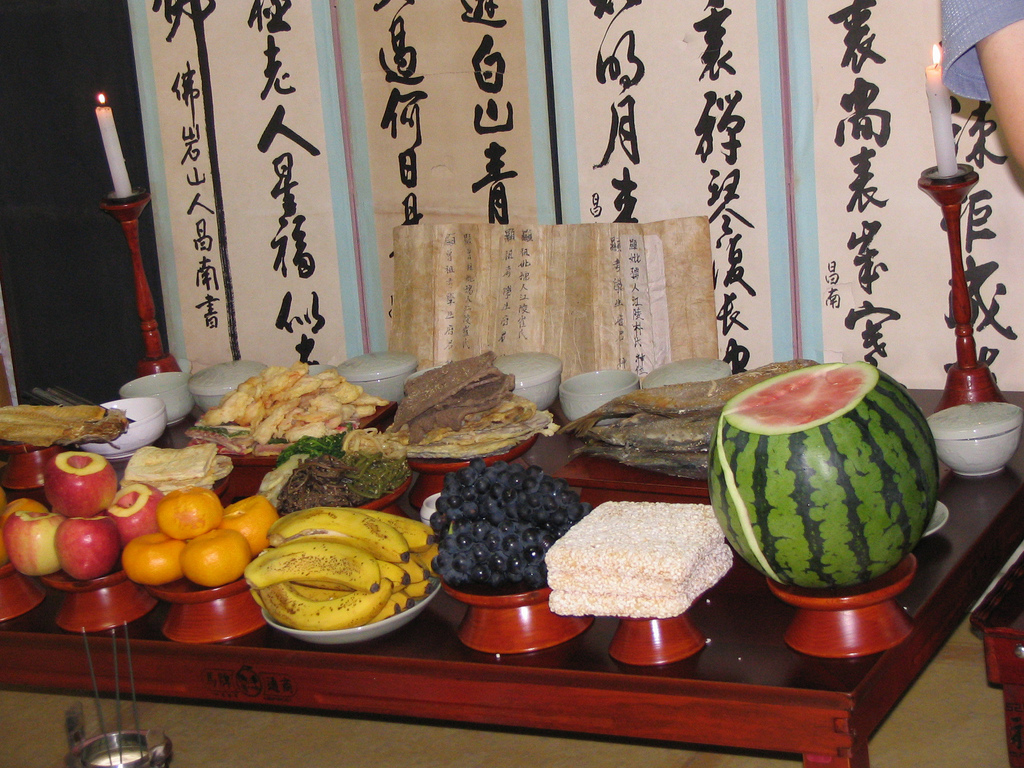 🇰🇷 South Korea and 1 moreChuseok추석 (Chuseok), 한가위 (Hangawi)
A Korean autumn harvest festival marked by ancestral rites and feasting on the full moon.Tradition · Speaking with spirits and the dead · Luck and prosperity Living
 🇰🇷 South Korea and 1 moreDaeboreum대보름
A Korean lunar holiday marking the first full moon with nut-cracking and field firesTradition · Protection · Luck and prosperity Living
Related elsewhere
All figure 🇮🇳 IndiaChakraचक्र
Meditation points in the subtle body used in Hindu and Buddhist yogaTradition · Speaking with spirits and the dead · Change and initiation Living
🇬🇧 United Kingdom and 1 moreChaos magic
A modern magical system that treats belief as a flexible tool rather than a fixed truth.Tradition · Change and initiation · Power and authority Living
 🇮🇳 IndiaNaropa
An Indian Buddhist master whose teachings shaped Tibetan Vajrayana practiceFigure · Change and initiation Historical
🇩🇪 GermanyChymical Wedding of Christian RosenkreutzChymische Hochzeit Christiani Rosencreutz anno 1459
An allegorical romance and Rosicrucian manifesto detailing a seven-day alchemical initiation.Text · Change and initiation · Power and authority Historical