Spirit photography
Photographs made or taken to show the dead, from studio sittings to haunted houses
A branch of picture-making that aims to record ghosts, most often the faces of the dead beside living sitters. It grew out of the mid-1800s Spiritualist movement and post-Civil War grief in the United States, became a paid trade, was repeatedly exposed as trickery, and lives on among ghost hunters.
- Mary Todd Lincoln sat for Mumler with the shape of her dead husband beside her
- Mumler faced a fraud trial in 1869 and was cleared; his methods were never shown
- In 1922, X-ray-marked plates caught William Hope out, yet his clients kept coming
- Buguet confessed his studio ghosts were dolls draped in gauze with pasted faces
- Camera makers call orbs a common fault: flash light off dust, rain or insects
What it is
Spirit photography is picture-making aimed at recording ghosts and other beings on film or sensor. It grew up alongside the Spiritualist movement of the mid-1800s, whose followers held that the dead survive and can make themselves known. Customers paid studios in the hope of seeing a lost parent, child or spouse beside them in the print. Investigators separate two strands. Studio-made pictures of the dead, later also taken in séance rooms, count as spirit photography, while snapshots taken at spots thought to be haunted are ghost photography. The first kind was run as a trade by mediums and was exposed again and again as trickery; the second often arises by accident from how cameras behave, though some is faked on purpose. Both remain active among today's ghost hunters.
Where it comes from
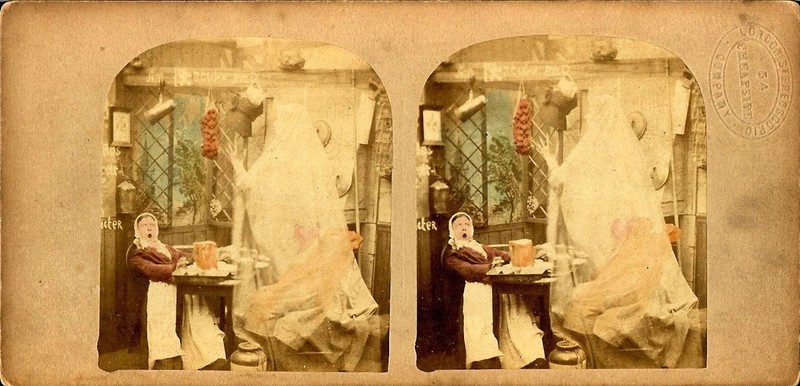
Photography arrived in 1839 with the daguerreotype, a process in which each plate held a single image, so pictures could not normally be layered. Long exposures, though, let stray movement register faintly, and could record reflections much as the stage effect known as Pepper's ghost did. In 1856 Sir David Brewster saw that such effects could be produced on purpose, and the London Stereoscopic Company issued a series on the theme called "The Ghost in the Stereoscope". When glass-plate negatives spread from about 1859, a plate could be used twice, leaving traces of the earlier sitting, and early operators built their trade on this. Grief did the rest: the Civil War dead and Victorian mourning fed demand, and the trade boomed until the 1920s, when Harry Houdini campaigned against Spiritualist trickery and interest fell away.
How it is done
Exposed cases point to a handful of studio devices. Plates that had not been wiped clean carried faces from earlier sitters into new portraits. Slow exposures let anyone walking through the frame leave a transparent figure, which explains the outline recorded at Combermere Abbey during a one-hour sitting. Frederick Hudson is said to have altered his camera so a ready-made image could slip into place, and Édouard Buguet admitted using dolls draped in gauze with faces pasted on. Today's ghost snaps usually come from ordinary camera behaviour: flash light off dust, hair, straps or insects, breath or smoke in cold air, and blur from a moving camera or a slow shutter.
Tools and materials
The central tool was the camera itself, at first the daguerreotype and then the glass-plate negative, whose ability to hold a faint earlier image did most of the work. Exposure length mattered: an hour at Combermere Abbey, seconds in the parlour. Fake spirits were staged with dolls, gauze and cut-out faces. In the digital age the plain camera flash took centre stage, since light bouncing off dust, rain, pollen or insects produces the round white spots many readers take for spirits, and camera makers themselves describe these spots as a routine fault.
Spirit photography, drawn and placed
- Living
- Revived
- Fading
- Historical
- Legendary
- Performed
- Lineage
- the Spiritualist movement of the mid-1800s
What it is for
The trade fed on mourning. After the Civil War left so many households without a body or a grave, clients came hoping the print would show a son or husband beside them, and many of the dead pictured were children or young soldiers. Mary Todd Lincoln sat for Mumler with the shape of her dead husband at her shoulder. Believers such as Arthur Conan Doyle held that a photograph offered proof of life after death, stronger than a medium's word alone. For the photographers it was a living: Mumler and Hope both ran busy studios.
Who does it
Most named figures were photographers first. Mumler was a jewelry engraver and amateur with a camera; his first picture, made in 1862 in Mrs Helen F. Stuart's Boston rooms, showed what he took for his cousin, dead twelve years, and he soon called himself a "spirit photographic medium", working first under Mrs Stuart and later in New York. Hudson ran a studio in England from 1872; Buguet worked in France and kept a London studio too; Hope led the Crewe Circle, a Spiritualist group. Mrs Stuart is thought to have helped produce the early pictures. Later, amateurs with portable cameras and then smartphones joined in.
Peoples and places
The practice is recorded first in the United States, then in England and France, each country supplying its own cast. Boston and New York hosted Mumler's business; England claimed Hudson's studio, Sybell Corbet's picture at Combermere Abbey in Cheshire, and Hope's Crewe Circle; France produced Buguet, whose downfall was reported in both French and English papers. The movement crossed the Atlantic with Spiritualism itself, and its clientele were largely Victorian mourners. Today ghost snapshots are taken by amateurs far and wide, from tourists at the Stanley Hotel in Colorado to posters of an old Belfast photograph.
At a glance: who, where and when
Peoples
Belief worlds


What people believe
Spiritualism, the movement behind the trade, taught that the dead live on and can appear to the living, and the Victorian era, steeped in death, wanted evidence of survival. A print showing a familiar face seemed like proof that a loved one still existed. Believers read odd lights as "ghost lights", and Annette Hill notes that digital cameras gave the idea new form: the light became an orb, a round white spot claimed on paranormal websites as a sign a spirit is present, a claim ghost hunters still argue over. Even clear proof of trickery did not shake devoted followers, who treated the findings as an attack on their cause.
How scholars and sceptics see it
Investigators have tested the pictures since the 1860s. P.T. Barnum spoke against Mumler in court, saying he traded on grief. In 1922 Harry Price of the Society for Psychical Research, the magician Seymour, Eric Dingwall and William Marriott handed Hope glass plates marked with X-rays; the plate returned with its spirit carried no marks, and Price printed the result in the Society's journal. Joe Nickell splits the field into studio fakes and accidental haunted-place shots. Ben Radford argues that ghost pictures stay vague even as cameras improve, and Kenny Biddle calls it the fallacy of arguing from ignorance to label any odd image paranormal simply because it is unexplained, adding pareidolia, the mind's habit of finding faces in patterns.
Cautions and what is closed
Fraud runs through the record. Buguet's 1875 confession filled the French and English papers, and Mumler, Hope, David Duguid and Edward Wyllie were all accused or exposed; Ronald Pearsall set out the trade's methods in his 1972 book The Table-Rappers. On the modern side, investigators warn that television series such as Ghost Hunters present routine camera faults as proof of spirits, and Massimo Polidoro sees in Hope's lasting following a lesson in how strong belief outlives strong evidence of cheating.
Compare and confuse
Nickell's line between spirit photography and ghost photography matters: the first was made for money in studios and later covered séance rooms, the second was taken at places thought haunted and could be either staged or unintended. Round white orbs are the digital descendants of the ghost lights believers once saw in old prints. The term ectoplasm, once applied to misty shapes, now gets used for breath, smoke or fog caught by a flash.
Law and persecution
The courts appear early in this story. Mumler was charged with fraud in 1869; the case ended in acquittal, with the showman Barnum among those giving evidence against him, and no one ever demonstrated his technique. Buguet faced a fraud prosecution in Paris in 1875 after admitting how his pictures were made. Beyond these court cases, exposures by investigators, from Houdini's campaign to the marked-plate test against Hope, did as much damage as any courtroom.
Today
Ghost photography thrives in digital form. Phone apps can drop a spirit figure into an existing picture, compact cameras breed orbs, and paranormal websites fill with artefacts offered as signs of the dead. Television series such as Ghost Hunters keep the hunt in view. In 2016 a visitor's picture of a staircase at the Stanley Hotel in Colorado, a place known for hauntings, was called unexplainable by amateur hunters; investigators attribute the figure to the phone's panorama mode and its slow, double-imaging exposure. That same year an old Belfast photograph from 1900 circulated on a local history site and drew fresh attention.
Questions people ask about Spirit photography
What is spirit photography?
Pictures taken with the aim of showing ghosts or spirits, especially dead relatives standing beside living sitters. It began in the 1860s in the United States, spread to England and France, and later split into studio spirit photos and snapshots taken at haunted places.
Why did people pay for these pictures?
Grief drove the trade. The American Civil War left families mourning children and young men, and Victorian life was full of death. Clients hoped a photograph would show a lost loved one's face, which believers took as proof of life after death.
Was it ever shown to be fake?
Repeatedly. Buguet confessed in 1875 that his spirits were gauze-draped dolls; investigators marked Hope's plates with X-rays in 1922 and the marks vanished from his prints. Mumler stood trial in 1869 but was acquitted, and Barnum argued he exploited mourners.
What are the white orbs in modern ghost photos?
Round white spots often called orbs, or sometimes ectoplasm. Camera makers describe them as a routine fault: flash light bouncing off dust, pollen, rain, insects or material inside the lens, especially with compact digital cameras. Believers read them as signs a spirit is near.
Is spirit photography still practised?
Yes, as ghost photography. Phone apps can add ghosts to pictures, paranormal websites post orbs as evidence, and television shows such as Ghost Hunters present camera faults as spirit signs. Investigators reply that better cameras have not produced clearer pictures of ghosts.
Good reading and sources
- Spirit photography on WikipediaEncyclopedia
- More photos on Wikimedia CommonsPhotos and video
- Wikidata recordOpen data
The facts on this page come from the Wikipedia article "Spirit photography", written by its contributors and used under the CC BY-SA 4.0 licence, and from its Wikidata record (CC0). EveryJaadu rewrote the text in its own words, with AI assistance, and compares every page with the article to make sure no passage is copied. It may be reused under the same CC BY-SA 4.0 licence with a link back.
It may contain mistakes. Names and customs differ from one community to the next, and some knowledge is closed to outsiders and left out here. This page describes belief and practice. It does not say that any of it works, it is not a how-to, and it is not medical advice. If something is wrong, tell us. Last refreshed 2026-10-16.
More from the United States
All the entries from the United States 🇺🇸 United States and 5 moreSatanism
A modern set of beliefs using the figure of Satan as a symbol or deity.Tradition · Power and authority · Cursing and harm Living
🇺🇸 United States and 5 moreSatanism
A modern set of beliefs using the figure of Satan as a symbol or deity.Tradition · Power and authority · Cursing and harm Living
 🇺🇸 United States and 1 moreGroundhog DayGrund'sau dåk
A North American custom using a burrowing rodent to forecast the end of winterTradition · Seeing and foretelling · Luck and prosperity Living
🇺🇸 United States and 1 moreGroundhog DayGrund'sau dåk
A North American custom using a burrowing rodent to forecast the end of winterTradition · Seeing and foretelling · Luck and prosperity Living
 🇺🇸 United States and 1 morePunxsutawney Phil
A groundhog who serves as the central figure in an annual American weather prediction festival.Belief · Seeing and foretelling · Wonder and entertainment Living
🇺🇸 United States and 1 morePunxsutawney Phil
A groundhog who serves as the central figure in an annual American weather prediction festival.Belief · Seeing and foretelling · Wonder and entertainment Living
 🇺🇸 United StatesSalem Witch Trials
A colonial legal crisis where over two hundred people faced accusations of sorcery in Massachusetts.Belief · Cursing and harm Historical
🇺🇸 United StatesSalem Witch Trials
A colonial legal crisis where over two hundred people faced accusations of sorcery in Massachusetts.Belief · Cursing and harm Historical
Related elsewhere
All tradition 🇮🇳 IndiaChakraचक्र
Meditation points in the subtle body used in Hindu and Buddhist yogaTradition · Speaking with spirits and the dead · Change and initiation Living
🇮🇳 IndiaChakraचक्र
Meditation points in the subtle body used in Hindu and Buddhist yogaTradition · Speaking with spirits and the dead · Change and initiation Living
 🇫🇷 France and 5 moreKabbalahקַבָּלָה
An esoteric school of thought within Judaism focused on the hidden meanings of scripture and the divine.Tradition · Speaking with spirits and the dead · Change and initiation Living
🇫🇷 France and 5 moreKabbalahקַבָּלָה
An esoteric school of thought within Judaism focused on the hidden meanings of scripture and the divine.Tradition · Speaking with spirits and the dead · Change and initiation Living
 🇮🇹 ItalyEtruscan religion
The polytheistic beliefs and divination practices of the ancient Etruscans of ItalyTradition · Seeing and foretelling · Speaking with spirits and the dead Historical
🇮🇹 ItalyEtruscan religion
The polytheistic beliefs and divination practices of the ancient Etruscans of ItalyTradition · Seeing and foretelling · Speaking with spirits and the dead Historical
 🇮🇶 Iraq and 5 moreGrimoire
A textbook containing instructions for spells, rituals, and the creation of magical objects.Text · Protection · Healing Historical
🇮🇶 Iraq and 5 moreGrimoire
A textbook containing instructions for spells, rituals, and the creation of magical objects.Text · Protection · Healing Historical