Shirt of Nessus
In its own language: Χιτών τοῦ Νέσσου
from Ancient Greek Chitṓn toû Néssou, the tunic of Nessus
A poisoned tunic from Greek myth, and a byword for a fatal gift
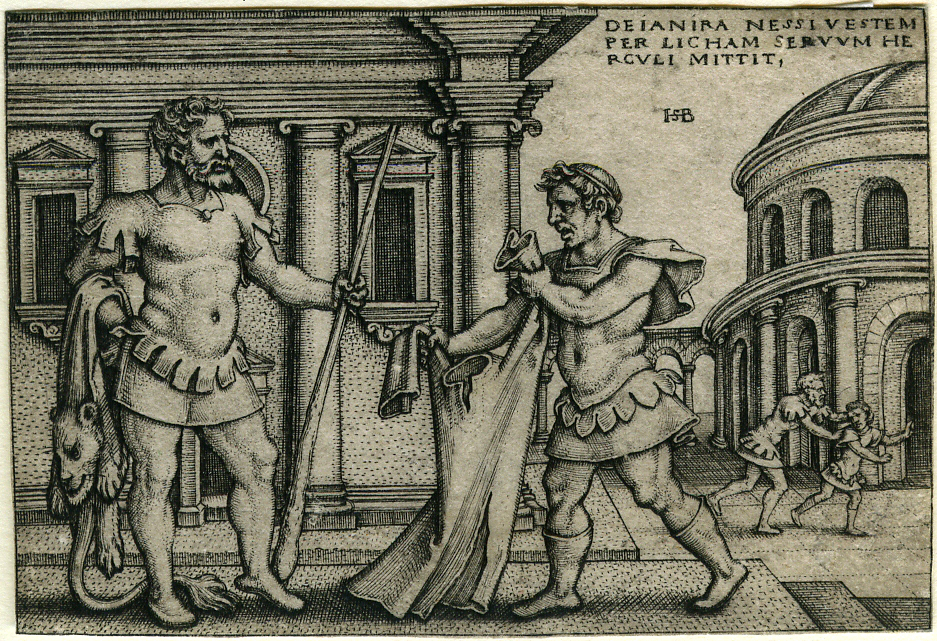
The Shirt of Nessus is a poisoned tunic in Greek myth, the garment that kills Heracles after his wife Deianeira is tricked into sending it to him. Its venom comes from the Lernaean Hydra by way of the centaur Nessus's blood, and the image has become a byword for a fatal gift.
- A poisoned tunic from Greek myth, sent to Heracles by his wife Deianeira
- Its venom came from the Lernaean Hydra, carried in the blood of the centaur Nessus
- Folklorists class it as an instance of the poison dress motif
- Henning von Tresckow called the failed Hitler plot a Robe of Nessus
- John Barth's 1952 master's thesis was titled The Shirt of Nessus
What it is
The Shirt of Nessus is a tunic in Greek myth that kills the hero Heracles. The cloth is stained with the blood of Nessus, a centaur, and that blood carries the venom of the Lernaean Hydra, the many-headed serpent Heracles had fought. Folklorists file the story under a pattern they call the poison dress motif, in which a garment becomes the means of a death. The shirt also lives outside the story as a figure of speech. Writers use it for a fatal gift, or for a burden that cannot be put down: a source of misfortune with no way out.
Where it comes from
The tale belongs to Greek mythology and is told of Heracles, his wife Deianeira and the centaur Nessus. Heracles shot Nessus with an arrow whose tip carried Hydra venom. As he died, Nessus told Deianeira that the blood around the wound was a charm that would keep her husband faithful, and she saved it. Later, hearing that Heracles had taken Iole as a lover, she sent him a tunic smeared with that blood. The story is a myth, told in ancient Greek literature and retold many times since.
How it is done
As the story tells it, Deianeira treats a tunic with the blood she has kept and sends it to Heracles. He puts it on, and the venom begins to burn him. The pain is described as cooking him alive, and the garment will not come off. To end the pain he has a funeral pyre built and throws himself onto it. The sequence runs as a chain of deception: a dying centaur's advice, a wife's hope, and a hero's death.
Tools and materials
The object is a chiton, the Greek word for a tunic, and the story turns on what soaks into it. Nessus's blood is the carrier and the venom of the Lernaean Hydra is the poison; Heracles had dipped his arrows in the same venom. The garment itself is plain cloth, with no ornament or inscription attached to it in the tale. In later writing the shirt keeps that sense of something worn close to the body and impossible to remove.
Shirt of Nessus, drawn and placed
- Living
- Revived
- Fading
- Historical
- Legendary
- Performed
- Lineage
- Greek mythology
What it is for
Deianeira sends the shirt as a love charm, or as what she takes to be one. Nessus has told her it will hold her husband's affection, and her aim is to keep Heracles, who has taken Iole as a new lover. The outcome is the reverse: a gift meant to steady a marriage becomes the instrument of his death. Later writers borrow the shirt for that shape of story, a present that cannot be refused and cannot be survived.
Who does it
Two figures drive the tale. Nessus, a centaur, devises the trick: wounded and dying, he gives Deianeira a false remedy. Deianeira, Heracles' wife, keeps the blood and later applies it, believing she is protecting her marriage. Heracles is the one who wears the result. No priest, diviner or professional magician appears in the story; the work falls to a deceived wife and a vengeful dying creature, and the garment does the rest.
What people believe
The tale assumes a world where a centaur's blood can carry a deadly poison and also pass for a love potion, and where a hero's arrows are dipped in the venom of a monster he has killed. Nessus's dying words are the hinge: a false claim about what the blood will do. The shirt works because the venom stays potent after the creature's death. Nothing in the story treats the garment as holy or as an object of worship; its force is poison, described in the language of heat and burning.
How scholars and sceptics see it
Folklorists treat the shirt as one case of a wider pattern they call the poison dress motif, and motif indexes of English and North American tales catalogue it. Adrienne Mayor has written on the Nessus shirt and smallpox blankets in the New World, following the image into later legend. Literary scholars note the shirt as a recurring figure in modern writing, where it stands for an inescapable consequence. The tale is studied as myth, not as a record of practice.
Compare and confuse
English gives the garment several names: Tunic of Nessus, Nessus-robe, Nessus' shirt and Robe of Nessus. The ancient Greek is Chitṓn toû Néssou. Folklorists group it with other poison dress stories, in which a garment is the means of a death. Its nearest relatives in modern usage are metaphors of a burden that cannot be shed, as when Carl Jung called knowledge of the unconscious a shirt that cannot be stripped off.
Today
The shirt survives mainly as an image. Henning von Tresckow, a conspirator in the July 20 plot against Hitler, said after its failure that everyone in the circle had put on the Robe of Nessus, and he killed himself soon afterwards. A 1956 non-fiction book on anti-Nazi groups in Germany took the title. John Barth's 1952 master's thesis was a short work called The Shirt of Nessus; the Polish writer Jan Józef Lipski used Tunika Nessosa for essays against Catholic nationalism; Uri Avnery compared Israel's occupied territories to the shirt; Jung used it for the unconscious.
Questions people ask about Shirt of Nessus
What is the Shirt of Nessus?
A poisoned tunic from Greek myth. Heracles' wife Deianeira sends it to him, believing that the blood of the centaur Nessus in its cloth will keep him faithful. That blood carries Hydra venom, and the garment kills him.
Where does the story come from?
From Greek mythology. It is told of Heracles, his wife Deianeira, the centaur Nessus and Heracles' new lover Iole. Folklorists also treat it as an example of the poison dress motif listed in tale indexes.
Why did Deianeira send the shirt?
She feared Heracles had taken Iole as a lover. The dying Nessus had told her that his blood was a charm to secure her husband's faithfulness, and she believed him. She did not know the blood carried the venom of the Lernaean Hydra.
How is the shirt used as a metaphor?
For a fatal gift, or a misfortune with no way out. A German conspirator used Robe of Nessus for the failed plot against Hitler, and Carl Jung used it for knowledge of the unconscious that cannot be stripped off.
What is the poison dress motif?
A category used in folkloristics for tales in which a garment becomes the means of a death. The Shirt of Nessus is given as an instance, and motif indexes of English and North American folktales catalogue the type.
Good reading and sources
The facts on this page come from the Wikipedia article "Shirt of Nessus", written by its contributors and used under the CC BY-SA 4.0 licence, and from its Wikidata record (CC0). EveryJaadu rewrote the text in its own words, with AI assistance, and compares every page with the article to make sure no passage is copied. It may be reused under the same CC BY-SA 4.0 licence with a link back.
It may contain mistakes. Names and customs differ from one community to the next, and some knowledge is closed to outsiders and left out here. This page describes belief and practice. It does not say that any of it works, it is not a how-to, and it is not medical advice. If something is wrong, tell us. Last refreshed 2026-10-17.
More from Greece
All the entries from Greece 🇮🇪 Ireland and 5 moreCairn
A human-made stack of stones used as a marker, memorial, or religious symbol across many cultures.Tradition · Protection · Speaking with spirits and the dead Living
🇮🇪 Ireland and 5 moreCairn
A human-made stack of stones used as a marker, memorial, or religious symbol across many cultures.Tradition · Protection · Speaking with spirits and the dead Living
 🇬🇷 Greece and 5 moreBay Laurelδάφνη
An aromatic Mediterranean plant used in cooking and as a symbol of victory and purification.Substance · Protection · Cleansing and purification Living
🇬🇷 Greece and 5 moreBay Laurelδάφνη
An aromatic Mediterranean plant used in cooking and as a symbol of victory and purification.Substance · Protection · Cleansing and purification Living
 🇮🇹 Italy and 5 moreRelic
An object or body part kept to honor a holy person and mark their connection to the divineCharm · Protection · Healing Living
🇮🇹 Italy and 5 moreRelic
An object or body part kept to honor a holy person and mark their connection to the divineCharm · Protection · Healing Living
 🇬🇷 Greece and 5 moreCrossroads (folklore)
A junction between worlds where spirits are met and deals are madeBelief · Speaking with spirits and the dead · Cursing and harm Living
🇬🇷 Greece and 5 moreCrossroads (folklore)
A junction between worlds where spirits are met and deals are madeBelief · Speaking with spirits and the dead · Cursing and harm Living
Related elsewhere
All charm 🇨🇱 ChileTrauco
A small forest spirit from Chiloé mythology known for seducing women and causing pregnancyBeing · Love and attraction · Cursing and harm Legendary
🇧🇷 Brazil and 1 moreQuimbanda
An Afro-Brazilian religion focused on male and female street spirits for worldly mattersTradition · Protection · Luck and prosperity Living
🇨🇱 ChileTrauco
A small forest spirit from Chiloé mythology known for seducing women and causing pregnancyBeing · Love and attraction · Cursing and harm Legendary
🇧🇷 Brazil and 1 moreQuimbanda
An Afro-Brazilian religion focused on male and female street spirits for worldly mattersTradition · Protection · Luck and prosperity Living
 🇮🇳 India and 5 moreHoliहोली
A Hindu spring festival marked by coloured powders and bonfires to celebrate love and virtue.Tradition · Love and attraction · Cursing and harm Living
🇪🇹 EthiopiaPlanetary hours
A system assigning celestial rulers to each hour of the day and weekTradition · Power and authority · Cursing and harm Historical
🇮🇳 India and 5 moreHoliहोली
A Hindu spring festival marked by coloured powders and bonfires to celebrate love and virtue.Tradition · Love and attraction · Cursing and harm Living
🇪🇹 EthiopiaPlanetary hours
A system assigning celestial rulers to each hour of the day and weekTradition · Power and authority · Cursing and harm Historical