Sanjhi
A festival and art form honoring a mother goddess through clay images and colored designs
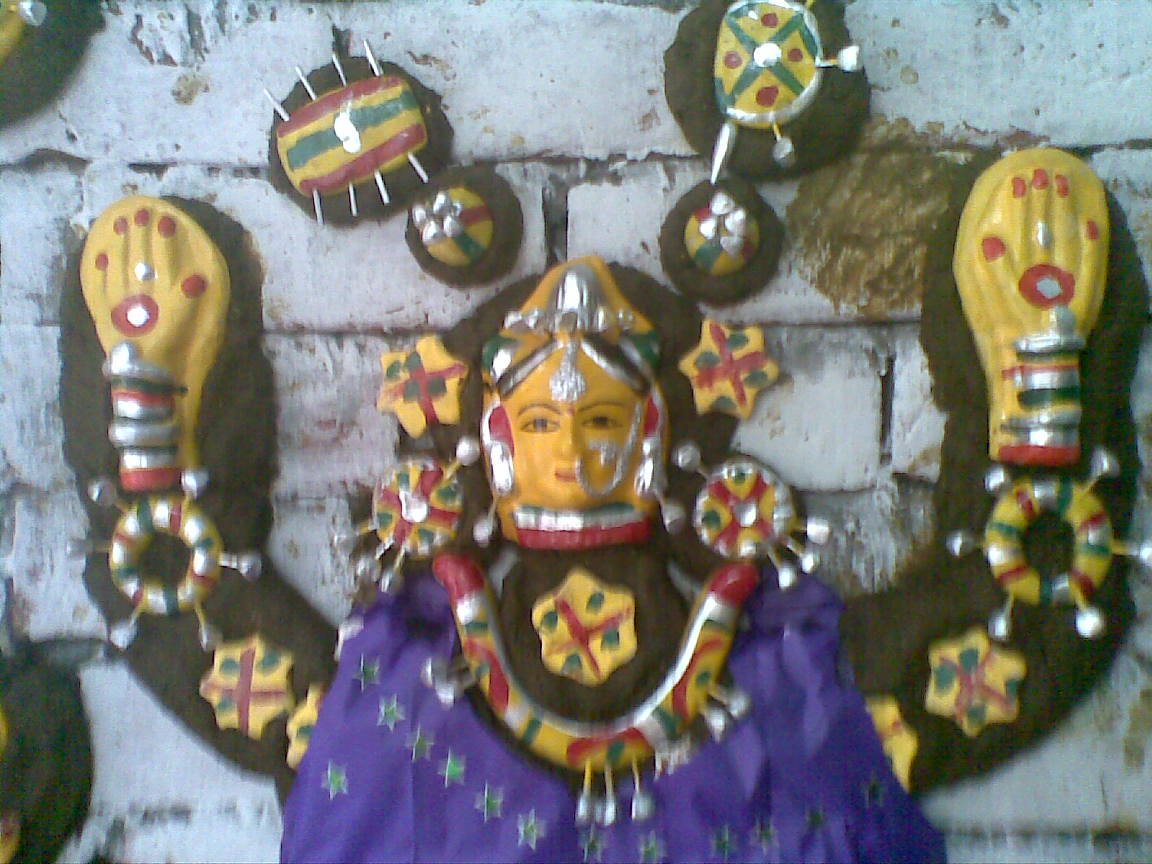
Sanjhi is a festival dedicated to a mother goddess, practiced by women in northern India. It involves creating mud figures or intricate colored floor designs to invoke her presence for blessings like marriage.
- Sanjhi honors a mother goddess through clay figures and colored designs
- Women lead daily singing and prayer rituals during the nine-day festival
- Temple art uses dry colors on octagonal platforms symbolizing a lotus
- Vraja tradition links designs to Radha and Krishna's divine love
- Images are immersed in water on Dussehra to close the festival
What it is
Sanjhi refers to both a specific mother goddess and the festival held in her honor. Women and girls create images from mud or craft elaborate designs using colored powders. These artistic efforts serve as focal points for devotion during a nine-day period. The practice blends household worship with temple traditions, emphasizing female participation and creative expression as acts of faith.
Where it comes from
The custom has roots in folk traditions across northern Indian states. A separate theological tradition links Sanjhi to Vraja, the homeland of Krishna. In this view, Radha created designs to evoke Krishna's presence. Another story suggests Krishna made a flower image of Radha at twilight. Temple versions of the art developed around the fifteenth or sixteenth century, evolving from simple village practices into complex ritual forms.
How it is done
Families prepare a Sanjhi image on a wall or floor. Women gather daily to sing devotional songs and perform rituals. Young girls offer prayers and food to the figure. The design expands outward from a central point representing the divine couple. On the final day, the image is immersed in water to conclude the festival. Men may join the evening ceremonies after their daily work ends.
Tools and materials
Practitioners use mud, cow dung, and flowers for early village styles. Temple artists employ dry colors on octagonal earthen platforms. The platform symbolizes an eight-petaled lotus. The center holds the seat of the deities. Intricate diagonal patterns radiate from this core. Ornaments and weapons adorn clay figures based on family resources.
Sanjhi, drawn and placed
- Living
- Revived
- Fading
- Historical
- Legendary
- Performed
- Lineage
- Hindu folk religion
- Timing
- during Navratri
What it is for
Worshippers seek fulfillment of wishes, known as mannat. Families pray for suitable husbands for their daughters. The goddess is believed to grant marital blessings. The rituals aim to establish a connection with the divine through art and song. Devotees view the creation of the image as a way to invite the goddess into their space.
Who does it
Women lead the household ceremonies, singing bhajans and guiding younger girls. Elderly women often instruct others in the correct procedures. In temples, specially trained Brahman priests handle the sophisticated design art. The practice relies heavily on female agency within the domestic sphere, though men participate in later stages.
Peoples and places
The festival is prominent in Delhi, Punjab, Haryana, and Uttar Pradesh. Punjabi communities refer to their wishes as mannat. The Vraja tradition connects the art to Krishna and Radha theology. Village practices remain distinct from the highly structured temple rituals. Both forms share a focus on the mother goddess and artistic devotion.
At a glance: who, where and when
Peoples
Belief worlds
Occasions


What people believe
The goddess is viewed as a powerful maternal figure capable of influencing fate. Tantric and Hindu beliefs underpin the use of geometric designs to channel divinity. The art is not merely decorative but serves as a sacred vessel. Song performed before the design is central to the worship experience. The immersion of the image marks the return of the deity to the natural world.
When it is done
The festival spans nine days, beginning on the first day of Navratri. Daily gatherings occur throughout this period. The climax takes place on Dussehra, the final day. Immersion rituals mark the end of the celebration. The timing aligns with broader autumnal festivals in the region.
Questions people ask about Sanjhi
What is Sanjhi?
Sanjhi is a festival and art form honoring a mother goddess. Women create mud images or colored floor designs to invoke her presence for blessings and wish fulfillment.
Where is it practiced?
It is mainly practiced by women in parts of northern India, including Delhi, Punjab, Haryana, and Uttar Pradesh. Temple traditions also exist in Vraja.
When does the festival happen?
The festival lasts nine days, starting on the first day of Navratri. It concludes on Dussehra with the immersion of the Sanjhi image in water.
Who performs the rituals?
Women and girls lead the household ceremonies, singing songs and offering prayers. Trained priests manage the complex temple art forms. Men may join evening sessions.
Good reading and sources
The facts on this page come from the Wikipedia article "Sanjhi", written by its contributors and used under the CC BY-SA 4.0 licence, and from its Wikidata record (CC0). EveryJaadu rewrote the text in its own words, with AI assistance, and compares every page with the article to make sure no passage is copied. It may be reused under the same CC BY-SA 4.0 licence with a link back.
It may contain mistakes. Names and customs differ from one community to the next, and some knowledge is closed to outsiders and left out here. This page describes belief and practice. It does not say that any of it works, it is not a how-to, and it is not medical advice. If something is wrong, tell us. Last refreshed 2026-10-11.
More from India
All the entries from India 🇮🇳 IndiaChakraचक्र
Meditation points in the subtle body used in Hindu and Buddhist yogaTradition · Speaking with spirits and the dead · Change and initiation Living
🇮🇳 IndiaChakraचक्र
Meditation points in the subtle body used in Hindu and Buddhist yogaTradition · Speaking with spirits and the dead · Change and initiation Living
 🇮🇳 IndiaMahakaleshwar JyotirlingaMahākāleśvara
A sacred Shiva shrine in Ujjain, India, known for its south-facing idol and ancient origins.Tradition · Protection · Power and authority Living
🇮🇳 IndiaMahakaleshwar JyotirlingaMahākāleśvara
A sacred Shiva shrine in Ujjain, India, known for its south-facing idol and ancient origins.Tradition · Protection · Power and authority Living
 🇮🇳 India and 5 moreHoliहोली
A Hindu spring festival marked by coloured powders and bonfires to celebrate love and virtue.Tradition · Love and attraction · Cursing and harm Living
🇮🇳 India and 5 moreHoliहोली
A Hindu spring festival marked by coloured powders and bonfires to celebrate love and virtue.Tradition · Love and attraction · Cursing and harm Living
 🇮🇳 India and 5 moreKolamகோலம்
A daily geometric floor drawing made with rice flour at the home entrance in South IndiaTradition · Protection · Luck and prosperity Living
🇮🇳 India and 5 moreKolamகோலம்
A daily geometric floor drawing made with rice flour at the home entrance in South IndiaTradition · Protection · Luck and prosperity Living
Related elsewhere
All tradition 🇮🇪 Ireland and 1 moreBrigid's crossCros Bhríde
A woven straw charm hung for protection, named after Ireland's patron saintCharm · Protection · Luck and prosperity Living
🇪🇹 EthiopiaPlanetary hours
A system assigning celestial rulers to each hour of the day and weekTradition · Power and authority · Cursing and harm Historical
🇧🇷 Brazil and 1 moreQuimbanda
An Afro-Brazilian religion focused on male and female street spirits for worldly mattersTradition · Protection · Luck and prosperity Living
🇮🇪 Ireland and 1 moreBrigid's crossCros Bhríde
A woven straw charm hung for protection, named after Ireland's patron saintCharm · Protection · Luck and prosperity Living
🇪🇹 EthiopiaPlanetary hours
A system assigning celestial rulers to each hour of the day and weekTradition · Power and authority · Cursing and harm Historical
🇧🇷 Brazil and 1 moreQuimbanda
An Afro-Brazilian religion focused on male and female street spirits for worldly mattersTradition · Protection · Luck and prosperity Living
 🇪🇪 Estonia and 5 moreFern flower
A mythical bloom said to bring fortune and unlock secrets, found only on midsummer night.Belief · Luck and prosperity · Love and attraction Living
🇪🇪 Estonia and 5 moreFern flower
A mythical bloom said to bring fortune and unlock secrets, found only on midsummer night.Belief · Luck and prosperity · Love and attraction Living