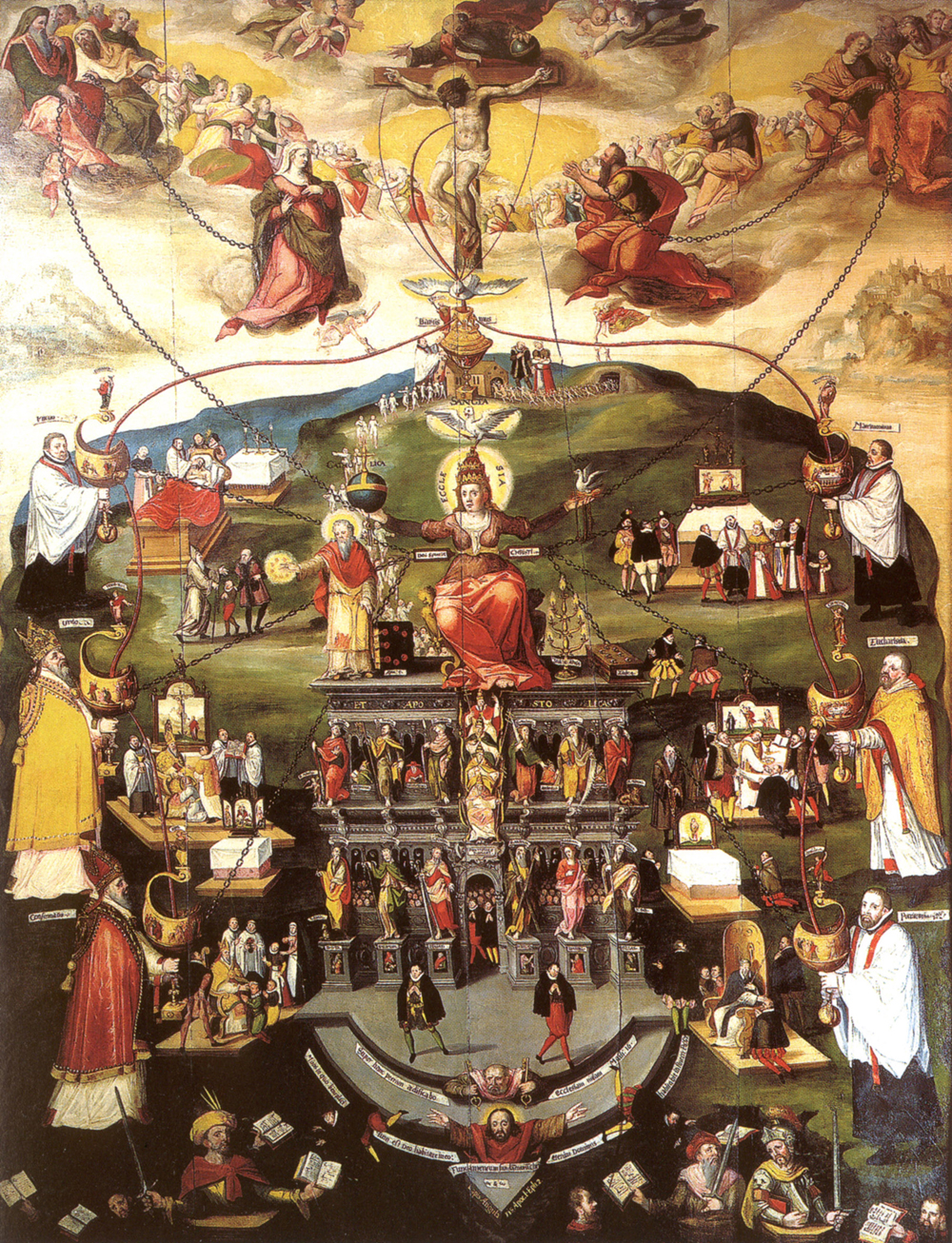
Sacred mysteries
In its own language: μυστήριον
from Greek mysterion, a secret revealed by divine disclosure
Secret ceremonies and divine doctrines held to exceed human reason
Sacred mysteries are secret rites, divine doctrines, and sacramental acts held to exceed ordinary human logic. Found in Mediterranean cults and Christian traditions, they are viewed by believers as truths disclosed only through divine revelation.
- Ancient Greek and Roman mystery cults required formal initiation and kept rituals secret from outsiders.
- Early Christian congregations observed secrecy under the disciplina arcani to protect rites from ridicule.
- The First Vatican Council declared anathema on claims that human reason alone can prove all divine dogmas.
- Eastern Orthodox theology refers to the sacraments, including the Eucharist, as the Sacred Mysteries.
What it is
A sacred mystery is a religious truth or rite linked to the divine that cannot be understood through everyday logic alone. The term covers two related concepts. First, it refers to closed rituals and teachings that groups hide from the uninitiated. Second, it describes religious doctrines that are public but considered impossible to explain by natural science or intellectual deduction. In these traditions, understanding comes only when a divinity discloses the truth. The Greek term denotes a hidden reality awaiting revelation. In Western and Eastern traditions, the concept includes foundational beliefs such as divine incarnation, as well as formal liturgical acts where divine grace is thought to touch human life.
Where it comes from
Mystery traditions grew across ancient Greece and spread throughout the Roman Empire. Popular movements centered on deities such as Isis, Mithras, Sol Invictus, and the rites of Eleusis. These groups required newcomers to pass through formal admission before receiving secret knowledge. During its earliest centuries, the Christian movement adopted a similar policy of secrecy known as the disciplina arcani. Early congregations kept core teachings and rituals hidden from non-members to prevent outside ridicule. New converts received instruction in stages. As social persecution ceased, this institutional secrecy relaxed, but the language of mysteries remained central to Christian theology and worship.
How it is done
Historical mystery cults conducted tiered ceremonies, guiding initiates through progressive ranks of esoteric learning. Priests revealed doctrines in private settings. In Christian sacramental practice, rites follow set liturgical formulas. Believers take part in Holy Communion, receiving consecrated bread and wine, and undergo rituals such as baptism, chrismation, confession, and anointing. In modern devotional revivals, participants gather for nocturnal ceremonies under the moon, combining rhythmic drumming with sacred chants to honor traditional deities.
Tools and materials
Liturgy and ritual utilize specific sacred objects and elements. In Christian observances, consecrated bread and wine serve as the focal elements of communion, and churches reserve them within tabernacles. Modern revivals of classical Roman rites make use of drums to create steady rhythms during night ceremonies, alongside dedicated altars and shrines built within consecrated temple spaces.
Sacred mysteries, drawn and placed
- Living
- Revived
- Fading
- Historical
- Legendary
- Performed
- Lineage
- Greco-Roman mystery traditions and Christian theology
- Timing
- during nocturnal rites and sacramental liturgies
What it is for
The central aim of these rites is personal transformation and communion with the divine. In ancient cults, initiation bound members to a deity and granted access to hidden doctrines. In Christian theology, the sacred mysteries serve as vessels through which the Holy Spirit invisibly bestows grace upon believers. Participation is believed to draw the faithful into union with God, a ongoing spiritual journey termed theosis. Sacraments are held to sustain believers through key life transitions and communal worship.
Who does it
In ancient traditions, teachers known as mystagogues or hierophants guarded sacred teachings and guided candidates through initiation rites. Certain cult doctrines were restricted solely to the priesthood. In Western and Eastern Christian churches, ordained male priests administer the principal sacraments, such as the Eucharist and reconciliation. Eastern Orthodox tradition admits women to monastic orders while reserving the priesthood for men. Lay believers participate as active recipients who must prepare spiritually before taking part in the rites.
At a glance: who, where and when
Belief worlds
Occasions
What people believe
Practitioners hold that divine reality exceeds the limits of human intellect and natural science. Certain truths cannot be proved through logical deduction alone, requiring divine revelation to become known. Christian teaching views the world as filled with divine presence, while maintaining that God acts with particular intensity through designated sacred rites. Events such as the virgin birth, the resurrection of Jesus, and the Trinity are treated as fundamental truths that lie beyond complete human comprehension.
Compare and confuse
Western and Eastern branches of Christianity understand sacred mysteries with slight differences in definition. The Roman Catholic Church established a strict list of seven sacraments at the Council of Trent, using the Latin phrase mysterium fidei during Mass. Eastern Orthodox theology uses the word mystery for these same rites, but avoids setting a rigid limit on their number. In biblical Greek, the term refers to a concealed divine plan awaiting disclosure, contrasting with modern ideas of a puzzle that cannot be solved.
Law and persecution
Ecclesiastical councils formally defined the role of mysteries within religious law. The Roman Catholic First Vatican Council decreed that belief in divine mysteries is mandatory, declaring anathema against the idea that human reason alone can explain all doctrines of faith. Earlier, the Council of Trent established canon law fixing the number of Western sacraments at seven, including baptism, confirmation, penance, the Eucharist, holy orders, matrimony, and the anointing of the sick.
Today
Sacred mysteries remain active in global worship and revivalist movements. Catholic and Eastern Orthodox communities celebrate them continuously through regular church liturgies and sacramental life. In Italy, organizations such as Pietas Comunità Gentile work to revive ancient Roman rites. They organize cultural events like the Dionisiache in Pulsano, honoring Dionysus and Artemis with nocturnal ceremonies, and maintain newly constructed temples dedicated to Apollo and Minerva.
Questions people ask about Sacred mysteries
What is a sacred mystery?
A sacred mystery is a religious practice kept secret from the uninitiated, or a theological truth held to exceed mundane reason. Believers view these doctrines and sacramental rites as truths that can only be understood through divine revelation.
Where did sacred mysteries originate?
They developed in ancient Greece and Rome through cults dedicated to figures like Isis, Mithras, and Dionysus. Early Christianity also used secrecy during periods of persecution, later embedding the concept of mystery into church sacraments and liturgical theology.
Who is a mystagogue or hierophant?
A mystagogue or hierophant is a religious teacher and holder of secret knowledge who instructs candidates and guides them through initiation into sacred rites.
How do Eastern Orthodox and Roman Catholic views of mysteries differ?
The Western Catholic Church legally fixed the number of sacraments at seven during the Council of Trent. Eastern Orthodoxy often lists the same seven rites but avoids defining their total number rigidly, calling all sacramental acts Sacred Mysteries.
Good reading and sources
The facts on this page come from the Wikipedia article "Sacred mysteries", written by its contributors and used under the CC BY-SA 4.0 licence, and from its Wikidata record (CC0). EveryJaadu rewrote the text in its own words, with AI assistance, and compares every page with the article to make sure no passage is copied. It may be reused under the same CC BY-SA 4.0 licence with a link back.
It may contain mistakes. Names and customs differ from one community to the next, and some knowledge is closed to outsiders and left out here. This page describes belief and practice. It does not say that any of it works, it is not a how-to, and it is not medical advice. If something is wrong, tell us. Last refreshed 2026-10-07.
More from Greece
All the entries from Greece 🇹🇷 Turkey and 5 moreEvil eye
A curse believed to be cast by a jealous glare and the charms used to stop itBelief · Protection Living
🇹🇷 Turkey and 5 moreEvil eye
A curse believed to be cast by a jealous glare and the charms used to stop itBelief · Protection Living
 🇬🇷 GreeceOrphismὈρφικά
A Greek mystery tradition based on the myth of Dionysus and the soul's journeyTradition Historical
🇬🇷 GreeceOrphismὈρφικά
A Greek mystery tradition based on the myth of Dionysus and the soul's journeyTradition Historical
 🇪🇬 Egypt and 2 moreLibation
The ritual pouring of liquid as an offering to spirits or the deadRite · Speaking with spirits and the dead · Protection Living
🇪🇬 Egypt and 2 moreLibation
The ritual pouring of liquid as an offering to spirits or the deadRite · Speaking with spirits and the dead · Protection Living
 🇮🇪 Ireland and 5 moreCairn
A human-made stack of stones used as a marker, memorial, or religious symbol across many cultures.Tradition · Protection · Speaking with spirits and the dead Living
🇮🇪 Ireland and 5 moreCairn
A human-made stack of stones used as a marker, memorial, or religious symbol across many cultures.Tradition · Protection · Speaking with spirits and the dead Living
Related elsewhere
All belief 🇺🇸 United StatesGhost DanceNanissaanah
A circular movement seeking spiritual renewal and reunion with ancestorsRite · Speaking with spirits and the dead · Change and initiation Living
🇺🇸 United StatesGhost DanceNanissaanah
A circular movement seeking spiritual renewal and reunion with ancestorsRite · Speaking with spirits and the dead · Change and initiation Living
 🇮🇳 IndiaChakraचक्र
Meditation points in the subtle body used in Hindu and Buddhist yogaTradition · Speaking with spirits and the dead · Change and initiation Living
🇮🇳 IndiaChakraचक्र
Meditation points in the subtle body used in Hindu and Buddhist yogaTradition · Speaking with spirits and the dead · Change and initiation Living
 🇺🇸 United States and 1 moreMedicine wheel
Circular stone formations built by Indigenous peoples of North America for ceremony and astronomy.Tradition · Speaking with spirits and the dead · Power and authority Living
🇺🇸 United States and 1 moreMedicine wheel
Circular stone formations built by Indigenous peoples of North America for ceremony and astronomy.Tradition · Speaking with spirits and the dead · Power and authority Living
 🇳🇬 NigeriaOrunmilaỌ̀rúnmìlà
Yoruba deity of wisdom and the creator of the Ifá divination systemBeing · Seeing and foretelling · Speaking with spirits and the dead Living
🇳🇬 NigeriaOrunmilaỌ̀rúnmìlà
Yoruba deity of wisdom and the creator of the Ifá divination systemBeing · Seeing and foretelling · Speaking with spirits and the dead Living