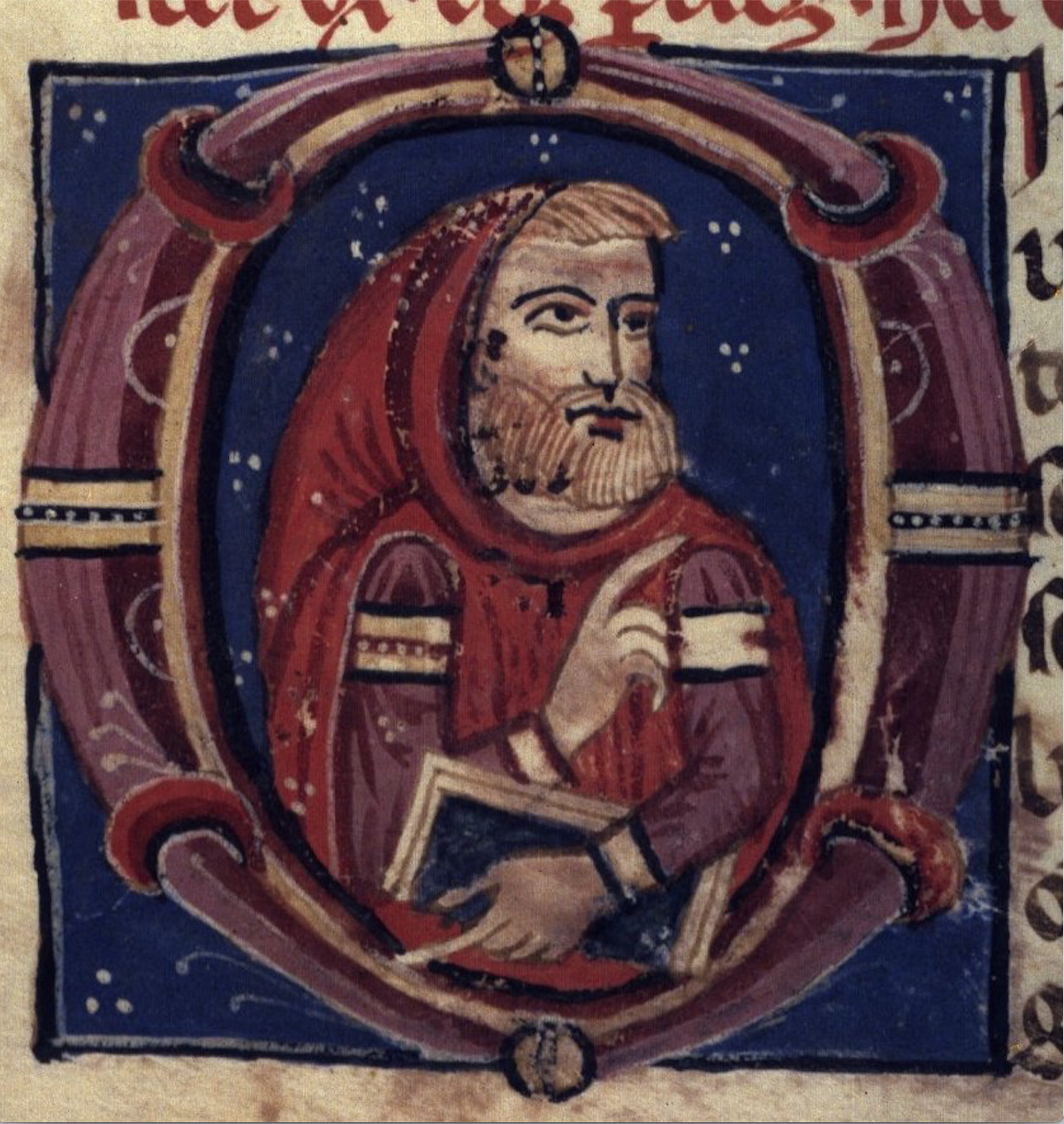
Michael Scot
from the Latin Michael Scotus, meaning Michael the Scotsman
A medieval scholar and astrologer who became a legendary magician in folklore.
Michael Scot was a Scottish mathematician and translator who served as court astrologer to Emperor Frederick II. His scholarly work on Arabic philosophy earned him fame, while legends later cast him as a sorcerer who summoned spirits and turned witches to stone.
- Translated Arabic commentaries on Aristotle into Latin.
- Served as court astrologer to Emperor Frederick II.
- Legendary for turning witches into stone circles.
- Appears in Dante's Divine Comedy in Hell.
- Born in Scotland around 1175.
What it is
Michael Scot is remembered both as a serious intellectual of the thirteenth century and as a figure of magical legend. In history, he was a polyglot scholar who translated key Arabic texts on Aristotle into Latin. In folklore, he evolved into a powerful wizard. Stories describe him using magic to perform feats that defied natural law, such as calling forth spirits to serve meals or turning enemies into stone. This dual reputation places him at the intersection of medieval science and popular superstition.
Where it comes from
Scot was born around 1175 in the border regions of Scotland. He studied at Durham, Oxford, and Paris before traveling to Italy and Spain. His career flourished under the patronage of Holy Roman Emperor Frederick II. It was at the imperial court in Palermo and through his work in Toledo that he gained access to Arabic knowledge. The transition from respected scholar to legendary magician began shortly after his death, as stories about his life were embellished with supernatural elements.
How it is done
The legends attribute various magical acts to Scot. He is said to have summoned spirits from royal kitchens in France and Spain to feast his friends. Other tales claim he used his powers to petrify a coven of witches, creating the Long Meg and Her Daughters stone circle in Cumbria. One famous story involves him wearing an iron skullcap to protect himself from a prophesied fatal blow, only to die when he removed it in church. These narratives function as moral tales or explanations for ancient monuments rather than records of actual ritual practice.
Tools and materials
His historical tools were books and languages. He mastered Latin, Greek, Arabic, and Hebrew to translate works by Averroes and Avicenna. His legendary tools were implied to be arcane knowledge and command over spirits. In the tale of his death, an iron skullcap serves as a magical protective device. His writings on physiognomy and astrology formed the basis of his reputation for foresight and hidden knowledge.
Michael Scot, drawn and placed
- Living
- Revived
- Fading
- Historical
- Legendary
- Performed
- Lineage
- medieval scholasticism and astrology
What it is for
As a scholar, his purpose was to advance understanding of mathematics, astronomy, and philosophy. As a court astrologer, he advised the emperor on celestial matters. In legend, his magic served to demonstrate supreme power. He was depicted as a predictor of the future, comparable to biblical prophets and classical sibyls. His role in folklore often involved outwitting demons or explaining the origins of landscape features through supernatural intervention.
Who does it
Historically, Scot was an ordained priest and a wandering academic. He held ecclesiastical positions but declined high office like the Archbishopric of Cashel. He worked closely with Emperor Frederick II, acting as a scientific adviser and diplomat. In the realm of legend, he is portrayed as a master magician whose skills were so great that they were attributed to dark arts or demonic pacts, despite his clerical status.
Peoples and places
Scot is primarily associated with Scotland due to his birth, though his major work occurred in Italy and Spain. He appears in Dante's Divine Comedy as a resident of Hell, marking him as the only Scot in that specific circle. Scottish folklore attributes ancient stone circles and laborious constructions to him. Italian and Spanish traditions recognize him as a key translator of scientific knowledge. His legend spread across Europe through literary works.
At a glance: who, where and when
What people believe
The belief surrounding Scot reflects medieval views on the boundary between science and magic. Astrology was considered a legitimate science that revealed divine secrets. Physiognomy, the study of facial features to determine character, was also taken seriously. However, the ability to control spirits or predict the future with certainty was often viewed with suspicion. Dante’s placement of Scot in Hell suggests a contemporary belief that claiming true foresight was a form of false prophecy.
Cautions and what is closed
Dante placed Scot in the Eighth Circle of Hell among sorcerers and false prophets. This indicates that some contemporaries believed his astrological claims exceeded acceptable bounds. The legend of his death serves as a caution against pride or ignoring fate. Modern scholars note that his reputation for magic was partly constructed by critics who opposed his astrological work. There is no evidence of harm caused by his actual scholarly activities.
Questions people ask about Michael Scot
Who was Michael Scot?
He was a Scottish scholar and mathematician who lived in the thirteenth century. He is known for translating Arabic philosophical texts and serving as an advisor to Emperor Frederick II. Legends later transformed him into a powerful magician.
What did Michael Scot do?
Historically, he translated works by Averroes and Avicenna and studied astrology and alchemy. In legend, he is said to have summoned spirits to feed his guests and used magic to create stone circles in England.
Why is Michael Scot in Dante's Inferno?
Dante placed him in the Eighth Circle of Hell among sorcerers. This reflects a belief that his astrological predictions claimed a divine foresight that belonged only to God, thus constituting a form of false prophecy.
How did Michael Scot die according to legend?
Legend says he foresaw he would be killed by a falling stone. To protect himself, he wore an iron helmet. He died when he removed the helmet inside a church, allowing a stone to strike him.
Where did Michael Scot live?
He was born in Scotland but traveled widely. He studied in Paris and worked in Bologna and Toledo. He spent significant time at the court of Emperor Frederick II in Palermo, Sicily.
Good reading and sources
- Michael Scot on WikipediaEncyclopedia
- More photos on Wikimedia CommonsPhotos and video
- Wikidata recordOpen data
The facts on this page come from the Wikipedia article "Michael Scot", written by its contributors and used under the CC BY-SA 4.0 licence, and from its Wikidata record (CC0). EveryJaadu rewrote the text in its own words, with AI assistance, and compares every page with the article to make sure no passage is copied. It may be reused under the same CC BY-SA 4.0 licence with a link back.
It may contain mistakes. Names and customs differ from one community to the next, and some knowledge is closed to outsiders and left out here. This page describes belief and practice. It does not say that any of it works, it is not a how-to, and it is not medical advice. If something is wrong, tell us. Last refreshed 2026-10-05.
More from the United Kingdom
All the entries from the United Kingdom 🇬🇧 United Kingdom and 2 moreKing ArthurBrenin Arthur
A legendary British king and folk hero of medieval literature and Welsh mythologyFigure · Power and authority · Wonder and entertainment Legendary
🇬🇧 United Kingdom and 2 moreKing ArthurBrenin Arthur
A legendary British king and folk hero of medieval literature and Welsh mythologyFigure · Power and authority · Wonder and entertainment Legendary
 🇬🇧 United KingdomMatthew Hopkins
The English witch-hunter who led the deadliest wave of executions in Britain.Figure · Cursing and harm Historical
🇬🇧 United KingdomMatthew Hopkins
The English witch-hunter who led the deadliest wave of executions in Britain.Figure · Cursing and harm Historical
 🇬🇧 United Kingdom and 2 moreExcalibur
The mythical sword of King Arthur, symbolizing rightful sovereignty and magical power.Figure · Power and authority Legendary
🇬🇧 United Kingdom and 1 moreSamuel Liddell MacGregor Mathers
British occultist and co-founder of the Hermetic Order of the Golden DawnFigure Historical
🇬🇧 United Kingdom and 2 moreExcalibur
The mythical sword of King Arthur, symbolizing rightful sovereignty and magical power.Figure · Power and authority Legendary
🇬🇧 United Kingdom and 1 moreSamuel Liddell MacGregor Mathers
British occultist and co-founder of the Hermetic Order of the Golden DawnFigure Historical
Related elsewhere
All figure 🇨🇳 ChinaHe Xiangu何仙姑
A female immortal from Chinese Taoist legend known for divination and lotus magicFigure · Seeing and foretelling · Healing Legendary
🇨🇳 ChinaHe Xiangu何仙姑
A female immortal from Chinese Taoist legend known for divination and lotus magicFigure · Seeing and foretelling · Healing Legendary
 🇯🇵 JapanAbe no Seimei安倍 晴明
A historical court official turned legendary Japanese onmyōji and folk heroFigure · Protection · Seeing and foretelling Legendary
🇪🇬 EgyptDjedi
A fictional magician from the Westcar Papyrus who resurrects animals and foretells a king's lineage.Figure · Seeing and foretelling · Wonder and entertainment Legendary
🇯🇵 JapanAbe no Seimei安倍 晴明
A historical court official turned legendary Japanese onmyōji and folk heroFigure · Protection · Seeing and foretelling Legendary
🇪🇬 EgyptDjedi
A fictional magician from the Westcar Papyrus who resurrects animals and foretells a king's lineage.Figure · Seeing and foretelling · Wonder and entertainment Legendary
 🇺🇸 United States and 1 morePunxsutawney Phil
A groundhog who serves as the central figure in an annual American weather prediction festival.Belief · Seeing and foretelling · Wonder and entertainment Living
🇺🇸 United States and 1 morePunxsutawney Phil
A groundhog who serves as the central figure in an annual American weather prediction festival.Belief · Seeing and foretelling · Wonder and entertainment Living