
Fountain of Youth
A legendary spring said to reverse aging and cure illness, appearing in myths across the world.
The Fountain of Youth is a mythical water source believed to restore youth and health. Stories of such springs appear in ancient texts from Mesopotamia, Greece, and the Middle East, as well as in Caribbean folklore and later European tales of exploration.
- Ancient texts describe springs that grant longevity or immortality.
- Alexander the Great sought life-giving waters in distant lands.
- Caribbean legends mentioned a land called Bimini with healing powers.
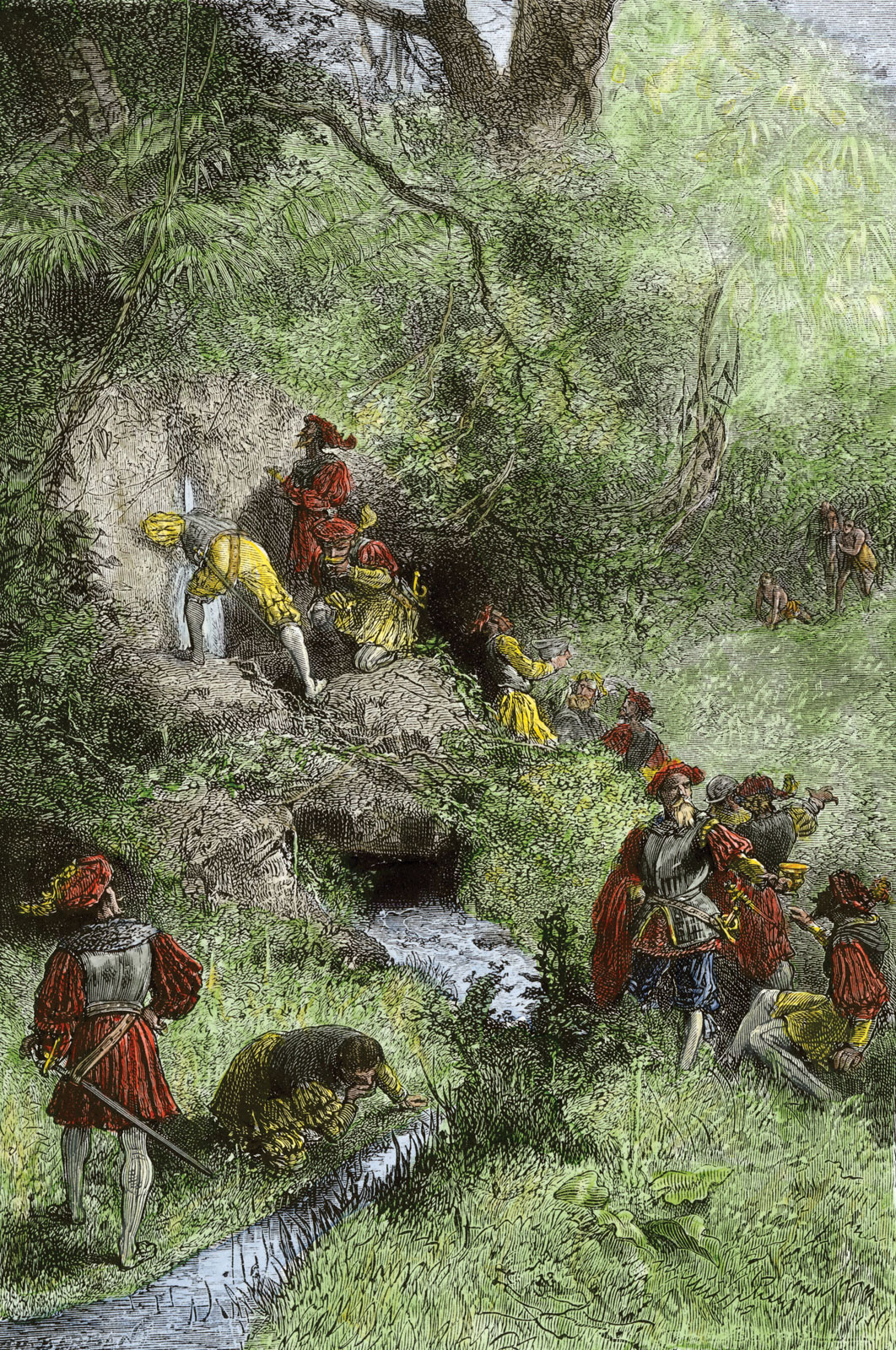
- Juan Ponce de León's link to the fountain was added by later writers.
- Artworks depict elderly people bathing in pools to become young again.
What it is
This legend describes a magical spring whose waters grant eternal youth or reverse the aging process. People who drink or bathe in these waters are said to become young again and free from sickness. The story appears in many cultures as a symbol of the human desire to live forever. It is not a real place but a recurring theme in stories and art that explores the fear of death and the hope for renewal.
Where it comes from
The idea of life-giving water dates back thousands of years. Early versions appear in the Babylonian Epic of Gilgamesh, where the hero seeks a plant to regain youth. Herodotus wrote about a long-lived people in Africa who used special water. These tales traveled through Europe and Asia, mixing with local beliefs and creating new versions of the legend over centuries.
How it is done
Instead, the legend involves explorers searching for hidden springs in remote or dangerous places. In some stories, seekers must travel through dark lands or cross deadly waters. The act of discovery is often accidental, such as when a cook washes a fish that comes back to life, revealing the spring's location to the seeker.
Tools and materials
No physical tools are required to use the fountain. The essential element is the water itself, which may come from a river, a lake, or a hidden spring. In some artistic depictions, the fountain is shown as a pool surrounded by crystal or marble, with sculptures of animals like lions. The water is sometimes described as having a pleasant scent or unique properties, such as being too weak to float objects.
Fountain of Youth, drawn and placed
- Living
- Revived
- Fading
- Historical
- Legendary
- Performed
- Lineage
- Irish mythology
What it is for
People seek the fountain to cure diseases, heal wounds, and stop the aging process. It is also desired for its ability to grant immortality, allowing individuals to live indefinitely. In religious and mythological contexts, the water represents divine wisdom or a connection to the gods. Explorers historically looked for it as a way to gain power and prestige, believing it would make them invincible.
Who does it
The legend does not have dedicated practitioners. It is primarily a subject of study for historians and scholars who trace its evolution through literature and art. Explorers like Juan Ponce de León were associated with the search, though they did not necessarily believe in the fountain themselves. Indigenous peoples in the Caribbean spoke of similar lands, but these were part of their broader geographic knowledge rather than a formal practice.
Peoples and places
The story appears in many cultures. Ancient Greeks and Babylonians told tales of life-giving waters. African groups like the Macrobians were said to possess longevity through special springs. In the Caribbean, Arawak people spoke of a land called Bimini, which later explorers conflated with the fountain legend. Spanish conquistadors brought the story to the Americas, where it became linked to Florida and the Bahamas.
At a glance: who, where and when
Peoples


What people believe
The fountain represents the belief that nature holds secrets capable of overcoming human mortality. In some traditions, the water is connected to sacred sites like the Garden of Eden or the confluence of two seas. It is often guarded by demons or located in inaccessible places, reflecting the idea that eternal life is reserved for the gods. The legend serves as a metaphor for the spiritual quest for purity and wisdom.
When it is done
There are no specific festivals or calendar days associated with the fountain. However, it was popular during the Age of Exploration, when European navigators searched for new worlds. Artworks depicting the fountain were created throughout the medieval and Renaissance periods, reflecting the enduring interest in the theme.
How scholars and sceptics see it
Historians note that the fountain legend evolved from earlier myths about immortality. Scholars point out that Juan Ponce de León likely did not search for the fountain, as his own writings do not mention it. The connection was added later by chroniclers who wanted to dramatize his voyages. Researchers view the story as a cultural construct that reflects European anxieties about aging and death, rather than a historical event.
Cautions and what is closed
The legend has been used to justify colonial expansion and the exploitation of indigenous lands. Explorers claimed territories based on false reports of magical resources. There are no known harms associated with the fountain itself, as it is fictional. However, the pursuit of such myths led to violence and displacement of native populations who were forced to reveal the locations of real springs and rivers.
Compare and confuse
The fountain is similar to other mythical remedies like the Philosopher's Stone or the Elixir of Life. These all represent the desire to conquer death. In different cultures, the same motif appears as a magical plant, a holy spring, or a divine gift. The name Bimini is often confused with other mythical islands, showing how legends merge and change as they spread across regions.
Questions people ask about Fountain of Youth
What is the Fountain of Youth?
It is a mythical spring believed to restore youth and cure illness. Stories of such waters appear in ancient literature and folklore worldwide, symbolizing the desire for eternal life.
Where does the legend come from?
The legend has roots in ancient Babylonian, Greek, and African stories. It evolved through medieval European tales and was later associated with Caribbean geography and Spanish exploration.
Did Juan Ponce de León really search for it?
His own writings do not mention the fountain. The connection was made by later chroniclers who wanted to add drama to his expedition, suggesting he sought the waters of Bimini.
What is Bimini?
Bimini was a mythical land mentioned by Caribbean indigenous people. Explorers conflated it with the fountain legend, placing it in the Bahamas or Florida, though it likely referred to real places in Yucatán.
Good reading and sources
- Fountain of Youth on WikipediaEncyclopedia
- More photos on Wikimedia CommonsPhotos and video
- Wikidata recordOpen data
The facts on this page come from the Wikipedia article "Fountain of Youth", written by its contributors and used under the CC BY-SA 4.0 licence, and from its Wikidata record (CC0). EveryJaadu rewrote the text in its own words, with AI assistance, and compares every page with the article to make sure no passage is copied. It may be reused under the same CC BY-SA 4.0 licence with a link back.
It may contain mistakes. Names and customs differ from one community to the next, and some knowledge is closed to outsiders and left out here. This page describes belief and practice. It does not say that any of it works, it is not a how-to, and it is not medical advice. If something is wrong, tell us. Last refreshed 2026-10-05.
More from India
All the entries from India 🇮🇳 India and 5 moreAstrology
A divinatory practice that reads human fate through the positions of celestial bodies.Belief · Seeing and foretelling · Luck and prosperity Living
🇮🇳 India and 5 moreAstrology
A divinatory practice that reads human fate through the positions of celestial bodies.Belief · Seeing and foretelling · Luck and prosperity Living
 🇮🇳 IndiaChakraचक्र
Meditation points in the subtle body used in Hindu and Buddhist yogaTradition · Speaking with spirits and the dead · Change and initiation Living
🇮🇳 IndiaChakraचक्र
Meditation points in the subtle body used in Hindu and Buddhist yogaTradition · Speaking with spirits and the dead · Change and initiation Living
 🇹🇷 Turkey and 5 moreEvil eye
A curse believed to be cast by a jealous glare and the charms used to stop itBelief · Protection Living
🇮🇳 IndiaPanchagavya
A fermented mixture of five cow products used in Hindu rituals and Ayurvedic traditions.Substance · Cleansing and purification · Healing Living
🇹🇷 Turkey and 5 moreEvil eye
A curse believed to be cast by a jealous glare and the charms used to stop itBelief · Protection Living
🇮🇳 IndiaPanchagavya
A fermented mixture of five cow products used in Hindu rituals and Ayurvedic traditions.Substance · Cleansing and purification · Healing Living
Related elsewhere
All belief 🇫🇷 FranceHoly GrailSaint Graal
A cup or stone from Arthurian tales that grants healing and eternal lifeFigure · Healing · Luck and prosperity Legendary
🇫🇷 FranceHoly GrailSaint Graal
A cup or stone from Arthurian tales that grants healing and eternal lifeFigure · Healing · Luck and prosperity Legendary
 🇺🇦 Ukraine and 5 moreMugwortчорнобиль (chornóbyl')
An aromatic herb used in folk medicine, cooking, and magical protection across Eurasia.Substance · Protection · Healing Living
🇺🇦 Ukraine and 5 moreMugwortчорнобиль (chornóbyl')
An aromatic herb used in folk medicine, cooking, and magical protection across Eurasia.Substance · Protection · Healing Living
 🇲🇦 Morocco and 5 moreWild rueاسپند
A desert plant whose seeds hold psychoactive alkaloids and serve as incense in the Middle East.Substance · Protection · Speaking with spirits and the dead Living
🇲🇦 Morocco and 5 moreWild rueاسپند
A desert plant whose seeds hold psychoactive alkaloids and serve as incense in the Middle East.Substance · Protection · Speaking with spirits and the dead Living