Deity yoga
from Sanskrit devatayoga, meaning union with a deity
A Vajrayana meditation on embodying a chosen Buddha figure to realize emptiness
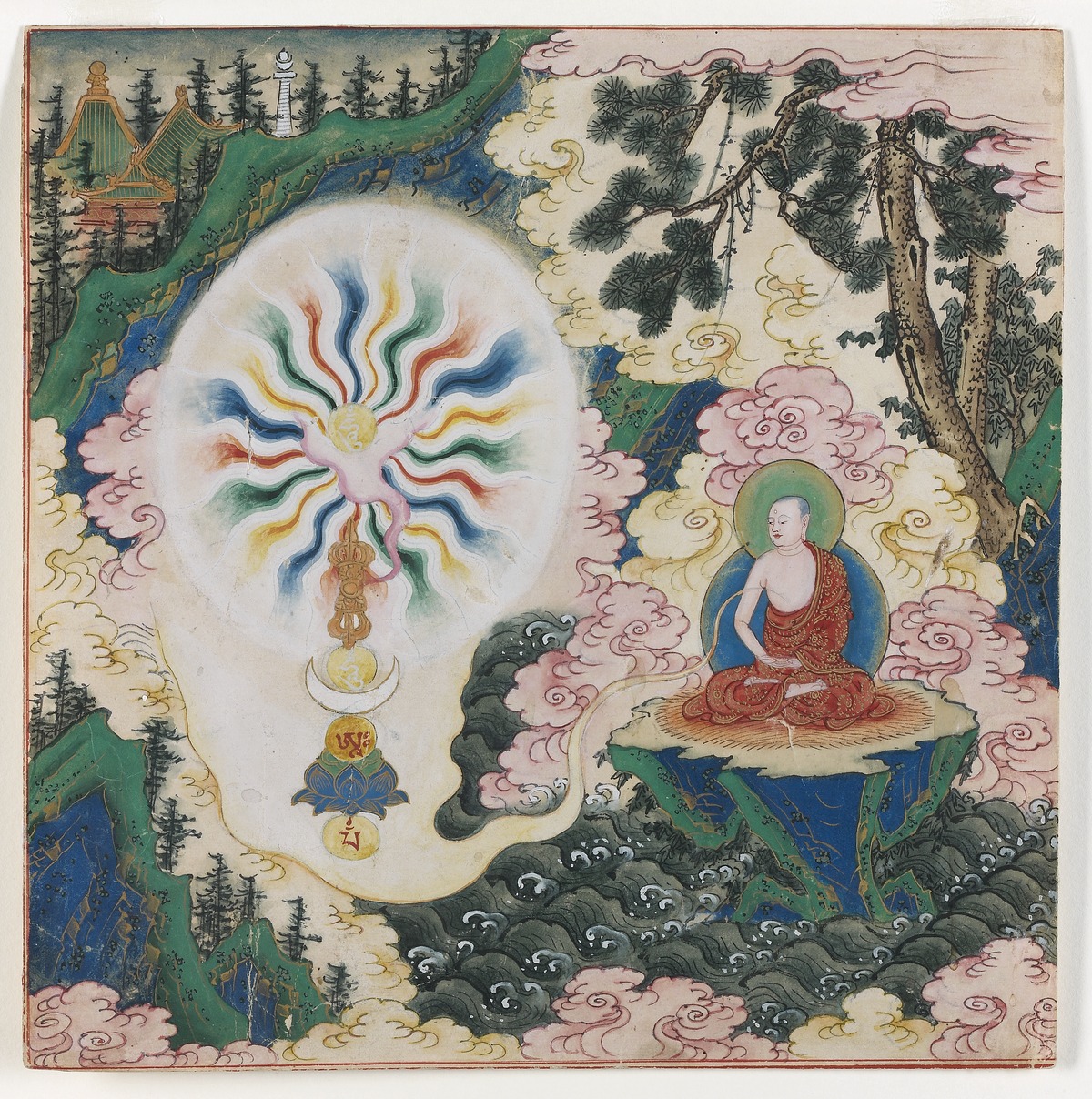
Deity yoga is the central meditation of Vajrayana Buddhism. Practitioners visualize a chosen deity and recite mantras to align their own body, speech, and mind with enlightened qualities. The goal is to realize that the self and the deity are fundamentally non-dual.
- Deity yoga is the central practice of Vajrayana Buddhism.
- It involves visualizing a chosen deity and reciting mantras.
- Tsongkhapa called it the distinctive feature of Tantra.
- Practitioners aim to realize non-duality between self and deity.
- Mandalas serve as visual aids representing sacred spaces.
What it is
Deity yoga, or devatayoga, is the fundamental practice of Vajrayana and Tibetan tantra. It centers on a chosen deity, known as a yidam or cherished divinity. The practice involves reciting mantras and prayers while visualizing the deity and their sacred mandala. Tsongkhapa, a fourteenth-century scholar, identified this as the key feature distinguishing Tantra from Sutra-based paths. The method aims to transform ordinary perception into an enlightened view by aligning the practitioner's body, speech, and mind with the deity's qualities.
Where it comes from
The practice originated in India and was later systematized by commentators like Buddhaguhya around seven hundred CE. It spread to Tibet and other regions, becoming a core component of Vajrayana Buddhism. The techniques were refined over centuries, with scholars like Tsongkhapa providing detailed frameworks for understanding its stages and purposes within the broader context of Buddhist philosophy.
How it is done
Practitioners engage in two main stages: generation and completion. In the generation stage, they dissolve ordinary perception and re-imagine reality through the form of the deity, visualizing them as empty yet apparent like a mirage. This includes front-generation, where the deity appears before the meditator, and self-generation, where the practitioner imagines themselves as the deity. Mantras are recited, often while focusing on seed syllables at the heart. The completion stage follows, involving practices like dream yoga and working with subtle body energies to realize the nature of mind directly.
Tools and materials
Visual aids such as statues (murti), paintings (thangka), and mandalas support visualization. Mandalas represent both sacred spaces and inner human workings. Ritual implements include the vajra, bell, hand-drum (damaru), and ritual dagger (phurba). Mudras, or hand gestures, and specific chanting techniques create a specialized environment for practice. These tools carry elaborate symbolic meanings to aid in the transformation of perception.
Deity yoga, drawn and placed
- Living
- Revived
- Fading
- Historical
- Legendary
- Performed
- Lineage
- Vajrayana Buddhism
- Timing
- during meditation sessions
What it is for
The ultimate purpose is to realize the non-dual nature of self and deity, understanding that both are empty of inherent existence. This realization undermines habitual grasping at a solid reality and purifies spiritual obscurations. Divine pride, grounded in compassion and emptiness, protects practitioners from ordinary pride and attachments. The practice transforms how one views appearances, seeing them as manifestations of luminous mind rather than fixed entities.
Who does it
The practitioner, or sadhaka, undergoes rigorous training to master visualization and mantra recitation. They must establish a view realizing emptiness before attempting advanced self-generation practices. Training involves stabilizing the mind, often using breath control and focus on subtle objects. Scholars and commentators have documented these methods, emphasizing the need for proper guidance to navigate the spiritual risks associated with higher tantric practices.
Peoples and places
Deity yoga is practiced within Vajrayana communities, with roots in India and significant development in Tibet and Japan. Different lineages may emphasize specific deities or methods, such as the Six Dharmas of Naropa or the Six Yogas of Kalachakra. The practice adapts to cultural contexts while maintaining core philosophical principles centered on emptiness and compassion. Scholars study these traditions to understand their historical evolution and psychological dimensions.
At a glance: who, where and when


What people believe
The worldview underlying deity yoga posits that all phenomena are empty of inherent existence but appear dependently. Deities are not external gods but expressions of ultimate truth and enlightened qualities. Divine pride arises from recognizing one's own buddha nature, which is intrinsically pure. This belief system rejects dualistic thinking, aiming instead for a direct experience of non-duality where self and deity are seen as inseparable.
Questions people ask about Deity yoga
What is deity yoga?
Deity yoga is a Vajrayana Buddhist meditation practice focused on a chosen deity. Practitioners visualize the deity and recite mantras to align their own qualities with enlightened attributes, aiming to realize the non-dual nature of reality.
Where does deity yoga come from?
It originates from Indian Buddhist tantra and was systematized by commentators like Buddhaguhya. It spread to Tibet and Japan, becoming a core practice in Vajrayana traditions, with scholars like Tsongkhapa refining its theoretical framework.
How is deity yoga practiced?
It involves two stages: generation and completion. Practitioners visualize deities and mandalas, recite mantras, and use ritual implements. The goal is to transform ordinary perception into an enlightened view through sustained meditation and mindfulness.
Good reading and sources
The facts on this page come from the Wikipedia article "Deity yoga", written by its contributors and used under the CC BY-SA 4.0 licence, and from its Wikidata record (CC0). EveryJaadu rewrote the text in its own words, with AI assistance, and compares every page with the article to make sure no passage is copied. It may be reused under the same CC BY-SA 4.0 licence with a link back.
It may contain mistakes. Names and customs differ from one community to the next, and some knowledge is closed to outsiders and left out here. This page describes belief and practice. It does not say that any of it works, it is not a how-to, and it is not medical advice. If something is wrong, tell us. Last refreshed 2026-10-06.
More from India
All the entries from India 🇮🇳 IndiaChakraचक्र
Meditation points in the subtle body used in Hindu and Buddhist yogaTradition · Speaking with spirits and the dead · Change and initiation Living
🇮🇳 IndiaChakraचक्र
Meditation points in the subtle body used in Hindu and Buddhist yogaTradition · Speaking with spirits and the dead · Change and initiation Living
 🇮🇳 IndiaMahakaleshwar JyotirlingaMahākāleśvara
A sacred Shiva shrine in Ujjain, India, known for its south-facing idol and ancient origins.Tradition · Protection · Power and authority Living
🇮🇳 IndiaMahakaleshwar JyotirlingaMahākāleśvara
A sacred Shiva shrine in Ujjain, India, known for its south-facing idol and ancient origins.Tradition · Protection · Power and authority Living
 🇮🇳 India and 5 moreKolamகோலம்
A daily geometric floor drawing made with rice flour at the home entrance in South IndiaTradition · Protection · Luck and prosperity Living
🇮🇳 India and 5 moreKolamகோலம்
A daily geometric floor drawing made with rice flour at the home entrance in South IndiaTradition · Protection · Luck and prosperity Living
 🇮🇳 India and 5 moreHoliहोली
A Hindu spring festival marked by coloured powders and bonfires to celebrate love and virtue.Tradition · Love and attraction · Cursing and harm Living
🇮🇳 India and 5 moreHoliहोली
A Hindu spring festival marked by coloured powders and bonfires to celebrate love and virtue.Tradition · Love and attraction · Cursing and harm Living
Related elsewhere
All tradition 🇬🇧 United Kingdom and 5 moreAleister Crowley
English occultist and founder of the religion of ThelemaText · Power and authority · Change and initiation Living
🇨🇳 China and 3 moreQi氣 / 气
A vital force in Chinese philosophy and medicine, believed to flow through all living things.Substance · Healing · Power and authority Living
🇬🇧 United Kingdom and 1 moreChaos magic
A modern magical system that treats belief as a flexible tool rather than a fixed truth.Tradition · Change and initiation · Power and authority Living
🇬🇧 United Kingdom and 5 moreAleister Crowley
English occultist and founder of the religion of ThelemaText · Power and authority · Change and initiation Living
🇨🇳 China and 3 moreQi氣 / 气
A vital force in Chinese philosophy and medicine, believed to flow through all living things.Substance · Healing · Power and authority Living
🇬🇧 United Kingdom and 1 moreChaos magic
A modern magical system that treats belief as a flexible tool rather than a fixed truth.Tradition · Change and initiation · Power and authority Living
 🇪🇬 Egypt and 5 moreHermetica
A collection of ancient texts attributed to Hermes Trismegistus, covering magic, alchemy and philosophy.Text · Seeing and foretelling · Change and initiation Historical
🇪🇬 Egypt and 5 moreHermetica
A collection of ancient texts attributed to Hermes Trismegistus, covering magic, alchemy and philosophy.Text · Seeing and foretelling · Change and initiation Historical