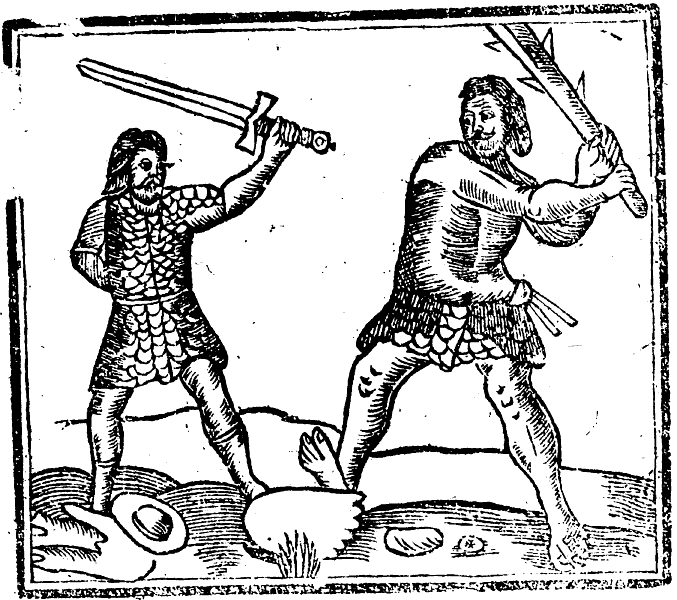
Colbrand is a figure from English folklore, described as a giant champion for invading northern kings. He was slain in single combat by Guy of Warwick to save Winchester, an event tied to the Matter of England romances.
- Colbrand was a legendary giant and Danish champion.
- He was slain by Guy of Warwick in single combat.
- The duel took place at Hyde Mead in Winchester.
- Shakespeare mentioned Colbrand in Henry VIII and King John.
- The name became a nickname for large people by the 1700s.
What it is
Colbrand appears in English folklore as a giant and military champion. He serves as the primary antagonist in the legend of Guy of Warwick, a heroic figure central to the Matter of England literary tradition. The narrative positions Colbrand as a formidable warrior whose defeat establishes the hero's status. This story circulated widely across England and France between the thirteenth and seventeenth centuries. The character functions as a mythic obstacle within these medieval romances.
Where it comes from
The legend originates from the romance of Sir Guy, which gained popularity during the late medieval period. The tale recounts Guy's return to England after a long absence. His mission involves delivering the city of Winchester to King Athelstan. To achieve this, Guy must defeat the invading forces led by Anelaph and Gonelaph. Colbrand acts as their designated champion in single combat. The specific location of this duel is fixed by local tradition at Hyde Mead, situated near the Abbey in Winchester.
How it is done
The confrontation occurs through formal single combat rather than a general battle. Guy of Warwick challenges Colbrand directly to settle the fate of Winchester. This act of violence is presented as the decisive moment that secures the city for the English king. The tradition maintains that the sword used for this deed was preserved and cared for by the royal household under Henry VIII.
Tools and materials
The legend highlights a specific weapon associated with the giant's defeat. A sword used to slay Colbrand became a notable object of preservation. During the reign of Henry VIII, a custodian named William Hoggenson received a daily wage to maintain this item. The sword represents the physical instrument of the hero's victory. No other magical tools or ritual objects are mentioned in the surviving accounts of the duel.
Colbrand, drawn and placed
- Living
- Revived
- Fading
- Historical
- Legendary
- Performed
- Lineage
- Matter of England
What it is for
The duel serves a political and territorial purpose within the narrative. It allows Guy of Warwick to prove his worth and secure Winchester for King Athelstan. The defeat of the giant removes the threat posed by the invading northern kings. Later cultural usage transformed the name into a nickname for individuals of considerable size or strength. This semantic shift occurred by the eighteenth century, appearing in literature such as Samuel Richardson's novel Pamela.
Who does it
Guy of Warwick is the sole practitioner of the martial skill required to defeat Colbrand. He is portrayed as a legendary English hero capable of overcoming supernatural odds. The narrative does not detail his training but presents him as the chosen defender of Winchester. The preservation of the giant-slaying sword involved a yeoman of the buttery, indicating a courtly interest in the relic. Shakespeare later referenced the character in his historical plays, cementing the figure in literary memory.
Peoples and places
The legend is primarily rooted in English folklore and the Matter of England cycle. It features Danish invaders, identifying Colbrand as a northern champion. The story resonated in both England and France during its peak popularity. The character evolved beyond the original romance to become a generic term for a large person in English culture. This adaptation shows how folk figures can transcend their original narrative context to influence language and social perception.
At a glance: who, where and when
What people believe
The figure exists within the framework of medieval romance and folklore. He represents the archetypal monstrous opponent that the national hero must overcome. The belief in his existence is tied to local traditions in Winchester, which claim the site of the duel. Scholars view the story as part of a broader literary tradition rather than historical fact. The persistence of the name suggests a cultural fascination with giants and heroic combat in English storytelling.
When it is done
No specific festivals or calendar dates are associated with the legend of Colbrand. The events are set within a vague historical timeframe involving King Athelstan. The preservation of the sword continued into the Tudor period under Henry VIII. There are no recorded annual rites or seasonal celebrations dedicated to the giant or his defeat. The story remains a static narrative element within the larger Guy of Warwick cycle.
How scholars and sceptics see it
Scholars classify the story of Sir Guy as part of the Matter of England. This places it alongside other national legends distinct from Arthurian cycles. Researchers note the widespread circulation of the romance in England and France. The literary analysis focuses on the hero's journey and the defeat of foreign threats. The evolution of the name into a common noun is studied as a linguistic phenomenon in eighteenth-century literature.
Cautions and what is closed
The legend contains violent imagery involving the slaying of a giant. However, it is treated as fictional entertainment and folklore. There are no reports of harm associated with the practice of telling the story. The preservation of the sword was a matter of royal curiosity rather than religious veneration. Modern readers encounter the figure primarily through literary references and historical studies of folklore.
Compare and confuse
Colbrand is similar to other giant figures in European folklore who serve as antagonists to heroes. He differs from mythological giants by being grounded in a specific national romance. The name's evolution parallels other eponyms derived from legendary strongmen. Unlike purely mythical beings, Colbrand is tied to a specific geographic location in Winchester. This localisation distinguishes him from more abstract supernatural entities.
Questions people ask about Colbrand
Who is Colbrand?
Colbrand is a legendary giant from English folklore. He serves as the champion for invading northern kings in the romance of Guy of Warwick. He is best known for being defeated in single combat by the hero Guy.
Where did the fight happen?
Local tradition places the duel at Hyde Mead, near the Abbey in Winchester, England. This location is cited as the site where Guy of Warwick slew the giant to deliver the city to King Athelstan.
What happened to the sword?
The sword used to slay Colbrand was preserved as a relic. Under Henry VIII, a custodian received a daily wage to look after it. This indicates the object held significant interest for the royal household.
Is Colbrand a real person?
Colbrand is considered a figure of legend and folklore. Scholars view the story as part of the Matter of England literary tradition. He is not regarded as a historical individual but as a character in medieval romance.
Good reading and sources
- Colbrand (giant) on WikipediaEncyclopedia
- More photos on Wikimedia CommonsPhotos and video
- Wikidata recordOpen data
The facts on this page come from the Wikipedia article "Colbrand (giant)", written by its contributors and used under the CC BY-SA 4.0 licence, and from its Wikidata record (CC0). EveryJaadu rewrote the text in its own words, with AI assistance, and compares every page with the article to make sure no passage is copied. It may be reused under the same CC BY-SA 4.0 licence with a link back.
It may contain mistakes. Names and customs differ from one community to the next, and some knowledge is closed to outsiders and left out here. This page describes belief and practice. It does not say that any of it works, it is not a how-to, and it is not medical advice. If something is wrong, tell us. Last refreshed 2026-10-07.
More from the United Kingdom
All the entries from the United Kingdom 🇬🇧 United Kingdom and 2 moreKing ArthurBrenin Arthur
A legendary British king and folk hero of medieval literature and Welsh mythologyFigure · Power and authority · Wonder and entertainment Legendary
🇬🇧 United Kingdom and 2 moreKing ArthurBrenin Arthur
A legendary British king and folk hero of medieval literature and Welsh mythologyFigure · Power and authority · Wonder and entertainment Legendary
 🇬🇧 United KingdomMatthew Hopkins
The English witch-hunter who led the deadliest wave of executions in Britain.Figure · Cursing and harm Historical
🇬🇧 United KingdomMatthew Hopkins
The English witch-hunter who led the deadliest wave of executions in Britain.Figure · Cursing and harm Historical
 🇬🇧 United Kingdom and 2 moreExcalibur
The mythical sword of King Arthur, symbolizing rightful sovereignty and magical power.Figure · Power and authority Legendary
🇬🇧 United Kingdom and 1 moreSamuel Liddell MacGregor Mathers
British occultist and co-founder of the Hermetic Order of the Golden DawnFigure Historical
🇬🇧 United Kingdom and 2 moreExcalibur
The mythical sword of King Arthur, symbolizing rightful sovereignty and magical power.Figure · Power and authority Legendary
🇬🇧 United Kingdom and 1 moreSamuel Liddell MacGregor Mathers
British occultist and co-founder of the Hermetic Order of the Golden DawnFigure Historical
Related elsewhere
All figure 🇪🇬 Egypt and 1 moreLilithלִילִית
A feminine figure from Mesopotamian and Jewish mythology, often depicted as a night demon or spirit.Being · Cursing and harm Legendary
🇬🇧 United KingdomGiles Corey
An English-born farmer pressed to death for refusing to plead during the Salem witch trialsFigure Historical
🇪🇬 Egypt and 1 moreLilithלִילִית
A feminine figure from Mesopotamian and Jewish mythology, often depicted as a night demon or spirit.Being · Cursing and harm Legendary
🇬🇧 United KingdomGiles Corey
An English-born farmer pressed to death for refusing to plead during the Salem witch trialsFigure Historical
 🇨🇳 China and 2 moreEight Immortals八仙
Eight legendary Taoist figures of China, each with a power and a vesselFigure · Protection · Healing Living
🇪🇬 EgyptDjedi
A fictional magician from the Westcar Papyrus who resurrects animals and foretells a king's lineage.Figure · Seeing and foretelling · Wonder and entertainment Legendary
🇨🇳 China and 2 moreEight Immortals八仙
Eight legendary Taoist figures of China, each with a power and a vesselFigure · Protection · Healing Living
🇪🇬 EgyptDjedi
A fictional magician from the Westcar Papyrus who resurrects animals and foretells a king's lineage.Figure · Seeing and foretelling · Wonder and entertainment Legendary