
Akelarre
Basque aker, 'buck goat', plus larre, 'meadow'; a rival reading takes alka, a herb name
The Basque name for a witches' sabbath, an assembly said to answer to a black he-goat
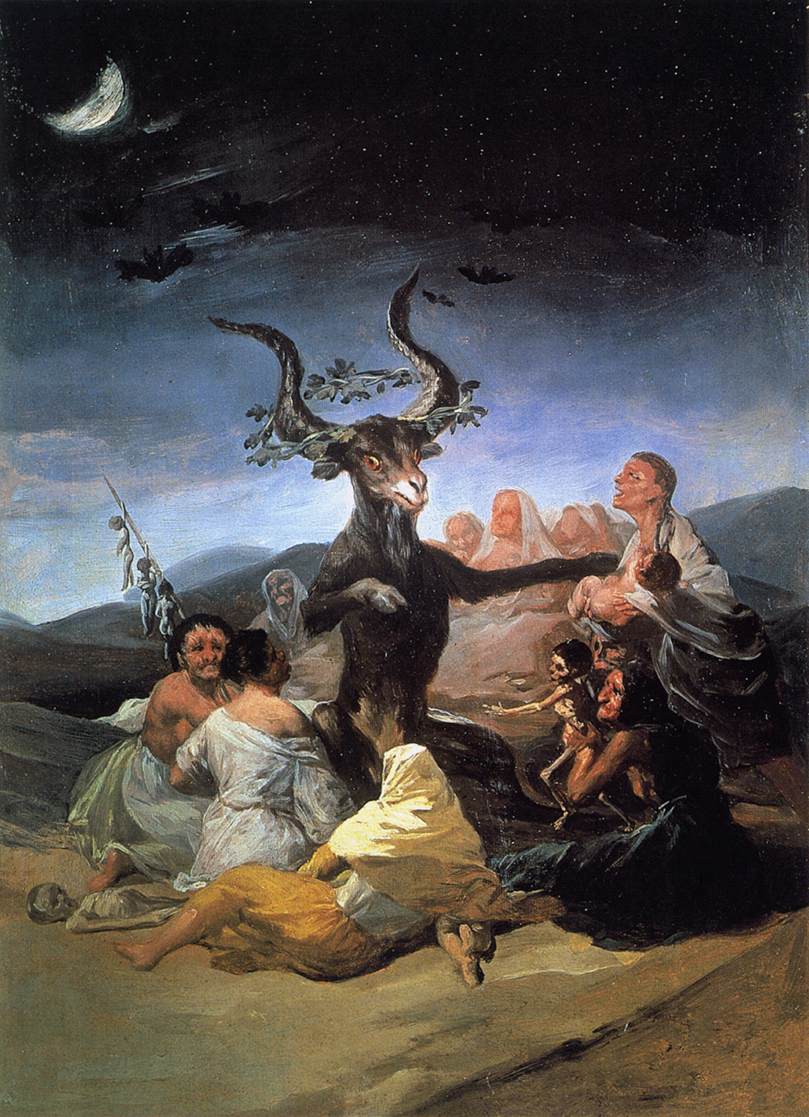
Akelarre is the Basque term for a witches' sabbath, a gathering of practitioners imagined under the rule of a male goat. Borrowed into Spanish as Aquelarre during the seventeenth-century Navarrese witch trials, it is now best known from Goya's painting in the Prado.
- Aker means buck goat in Basque; the imagined sabbath gathered under one
- First recorded in 1609 in an inquisitorial briefing as junta diabólica
- The 1610 Logroño hunt accused about 300 people; 12 died by fire
- Goya's El Aquelarre in the Prado shows witches with a huge he-goat
- A stone of Roman times carries a dedication 'to the god Aherbelts'
What it is
Akelarre names the gathering that witch beliefs in the Basque Country placed at the centre of witchcraft: an assembly under the rule of a he-goat. The word pairs aker, the Basque for a buck goat, with larre, a meadow, though that reading is contested. Castilian Spanish borrowed it as Aquelarre and has used it since the Navarrese prosecutions of the seventeenth century. Its earliest record, in 1609, is a Spanish briefing for inquisitors that offers it as another name for a junta diabólica, an assembly of the devil's people. The term is fixed in the wider imagination by Francisco Goya's canvas in the Prado, which stages witches around an enormous goat. Behind it stands Akerbeltz, the black he-goat of Basque legend, tied to the goddess Mari.
Where it comes from
The oldest surviving use is dated 1609: a Spanish briefing paper for inquisitors listing akelarre as a synonym for junta diabólica. Basque words were often set down in Spanish texts by copyists who spoke no Basque, and such transcriptions were prone to error. The usual explanation reads the word as the field of the buck goat, aker plus larre, which suits the goat-led sabbath. A rival reading takes the first part as alka, the district's name for the herb Dactylis hispanica, making it a herb meadow instead; on that view the goat story was an inquisitorial invention, and Basques caught up in the persecutions of 1609 to 1612 did not even know what the inquisitors' term meant. Either way, the big Navarrese trials seem to have fixed akelarre in everyday speech in both languages.
How it is done
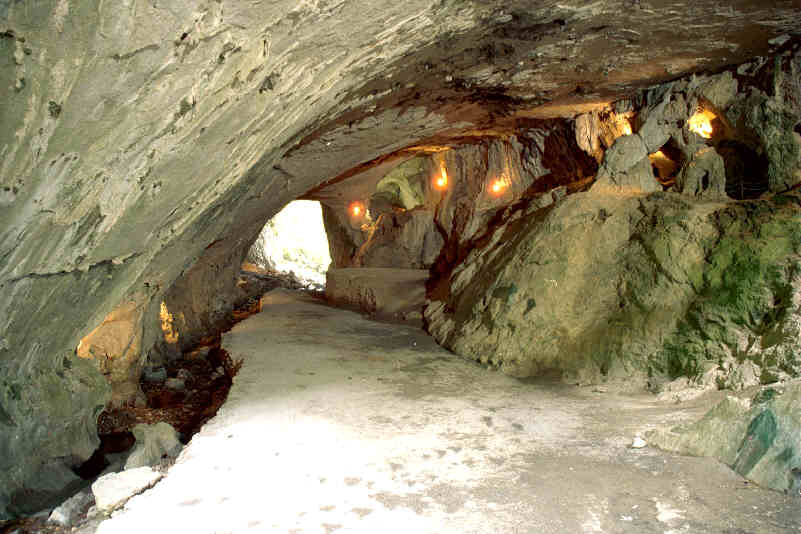
Records and folklore describe the assembly as taking place at wild sites: the great cave at Zugarramurdi, fields, springs and mountain tops. At Zugarramurdi the meeting is said to have happened outside the cave itself, at a spot named Berroskoberro, where a hole in the rock served as the goat's mouthpiece. Historian Emma Wilby's study of the Navarrese suspects shows their accounts followed no single template: descriptions of the akelarre wove together folk magic, medicines made in common, club-like fellowship meetings, and Catholic forms bent out of shape, including masses spoken as curses and rites turned to mockery. In the Catalan version, the hilltop gathering was credited with the storms that battered the plains below.
Tools and materials
The goat is the central figure: Akerbeltz, the black he-goat, stands in Basque mythology beside the goddess Mari, and a stone carved in Roman times with the Aquitanian dedication Aherbelts Deo, 'to the god Aherbelts', shows a goat divinity honoured long before the trials. The ground carries meaning too. Field and cave names mark meeting spots across the provinces: dancing grounds, witches' holes and creeks, a partridge field, a sinful meadow, and a pleasure orchard that inquisitorial records say the accused themselves named, beside a site belonging to Basajaun, the forest's wild man.
Akelarre, drawn and placed
- Living
- Revived
- Fading
- Historical
- Legendary
- Performed
- Lineage
- Basque mythology
What it is for
In inquisitorial eyes the assembly served the devil, and honouring a goat counted as reverence for Satan. The beliefs as people held them gave the nights other work. Witches were said to send storms from the Catalan peak of Canigou onto the lowland plains. Among the Navarrese suspects' own accounts, curses sat beside healing, since medicine made in common was part of what they described. One field in Errenteria was remembered as a pleasure orchard, the name the accused themselves used, hinting at festivity alongside fear. What survives comes from interrogation records, briefings and local sayings, all passed through inquisitorial hands.
Who does it
The people brought before the tribunal were villagers of Navarre and its borderlands rather than a trained priesthood; some 300 stood accused in 1610. Basque tradition calls its witches sorginak. Their knowledge, as Emma Wilby reads it, grew from ordinary life: herbal work done together, parish ritual known from the inside, gatherings like small brotherhoods. On the other side stood the lawyers of the Logroño tribunal, who shaped what was written down; the same years had French counterparts in hunts run by Pierre de Lancre. Later students include Julio Caro Baroja, whose book The World of the Witches argues that Basque witchcraft owes its fame to this one hunt.
Peoples and places
The akelarre belongs to the Basque Country: sites are recorded in Biscay, Gipuzkoa, Alava and Navarre, and the mountains Larrun and Jaizkibel drew witches from villages on either side of the border, Bera in Navarre and Sara and Azkaine in Lapurdi. At Jaizkibel the inquisitors heard of gatherings close to Santa Barbara's church, and local sayings put sabbaths on three bridges, Mendelu, Santa Engrazi and Puntalea. The same belief in mountain gatherings runs along the Pyrenees into Aragon, Catalonia and Occitania, where shepherds, moving flocks each year between summer pasture and winter lowland in the pattern called transhumance, carried the stories with them. Related sites appear as far off as the Anaga massif on Tenerife and the cave of Salamanca.
At a glance: who, where and when
Belief worlds

What people believe
The worldview mixes Basque legend with inquisitorial fears. The black he-goat Akerbeltz belongs to Basque mythology as an emblem of the goddess Mari, and a stone of the Roman period bearing the dedication Aherbelts Deo points to a goat god honoured in Aquitanian times, before Christianity reached the region. Under the Inquisition this figure merged with Satan, and goat-worship was read as devil-worship. The landscape is peopled as well: Basajaun, the forest's wild man, gives his name to a meeting ground, and the gathering places themselves, holes, creeks, dancing fields and springs, sketch a countryside where caves and hilltops belonged to night assemblies and spirit beings.
How scholars and sceptics see it
Julio Caro Baroja's The World of the Witches treats the 1610 hunt as the reason Basque witchcraft is famous at all, ranking it among Europe's most notorious persecutions, and holds the trials responsible for turning akelarre into a general word for the sabbath. Emma Wilby's more recent work shifts attention from the machinery of prosecution to the suspects themselves: their testimony, she finds, drew on a wide stock of experience, from everyday folk magic and shared medicine-making to fellowship meetings and Catholic religious theatre, including liturgy enacted askew and masses aimed as curses. On the word's origin, scholarship divides between the goat-meadow reading and the herb reading, the latter implying that inquisitorial translators bent a Basque word to fit their charges.
Cautions and what is closed
The human cost of the 1610 proceedings was heavy. About 300 people stood accused across Zugarramurdi and neighbouring villages; 40 were taken to Logroño, and 12 were put to death by fire at Zugarramurdi. Five of the twelve had already died under torture, so figures burned in their place. The episode ranks among the most notorious witch-hunts in Europe, and Julio Caro Baroja calls it the reason Basque witchcraft is known at all. The record itself is distorted: Basque terms passed through Spanish copyists who did not speak the language, and the accused apparently did not know what the inquisitors' key word meant. Everything about the gatherings reaches us through accusations and testimony.
Compare and confuse
Castilian writes the name Aquelarre; the 1609 briefing pairs it with junta diabólica, an assembly of devils. Neighbouring lands keep their own titles for such nights: Catalonia says Ajunt de Bruixes, best known on Canigou, and sabbath grounds appear in Aragon, Occitania, on Tenerife and at the cave of Salamanca. Basque witches themselves are called sorginak.
Law and persecution
The affair sat in the hands of the Spanish Inquisition, whose Logroño tribunal opened the big Navarrese hunt in 1610, covering Zugarramurdi and the villages around it. Roughly 300 people were accused of witchcraft and 40 were carried off to Logroño for judgment; the persecution period stretched from 1609 to 1612. Inquisitors had earlier levelled a charge of goat-worship, which they tied to Satan. On the French side of the mountains, the same years saw hunts run by Pierre de Lancre.
Today
The loanword has stayed in Castilian since the trials of the early seventeenth century, and the name also titles a role-playing game. Goya's El Aquelarre in the Prado keeps the image of the goat-led gathering before the public eye. At Zugarramurdi the great cave, Akelarrenlezea, can still be walked: its widest chamber spans about 120 metres, the river of 'hell' has worn the floor down until the roof stands some twelve metres up, and an eighteenth-century lime oven, once used by farmers, remains inside. From the main chamber one can enter the smaller cave of the Akelarre.
Questions people ask about Akelarre
What is an akelarre?
In Basque belief it is the witches' sabbath, a gathering of practitioners imagined under a male goat. The word pairs aker, buck goat, with larre, meadow, though a rival reading makes it a herb meadow. Spanish borrowed it as Aquelarre.
Where does the word come from?
It is Basque, first written down in 1609 in a briefing for the Spanish Inquisition as another name for a junta diabólica, an assembly of devils. It entered Castilian Spanish around the Navarrese trials and remains in the language today.
Did the gatherings actually take place?
The trials and executions at Zugarramurdi are documented history. What the accused described, historian Emma Wilby finds, drew on folk magic, shared medicine-making, fellowship meetings and Catholic rites bent to parody, so the accounts blend many strands of village life.
Who is the goat?
He is Akerbeltz, the black he-goat of Basque mythology, an emblem of the goddess Mari. His cult is old: a stone from the Roman period bears a dedication 'to the god Aherbelts' in the Aquitanian language. The Inquisition read goat-worship as Satan's cult.
Where are the sabbath sites?
Fields, caves and mountains across the Basque Country carry names marking them, the best known being Akelarrenlezea, the great cave at Zugarramurdi in Navarre. Similar gathering grounds run along the Pyrenees into Aragon, Catalonia and Occitania, with outliers on Tenerife and at Salamanca.
Good reading and sources
The facts on this page come from the Wikipedia article "Akelarre", written by its contributors and used under the CC BY-SA 4.0 licence, and from its Wikidata record (CC0). EveryJaadu rewrote the text in its own words, with AI assistance, and compares every page with the article to make sure no passage is copied. It may be reused under the same CC BY-SA 4.0 licence with a link back.
It may contain mistakes. Names and customs differ from one community to the next, and some knowledge is closed to outsiders and left out here. This page describes belief and practice. It does not say that any of it works, it is not a how-to, and it is not medical advice. If something is wrong, tell us. Last refreshed 2026-10-17.
More from Spain
All the entries from Spain 🇮🇪 Ireland and 5 moreHalloween
A Christian vigil on 31 October for the dead, now marked by costumes and carved vegetablesRite · Speaking with spirits and the dead · Protection Living
🇮🇪 Ireland and 5 moreHalloween
A Christian vigil on 31 October for the dead, now marked by costumes and carved vegetablesRite · Speaking with spirits and the dead · Protection Living
 🇪🇸 Spain and 5 moreSt John's Eve
A Christian vigil marked by bonfires and plant gathering on the summer solstice eveRite · Protection · Speaking with spirits and the dead Living
🇪🇸 Spain and 5 moreSt John's Eve
A Christian vigil marked by bonfires and plant gathering on the summer solstice eveRite · Protection · Speaking with spirits and the dead Living
 🇬🇷 Greece and 5 moreBay Laurelδάφνη
An aromatic Mediterranean plant used in cooking and as a symbol of victory and purification.Substance · Protection · Cleansing and purification Living
🇬🇷 Greece and 5 moreBay Laurelδάφνη
An aromatic Mediterranean plant used in cooking and as a symbol of victory and purification.Substance · Protection · Cleansing and purification Living
 🇵🇹 Portugal and 5 moreCocoCoca
A monster used to frighten children into obedience across the Iberian world and Latin America.Figure · Cursing and harm · Binding and oaths Living
🇵🇹 Portugal and 5 moreCocoCoca
A monster used to frighten children into obedience across the Iberian world and Latin America.Figure · Cursing and harm · Binding and oaths Living
Related elsewhere
All belief 🇮🇳 India and 5 moreBhairavaभैरव
A fierce manifestation of Shiva and a Buddhist protector deity worshipped across South and East Asia.Being · Protection · Cursing and harm Living
🇮🇳 India and 5 moreBhairavaभैरव
A fierce manifestation of Shiva and a Buddhist protector deity worshipped across South and East Asia.Being · Protection · Cursing and harm Living
 🇮🇱 IsraelUrim and Thummimהָאוּרִים וְהַתֻּמִּים
Sacred lots used by the ancient Israelite High Priest to reveal divine judgment.Charm · Cursing and harm · Speaking with spirits and the dead Historical
🇮🇱 IsraelUrim and Thummimהָאוּרִים וְהַתֻּמִּים
Sacred lots used by the ancient Israelite High Priest to reveal divine judgment.Charm · Cursing and harm · Speaking with spirits and the dead Historical
 🇯🇵 Japan and 1 moreRokurokubiろくろ首
A Japanese spirit with a stretching neck or a flying headBeing · Cursing and harm · Speaking with spirits and the dead Legendary
🇯🇵 Japan and 1 moreRokurokubiろくろ首
A Japanese spirit with a stretching neck or a flying headBeing · Cursing and harm · Speaking with spirits and the dead Legendary
 🇭🇹 HaitiBaron Samedi
A Haitian Vodou spirit of the dead who also controls healing and resurrection.Being · Healing · Cursing and harm Living
🇭🇹 HaitiBaron Samedi
A Haitian Vodou spirit of the dead who also controls healing and resurrection.Being · Healing · Cursing and harm Living