
Witch of Endor
In its own language: אֵ֥שֶׁת בַּֽעֲלַת־אֹ֖וב בְּעֵ֥ין דֹּֽור
from Hebrew baʿălaṯ-ʾōḇ, meaning mistress of the ʾōḇ or familiar spirit
A biblical spirit-diviner summoned by King Saul to consult the prophet Samuel.
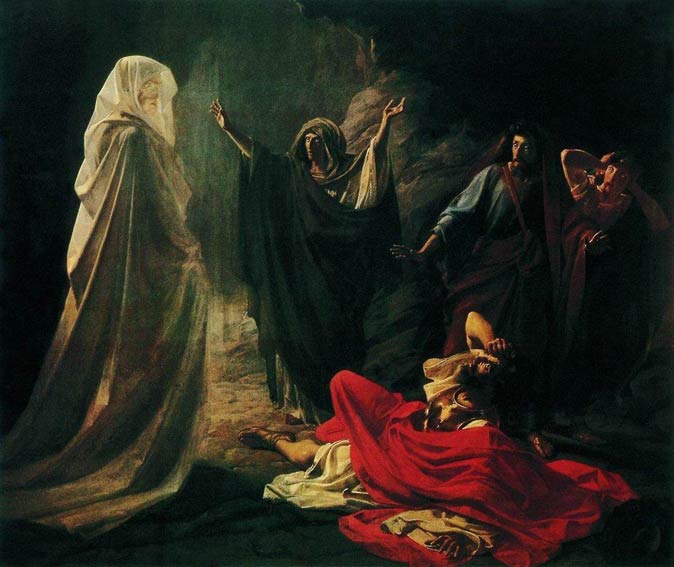
The Witch of Endor is a figure from the Hebrew Bible who practiced necromancy in the village of En Dor. She was consulted by King Saul to summon the spirit of the deceased prophet Samuel for military advice. The resulting prophecy foretold the king's defeat and death.
- King Saul disguised himself to visit her secretly.
- She summoned the spirit of the prophet Samuel.
- The spirit predicted Saul's defeat by the Philistines.
- Scholars link the ʾōḇ to Near Eastern ritual pits.
- The Septuagint calls her a belly-talking medium.
What it is
The Witch of Endor is a legendary figure described in the Hebrew Bible as a spirit-diviner. She lived in the settlement of En Dor and possessed an ʾōḇ, a term scholars interpret as a familiar spirit or a ritual pit used to summon the dead. Unlike later medieval depictions of harmful sorcerers, she is presented as a traditional necromancer. Her primary role in the narrative is to facilitate communication between the living and the deceased prophet Samuel at the request of King Saul.
Where it comes from
The story originates in 1 Samuel 28 within the context of ancient Israelite religion. It reflects indigenous practices of ancestral veneration and patrilineal family tomb rites common in the Near East. The narrative parallels Mesopotamian motifs where desperate monarchs seek guidance from deceased sages when standard divine channels fail. The text also shows influence from Greek literary genres of the Nekyia, or journey to the underworld.
How it is done
King Saul disguised himself to visit the woman after expelling other necromancers. He asked her to raise Samuel because dreams and prophets had failed him. The woman initially refused due to royal edicts but agreed after assurances of safety. She performed a ritual to summon the spirit, which appeared as an old man in a robe rising from the ground. The spirit delivered a prophecy of doom before disappearing.
Tools and materials
The central tool mentioned is the ʾōḇ. Scholars suggest this refers to a ritual pit for summoning the dead, similar to practices in Sumerian, Akkadian, and Hittite cultures. Other interpretations include a talisman or a wineskin used for ventriloquism. The Septuagint translates the term as engastrímuthos, implying a belly-talker or spirit medium using vocal tricks.
Witch of Endor, drawn and placed
- Living
- Revived
- Fading
- Historical
- Legendary
- Performed
- Lineage
- Canaanite religion
What it is for
Saul sought the ritual to gain strategic advice against the Philistine army. He needed direction after failing to receive answers through sacred lots or dreams. The purpose was strictly divinatory, aiming to access knowledge from the deceased prophet Samuel. The outcome was a prediction of military defeat and the king's imminent death.
Who does it
The woman is identified as a resident of En Dor. Joseph Blenkinsopp argues she represents a recognized domestic religious specialist rather than a criminal sorceress. The narrative portrays her sympathetically, noting her surprise at Saul's disguise and her fear upon seeing the spirit. She is not condemned explicitly in the text for performing the rite.
Peoples and places
The practice is rooted in ancient Israelite culture but shares features with broader Near Eastern traditions. Jewish interpretation views the soul as wandering for twelve months after death, allowing such summons. Christian writers have debated whether the spirit was real, a demon, or an illusion. Spiritualists cite the event as evidence of ancient mediumship.
At a glance: who, where and when
Peoples


What people believe
The worldview assumes the dead can be contacted and that spirits retain knowledge of earthly events. The term elohim is used to describe the rising spirit, linking it to divine or netherworld forces. Interpretations vary on whether the event was genuine magic, divine intervention, or demonic deception. Some view it as a test of faith or a consequence of Saul's disobedience.
How scholars and sceptics see it
Scholars like Klaus-Peter Adam note parallels with Greek tragedies involving ghostly apparitions. A. Graeme Auld observes the sympathetic portrayal of the medium. Paul R. Williamson argues the text does not imply demonic involvement. Modern theologians debate whether the prohibition of necromancy reflects state consolidation of Yahwism against older family rites.
Compare and confuse
The figure is often confused with generic witches due to later Christian labels. The term pythoness links her to the Oracle of Delphi. Ventriloism theories compare her to ancient belly-talkers. The narrative differs from folk witchcraft by focusing on ancestral consultation rather than hexes or curses.
Today
The story remains a subject of theological study and cultural reference. It appears in operas, ballets, and poetry. Writers like Rudyard Kipling used the tale to critique modern spiritualism. The character serves as a historical anchor for discussions on the history of magic and religion.
Questions people ask about Witch of Endor
Who was the Witch of Endor?
She was a spirit-diviner in the village of En Dor mentioned in the Hebrew Bible. King Saul visited her to summon the prophet Samuel for advice against the Philistines.
What does the name mean?
The Hebrew title means mistress of the ʾōḇ. This likely refers to a familiar spirit or a ritual pit used for necromancy in ancient Israelite and Near Eastern contexts.
Did she really summon Samuel?
The Bible states she raised the spirit. Scholars debate if it was the actual prophet, a demon, or a psychological event. The text describes an old man in a robe rising from the ground.
Is she considered a witch?
Modern scholars argue she was a necromancer or spirit-diviner. The label witch reflects later medieval Christian views rather than her specific role in ancient Israelite religion.
Where did this happen?
The event took place in En Dor, a settlement around a spring in ancient Israel. Saul crossed enemy lines to find her anonymously.
Good reading and sources
- Witch of Endor on WikipediaEncyclopedia
- More photos on Wikimedia CommonsPhotos and video
- Wikidata recordOpen data
The facts on this page come from the Wikipedia article "Witch of Endor", written by its contributors and used under the CC BY-SA 4.0 licence, and from its Wikidata record (CC0). EveryJaadu rewrote the text in its own words, with AI assistance, and compares every page with the article to make sure no passage is copied. It may be reused under the same CC BY-SA 4.0 licence with a link back.
It may contain mistakes. Names and customs differ from one community to the next, and some knowledge is closed to outsiders and left out here. This page describes belief and practice. It does not say that any of it works, it is not a how-to, and it is not medical advice. If something is wrong, tell us. Last refreshed 2026-10-05.
More from Israel
All the entries from Israel 🇮🇱 Israel and 1 moreShimon bar Yochaiשמעון בר יוחאי
A second-century sage of the Land of Israel and a central figure in Kabbalistic tradition.Figure · Power and authority Historical
🇮🇱 Israel and 1 moreShimon bar Yochaiשמעון בר יוחאי
A second-century sage of the Land of Israel and a central figure in Kabbalistic tradition.Figure · Power and authority Historical
 🇮🇱 Israel and 1 moreAzazelעזאזל
A desert place and fallen angel linked to the Yom Kippur scapegoat ritualFigure · Cursing and harm · Cleansing and purification Historical
🇮🇱 Israel and 1 moreAzazelעזאזל
A desert place and fallen angel linked to the Yom Kippur scapegoat ritualFigure · Cursing and harm · Cleansing and purification Historical
 🇪🇬 Egypt and 1 moreJannes and Jambresיניס וימבריס
Named Egyptian magicians who opposed Moses in biblical traditionFigure · Cursing and harm Historical
🇮🇱 Israel and 1 moreRighteous Priest
A messianic priestly figure in Jewish eschatology, identified with Shem and Melchizedek.Figure · Power and authority Historical
🇪🇬 Egypt and 1 moreJannes and Jambresיניס וימבריס
Named Egyptian magicians who opposed Moses in biblical traditionFigure · Cursing and harm Historical
🇮🇱 Israel and 1 moreRighteous Priest
A messianic priestly figure in Jewish eschatology, identified with Shem and Melchizedek.Figure · Power and authority Historical
Related elsewhere
All figure 🇮🇳 IndiaChakraचक्र
Meditation points in the subtle body used in Hindu and Buddhist yogaTradition · Speaking with spirits and the dead · Change and initiation Living
🇮🇳 IndiaChakraचक्र
Meditation points in the subtle body used in Hindu and Buddhist yogaTradition · Speaking with spirits and the dead · Change and initiation Living
 🇪🇸 Spain and 5 moreSt John's Eve
A Christian vigil marked by bonfires and plant gathering on the summer solstice eveRite · Protection · Speaking with spirits and the dead Living
🇪🇸 Spain and 5 moreSt John's Eve
A Christian vigil marked by bonfires and plant gathering on the summer solstice eveRite · Protection · Speaking with spirits and the dead Living
 🇲🇽 MexicoCalavera
A sugar or clay skull used in Mexican Day of the Dead celebrations.Charm · Speaking with spirits and the dead · Luck and prosperity Living
🇲🇽 MexicoCalavera
A sugar or clay skull used in Mexican Day of the Dead celebrations.Charm · Speaking with spirits and the dead · Luck and prosperity Living
 🇳🇬 NigeriaOrunmilaỌ̀rúnmìlà
Yoruba deity of wisdom and the creator of the Ifá divination systemBeing · Seeing and foretelling · Speaking with spirits and the dead Living
🇳🇬 NigeriaOrunmilaỌ̀rúnmìlà
Yoruba deity of wisdom and the creator of the Ifá divination systemBeing · Seeing and foretelling · Speaking with spirits and the dead Living