Round Table
In its own language: la Table ronde
from French la Table ronde, Welsh y Ford Gron, Cornish an Moos Krenn, Breton an Daol Grenn, and Latin Mensa Rotunda
A legendary table with no head, symbolizing equality among King Arthur's knights.
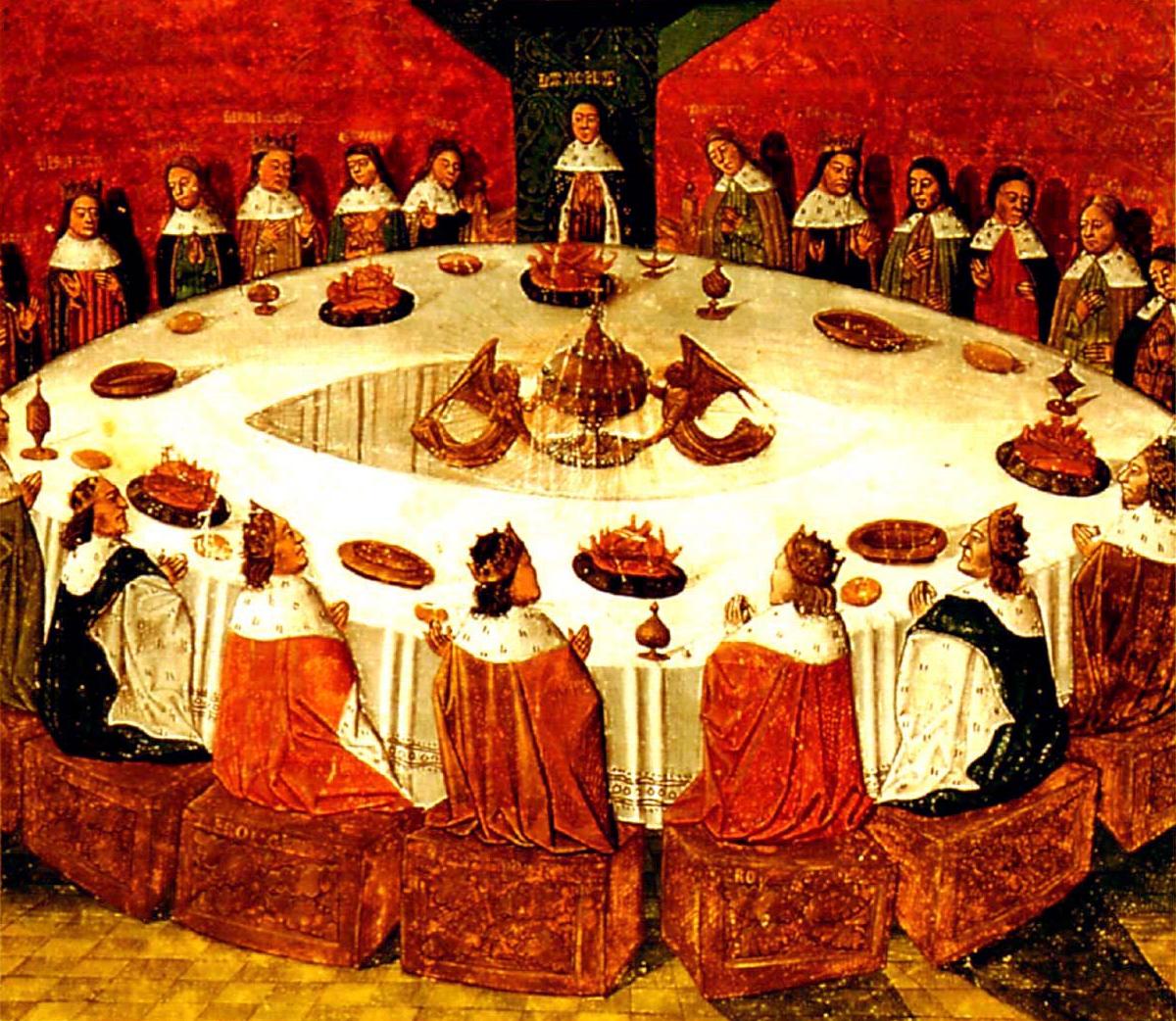
The Round Table is a famous piece of furniture in Arthurian legend, known for its circular shape that implies equal status for all who sit at it. First described by Wace in 1155, it evolved into a symbol of the chivalric order associated with King Arthur's court.
- First described by Wace in 1155 in the Roman de Brut.
- No head implies equal status for all seated knights.
- Merlin created a silver version with twelve seats plus one empty.
- The empty seat is called the Siege Perilous.
- Winchester Round Table dates to 1250–1280.
What it is
The Round Table is a central element of Arthurian legend, representing a gathering place for King Arthur and his knights. Its circular design means there is no head, suggesting that every knight seated there holds equal status. This contrasts with rectangular tables where rank determines position. The table serves as a physical manifestation of the chivalric ideals and fellowship that define Arthur's court.
Where it comes from
Wace first mentioned the table in 1155 in his Roman de Brut. He credited the idea to the Bretons, though scholars debate this. Layamon later added that a Cornish carpenter built it to stop fights over seating at Yuletide feasts. Earlier Welsh texts mention Arthur's court but not the table itself. Some suggest real sites like the amphitheatre at Caerleon or Chester inspired the legend, though archaeologists find no proof.
How it is done
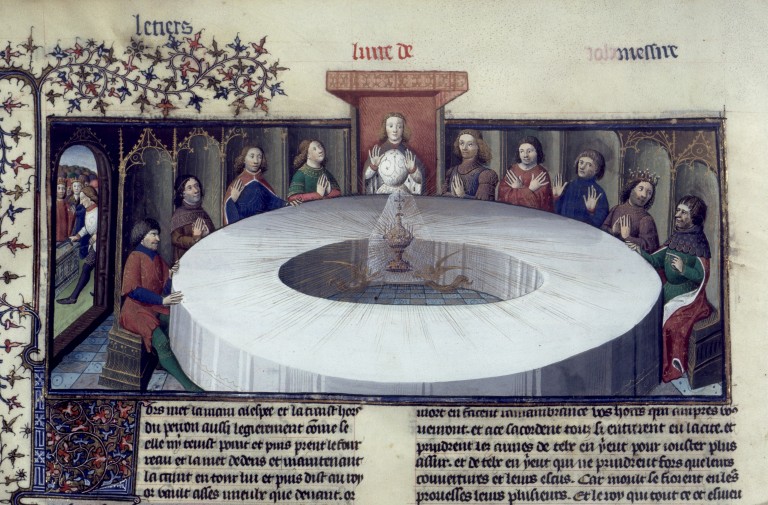
Knights gathered around the table for meetings and feasts. The layout prevented disputes over precedence because no one sat at a head. In later romances, Merlin created a version modeled on the Last Supper, featuring twelve seats and one empty spot called the Siege Perilous. Only a perfect knight could fill this seat without danger.
Tools and materials
The table was often depicted as made of silver. It featured specific seats, including the Siege Perilous, which marked the future Grail hero. Later versions expanded the number of seats significantly. The Winchester Round Table, a large wooden disc, bears painted names of knights and uses green and white colors linked to Welsh livery.
Round Table, drawn and placed
- Living
- Revived
- Fading
- Historical
- Legendary
- Performed
- Lineage
- Arthurian legend
- Timing
- Yuletide feast, Pentecost
What it is for
The table was intended to foster unity and prevent quarrels among powerful barons. It symbolized the code of chivalry and the ideal society under Arthur. Over time, it became linked to the quest for the Holy Grail, marking the beginning of spiritual journeys for the knights.
Who does it
King Arthur presided over the table. His knights, known as the Knights of the Round Table, were chosen for their bravery and virtue. Galahad eventually filled the empty seat, completing the fellowship. Historical figures like Edward I and Edward III hosted medieval tournaments imitating this courtly structure.
Peoples and places
The legend originated in Britain, particularly Wales and Cornwall, before spreading to France and Italy. Italian works like La Tavola Ritonda distinguished between Uther's 'Old Table' and Arthur's 'New Table'. The concept influenced European festivals where participants dressed as Arthur's knights.
At a glance: who, where and when
Peoples


What people believe
The table represents divine order and equality. Robert de Boron linked it to Joseph of Arimathea's Grail Table, connecting Arthurian lore to Christian sacred history. The empty seat signified that only a divinely chosen knight could achieve the highest spiritual goal.
When it is done
Feasts at the table often occurred during Yuletide. Edward III planned a restoration of the Order for Pentecost in 1344. Medieval tournaments celebrating the Round Table were held throughout Europe, sometimes coinciding with royal betrothals or religious holidays.
Questions people ask about Round Table
What is the Round Table?
It is a legendary table in Arthurian stories, famous for its round shape which ensures all knights sit as equals, unlike traditional tables with a designated head.
Where did the Round Table come from?
Wace introduced it in 1155, crediting the Bretons. Later writers like Layaman said a carpenter built it to stop arguments, while others linked it to earlier Welsh tales of Arthur's court.
Why is there an empty seat?
In later romances, one seat remained empty because it was reserved for the knight who would achieve the Holy Grail. Sitting there prematurely caused danger.
Is there a real Round Table?
A large wooden table exists in Winchester Castle, dating to the 13th century. It was likely made for a medieval tournament imitating Arthur's court, rather than being the original legendary item.
Good reading and sources
- Round Table on WikipediaEncyclopedia
- More photos on Wikimedia CommonsPhotos and video
- Wikidata recordOpen data
The facts on this page come from the Wikipedia article "Round Table", written by its contributors and used under the CC BY-SA 4.0 licence, and from its Wikidata record (CC0). EveryJaadu rewrote the text in its own words, with AI assistance, and compares every page with the article to make sure no passage is copied. It may be reused under the same CC BY-SA 4.0 licence with a link back.
It may contain mistakes. Names and customs differ from one community to the next, and some knowledge is closed to outsiders and left out here. This page describes belief and practice. It does not say that any of it works, it is not a how-to, and it is not medical advice. If something is wrong, tell us. Last refreshed 2026-10-06.
More from the United Kingdom
All the entries from the United Kingdom 🇬🇧 United Kingdom and 2 moreKing ArthurBrenin Arthur
A legendary British king and folk hero of medieval literature and Welsh mythologyFigure · Power and authority · Wonder and entertainment Legendary
🇬🇧 United Kingdom and 1 moreBugbear
A medieval English creature used to frighten children into obedienceFigure · Cursing and harm Legendary
🇬🇧 United KingdomGreen Children of Woolpit
A medieval English legend about two green-skinned siblings who appeared in a Suffolk village.Figure · Wonder and entertainment Legendary
🇬🇧 United Kingdom and 2 moreKing ArthurBrenin Arthur
A legendary British king and folk hero of medieval literature and Welsh mythologyFigure · Power and authority · Wonder and entertainment Legendary
🇬🇧 United Kingdom and 1 moreBugbear
A medieval English creature used to frighten children into obedienceFigure · Cursing and harm Legendary
🇬🇧 United KingdomGreen Children of Woolpit
A medieval English legend about two green-skinned siblings who appeared in a Suffolk village.Figure · Wonder and entertainment Legendary
 🇬🇧 United KingdomMatthew Hopkins
The English witch-hunter who led the deadliest wave of executions in Britain.Figure · Cursing and harm Historical
🇬🇧 United KingdomMatthew Hopkins
The English witch-hunter who led the deadliest wave of executions in Britain.Figure · Cursing and harm Historical
Related elsewhere
All figure 🇮🇳 India and 5 moreAstrology
A divinatory practice that reads human fate through the positions of celestial bodies.Belief · Seeing and foretelling · Luck and prosperity Living
🇮🇳 India and 5 moreAstrology
A divinatory practice that reads human fate through the positions of celestial bodies.Belief · Seeing and foretelling · Luck and prosperity Living
 🇮🇳 India and 2 morePalmistry
A divination method that interprets the lines and shapes of the hand to predict fate or reveal character.Oracle · Seeing and foretelling · Power and authority Living
🇮🇳 India and 2 morePalmistry
A divination method that interprets the lines and shapes of the hand to predict fate or reveal character.Oracle · Seeing and foretelling · Power and authority Living
 🇨🇳 China and 3 moreChinese dragon龍
A legendary water deity and imperial symbol in East Asian cultureBeing · Protection · Luck and prosperity Historical
🇨🇳 China and 3 moreChinese dragon龍
A legendary water deity and imperial symbol in East Asian cultureBeing · Protection · Luck and prosperity Historical
 🇮🇳 India and 1 moreGarba
A Gujarati circle dance performed around a central symbol during NavaratriIllusion · Power and authority · Luck and prosperity Living
🇮🇳 India and 1 moreGarba
A Gujarati circle dance performed around a central symbol during NavaratriIllusion · Power and authority · Luck and prosperity Living