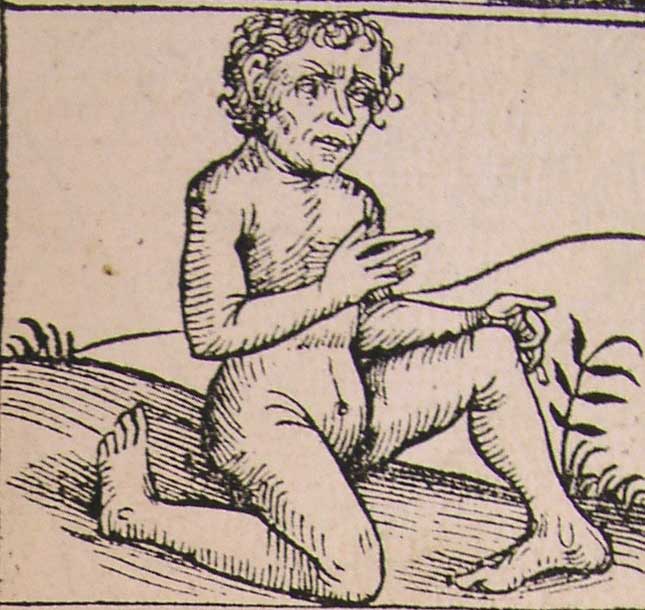
Abarimon
A mythical tribe with reversed feet, said to inhabit the Himalayas and run at extreme speeds.
The Abarimon are a legendary people described in ancient Greco-Roman texts as having reversed feet yet running with great speed. Pliny the Elder placed them in India near the Himalayas, while other accounts locate them in Scythia or Tataria.
- Pliny the Elder described them in Natural History VII 11.
- They had reversed feet but could run at extreme speeds.
- Baiton, Alexander's surveyor, provided details about them.
- Medieval maps placed them at the outermost borders of the world.
- Scholars suggest they may be based on Himalayan wildlife.
What it is
The Abarimon are a mythical tribe from Greco-Roman historiography known for their unusual physical traits. They are described as having reversed feet, which would seem to hinder movement, yet they were capable of running at extreme speeds. This contradiction made them a subject of fascination in ancient natural history. The name is also linked to the term antipode, referring to peoples living on the opposite side of the world. These figures appear in various classical texts as examples of the strange creatures believed to inhabit the distant edges of the known earth.
Where it comes from
The primary source for the Abarimon is Pliny the Elder, who included them in his Natural History. He credited information about them to Baiton, a land surveyor who accompanied Alexander the Great. Pliny placed this tribe in India. Another account by Aulus Gellius in Attic Nights presents a similar tale. Later interpretations varied; some legends identified Abarimon as a landscape in Scythia near Mount Imaus, possibly the Hindu Kush or Himalayas. In the Middle Ages, Thomas Cooper’s Thesaurus Linguae Romanae et Britannicae listed them as a tribe in Tataria. Medieval mapmakers often depicted these creatures at the outermost borders of the world.
Abarimon, drawn and placed
- Living
- Revived
- Fading
- Historical
- Legendary
- Performed
- Lineage
- Greco-Roman mythology
At a glance: who, where and when
Peoples
How scholars and sceptics see it
Modern scholars view the Abarimon as an exaggerated ethnographic description rather than a real people. The legend may stem from misinterpretations of prehistoric wildlife or local fauna found in the Himalayan regions. The story of reversed feet might be a metaphorical or distorted account of indigenous footwear or gait. The inclusion of such tribes in ancient texts reflects the Greco-Roman interest in cataloging the exotic and unknown lands beyond their borders. The varying locations assigned to them, from India to Scythia, highlight the fluid nature of ancient geographical knowledge.
Compare and confuse
The Abarimon share traits with other mythical beings like the Ciguapa and Curupira, who also have reversed feet or backward-facing features. These figures appear in different cultural mythologies as guardians or inhabitants of remote areas. The concept of antipodes was common in ancient thought, describing peoples living on the opposite side of the globe. Unlike the Abarimon, many of these figures are part of living folk traditions, whereas the Abarimon remain confined to classical literature and medieval cartography.
Today
The Abarimon survive today primarily in historical and literary contexts. They appear in encyclopedias of mythical creatures and discussions of ancient geography. Their image persists in references to medieval maps that placed strange beasts at the edges of the world. Modern interest in the Abarimon is academic, focusing on how ancient writers constructed narratives about distant lands. They serve as examples of early ethnographic speculation and the blending of fact and fantasy in classical natural history.
Questions people ask about Abarimon
What are the Abarimon?
The Abarimon are a mythical tribe from Greco-Roman texts. They are described as having reversed feet yet being able to run very fast. Ancient writers placed them in India or Scythia.
Where did the story come from?
The main source is Pliny the Elder's Natural History. He cited Baiton, a surveyor for Alexander the Great. Other writers like Aulus Gellius also mentioned similar tales.
Why do they have reversed feet?
The text does not explain why they have reversed feet. It simply states this as a physical trait. Scholars think it may be a distortion of observations about local people or animals.
Good reading and sources
The facts on this page come from the Wikipedia article "Abarimon", written by its contributors and used under the CC BY-SA 4.0 licence, and from its Wikidata record (CC0). EveryJaadu rewrote the text in its own words, with AI assistance, and compares every page with the article to make sure no passage is copied. It may be reused under the same CC BY-SA 4.0 licence with a link back.
It may contain mistakes. Names and customs differ from one community to the next, and some knowledge is closed to outsiders and left out here. This page describes belief and practice. It does not say that any of it works, it is not a how-to, and it is not medical advice. If something is wrong, tell us. Last refreshed 2026-10-11.
More from India
All the entries from India 🇮🇳 IndiaNaropa
An Indian Buddhist master whose teachings shaped Tibetan Vajrayana practiceFigure · Change and initiation Historical
🇮🇳 IndiaNaropa
An Indian Buddhist master whose teachings shaped Tibetan Vajrayana practiceFigure · Change and initiation Historical
 🇳🇵 Nepal and 1 moreMatsyendranathMacchindranāth, Mīnanātha
A yogi and rain deity revered across Hindu and Buddhist traditions in South Asia.Figure · Speaking with spirits and the dead · Power and authority Living
🇳🇵 Nepal and 1 moreMatsyendranathMacchindranāth, Mīnanātha
A yogi and rain deity revered across Hindu and Buddhist traditions in South Asia.Figure · Speaking with spirits and the dead · Power and authority Living
 🇮🇳 India and 2 moreGorakhnathगोरक्षनाथ
A Hindu yogi and saint who founded the Nath monastic order in India.Figure · Power and authority · Speaking with spirits and the dead Living
🇮🇳 India and 2 moreGorakhnathगोरक्षनाथ
A Hindu yogi and saint who founded the Nath monastic order in India.Figure · Power and authority · Speaking with spirits and the dead Living
 🇮🇳 India and 2 morePadmasambhavaཔདྨ་འབྱུང་གནས།
A tantric master credited with establishing Buddhism in Tibet and founding the Nyingma school.Figure · Protection · Power and authority Living
🇮🇳 India and 2 morePadmasambhavaཔདྨ་འབྱུང་གནས།
A tantric master credited with establishing Buddhism in Tibet and founding the Nyingma school.Figure · Protection · Power and authority Living
Related elsewhere
All figure 🇫🇷 France and 2 moreKing ArthurBrenin Arthur
A legendary British king and folk hero of medieval literature and Welsh mythologyFigure · Power and authority · Wonder and entertainment Legendary
🇫🇷 France and 2 moreKing ArthurBrenin Arthur
A legendary British king and folk hero of medieval literature and Welsh mythologyFigure · Power and authority · Wonder and entertainment Legendary
 🇪🇬 Egypt and 1 moreSphinx
A mythical hybrid with a human head and lion body, serving as guardian or riddler in Egyptian and Greek traditions.Being · Protection · Wonder and entertainment Legendary
🇪🇬 Egypt and 1 moreSphinx
A mythical hybrid with a human head and lion body, serving as guardian or riddler in Egyptian and Greek traditions.Being · Protection · Wonder and entertainment Legendary
 🇫🇷 France and 5 moreWerewolf
A mythical shapeshifter that turns into a wolf, central to European witch-hunts and Gothic horror.Being · Cursing and harm · Wonder and entertainment Legendary
🇷🇺 Russia and 3 moreNart sagaНарты кадджытæ
A collection of epic tales from the North Caucasus about a legendary group of heroes.Text · Wonder and entertainment Historical
🇫🇷 France and 5 moreWerewolf
A mythical shapeshifter that turns into a wolf, central to European witch-hunts and Gothic horror.Being · Cursing and harm · Wonder and entertainment Legendary
🇷🇺 Russia and 3 moreNart sagaНарты кадджытæ
A collection of epic tales from the North Caucasus about a legendary group of heroes.Text · Wonder and entertainment Historical