Ordo Templi Orientis
Latin for 'Order of the Temple of the East', also rendered 'Order of Oriental Templars'
A secret occult order of initiation degrees, reshaped by Aleister Crowley
Ordo Templi Orientis is an occult secret society and hermetic magical organisation that began in the early 20th century in German-speaking Europe, modelled at first on Freemasonry. From Aleister Crowley's time its guiding philosophy has been Thelema, and members hold that its degrees and its Gnostic Mass carry a hidden key to symbolism and to nature.
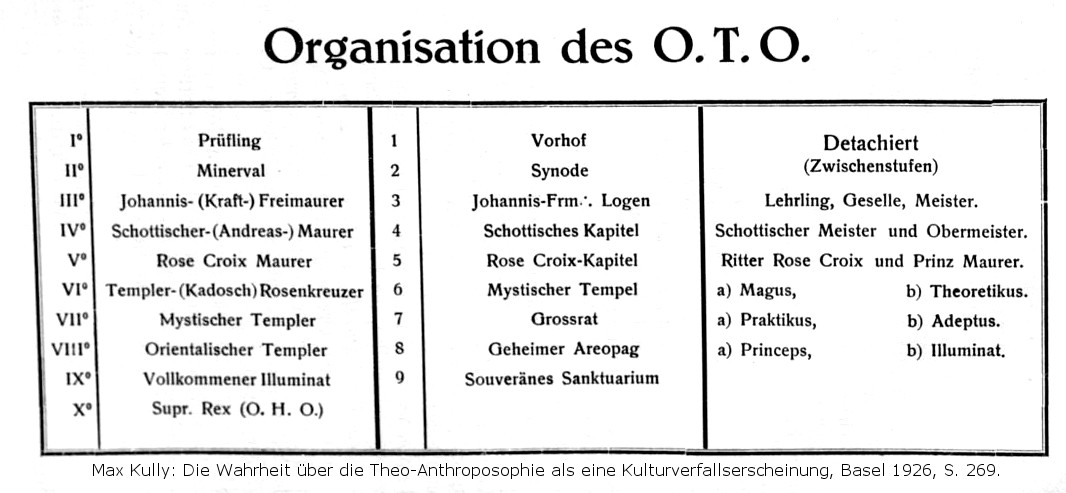
- Its first form took only Freemasons and worked ten degrees, five of them Masonic.
- Crowley led it from 1925 and made Thelema its guiding philosophy.
- The Gnostic Mass, written in Moscow in 1913, is its central ceremony.
- A Scottish Rite council in Detroit refused its rituals as too close to lodge practice.
- The California corporation of 1979 is treated in court as the order's legitimate successor.
What it is
O.T.O. stands for Ordo Templi Orientis, Latin for Order of the Temple of the East, also given in English as Order of Oriental Templars. It is an occult secret society and a hermetic magical organisation, started at the beginning of the 20th century. Members join by initiation and pass through a set of degrees. From Aleister Crowley's time the order's guiding philosophy has been Thelema, the occult system he devised, and its central ceremony is the Gnostic Mass, which he wrote in Moscow in 1913. Numbers were never large: at one stage the membership was counted in dozens, not hundreds or thousands.
Where it comes from
Little about the order's early years can be confirmed. No dependable record exists before 1904, and the order's birth is placed somewhere from 1895 to 1906 in German-speaking Europe, with both Austria and Germany given as its cradle. Carl Kellner, a well-off Austrian industrialist (1851 to 1905), is normally named as founder, working to set up an Academia Masonica in which advanced Masonic degrees could be given across German-speaking lands. Theodor Reuss (1855 to 1923) helped build the order and took charge after Kellner's death. Rights were assembled from several quarters: the Memphis and Mizraim rite was bought from the English Freemason John Yarker in 1902, confirmed in 1904 and again in 1905; Martinist authority came from Gérard Encausse; a clandestine Scottish Rite from Joseph Cerneau; and a warrant for a German college of the Societas Rosicruciana in Anglia from William Wynn Westcott.
How it is done
Work is by initiation. Ten degrees were set out, the first five Masonic, and from 1902 Reuss printed the collected rituals in a Masonic journal, The Oriflamme. When Crowley tried the Masonic version in Detroit in 1919, the local Council of the Scottish Rite refused it, holding that the symbolism came too near that of orthodox lodges. He answered by rewriting the rituals of the first three degrees and cutting most of their Masonic content, while the fourth degree kept its Royal Arch form and structure. Revised rituals for the British section were prepared by 1915.
Tools and materials
A lamen, a magical plaque or emblem, is shown as the order's device. Written texts carried the system: instructional manuscripts passed between leaders, and Crowley's Manifesto of the Mysteria Mystica Maxima laid out the ten degrees, with Kellner's Academia Masonica occupying the seventh, eighth and ninth. Reuss's 1917 Synopsis of Degrees called the third degree Craft of Masonry and the fourth the Holy Royal Arch of Enoch, also summarised as Scotch Masonry. The journal The Oriflamme put the rites into print.
Ordo Templi Orientis, drawn and placed
- Living
- Revived
- Fading
- Historical
- Legendary
- Performed
- Lineage
- Hermetic occultism, Masonic-derived, with Thelema as its philosophy after Crowley
What it is for
Kellner held that his wide reading in esoteric traditions had turned up a key explaining the tangled symbolism of Freemasonry and of nature alike, and he wanted the order to keep that key and hand it on. Once Crowley was in charge, the aim widened to carrying Thelema, his own system, with the Gnostic Mass placed at the centre of its public and private celebration. The order also gave German-speaking countries a body in which high-degree Masonry could be worked, something the 1800s there had barely seen.
Who does it
Headship carries the title Outer Head of the Order. Kellner held it to 1905, Reuss to 1923, Crowley from 1925 to 1947, Karl Germer to 1962, and William Breeze from 2014. Reuss's authority frayed after 1905: Masonic journals in Germany assailed him, doubting his credentials and whether his standing counted as regular, and after moving to London in 1906 he lost control of most of the lodges. Membership came by initiation, and in Crowley's day numbers were small. He told one correspondent that meeting fellow members was impossible, and that contact would only produce criticism of hats and morals.
Peoples and places
The order's home was German-speaking Europe, and under Reuss charters went out to occult bodies in Austria, Denmark, France, Switzerland and the United States. Crowley opened a British section, the Mysteria Mystica Maxima, in 1912, and held a title covering Ireland, Iona and the Britains. War broke the European branches or forced them underground; afterwards only Agapé Lodge in California still ran, beside scattered initiates elsewhere. Karl Germer, the German representative, reached America after being held by the Nazi authorities. Charters for English camps went in turn to Gerald Gardner, Frederic Mellinger and Kenneth Grant, then to Noel Fitzgerald.
At a glance: who, where and when
Who does it
Belief worlds
Occasions
What people believe
Behind the degrees sits a claim about concealed knowledge. Kellner taught that one principle unlocked both Masonic symbolism and the natural world, and the order was to guard it. Crowley set the Masonic frame aside in favour of Thelema, presented as a system of his own making, and order documents tie it to the Gnostic Catholic Church, a body branching from Jules Doinel's Église Gnostique, which Reuss met through Joanny Bricaud in 1908. Practitioners also hold that sexual magic belongs to the higher degrees, an element traced to writings by the American occultist Paschal Beverly Randolph, said to have reached Kellner through the Hermetic Brotherhood of Luxor.
How scholars and sceptics see it
Study of the order's beginnings is thin. Its early history is described as hard to trace, with nothing checkable before 1904. The scholar Marco Pasi questioned the common account that the sexual magic of the higher degrees came from Paschal Beverly Randolph by way of the Hermetic Brotherhood of Luxor: he found no evidence for it and proposed instead that Reuss took such ideas from John Yarker, who held unpublished Randolph material. Crowley's biographer Lawrence Sutin casts doubt on Crowley's claim that Reuss named him successor, while allowing that nothing proves or disproves it.
Compare and confuse
O.T.O. sits closest to European Freemasonry, whose degrees and ceremonies it borrowed and later partly dropped. Masonic bodies judged its rites irregular, and it also drew on the Swedenborg Rite, the Rite of Memphis and Mizraim, Martinism, a clandestine Scottish Rite and the Societas Rosicruciana in Anglia. Its church wing descends from Jules Doinel's Église Gnostique by way of Joanny Bricaud. The Latin title is given two ways in English, Order of the Temple of the East and Order of Oriental Templars.
Law and persecution
Several rites the order worked were counted irregular by established Masonry, and in 1919 a Scottish Rite council in Detroit declined to let its rituals be used. German Masonic journals disputed Reuss's standing. In the Second World War the European branches were destroyed or driven underground, and Germer had been held by the Nazi authorities before leaving for America. Court decisions recognise the body registered in California on 26 March 1979 as the order's legitimate successor and as holder of its trademarks, copyrights, name rights and remaining property. In 1982 the tax code's 501(c)(3) provision was applied to it, on the ground that it is a religious organisation.
Today
Karl Germer died in 1962 naming no successor. In 1969 Grady McMurtry acted on a letter of emergency authorisation from Crowley and became Frater Superior, beginning initiations the following year, though he declined the title Outer Head of the Order, saying in 1974 that nobody then held it. Members of the Ninth Degree, the Sovereign Sanctuary of the Gnosis, elected a Caliph in 1985, the year McMurtry died. Four branches had each claimed to be the true line. William Breeze has been Outer Head since 2014.
Questions people ask about Ordo Templi Orientis
What is Ordo Templi Orientis?
An occult secret society and hermetic magical organisation, Latin for Order of the Temple of the East. It works a system of initiation degrees, and since Aleister Crowley's time its guiding philosophy has been Thelema, the system he created.
Where does it come from?
Its beginnings are hard to trace. The order came into being in German-speaking Europe, with 1895 to 1906 given as the likely span and Austria or Germany as the likely place. Carl Kellner, an Austrian industrialist, is usually named as founder. Nothing checkable survives from before 1904.
Was it part of Freemasonry?
It was modelled on European Freemasonry and at first took only Freemasons, with five of its ten degrees Masonic. In 1919 a Scottish Rite council in Detroit refused its rituals as too near orthodox lodge practice. Crowley then rewrote the first three degrees, removing most Masonic material, though the fourth kept its Royal Arch shape.
Who has led it?
Carl Kellner led it from 1895 to 1905, Theodor Reuss until 1923, Aleister Crowley from 1925 to 1947 and Karl Germer until 1962. The post is called Outer Head of the Order. William Breeze has held it since 2014.
Is the California body the same order?
After Crowley died in 1947 four branches claimed to descend from his order. Court decisions treat the corporation Grady McMurtry registered in California in 1979 as the legitimate successor, and as owner of the order's trademarks, copyrights, name rights and other property.
Good reading and sources
- Ordo Templi Orientis on WikipediaEncyclopedia
- More photos on Wikimedia CommonsPhotos and video
- Wikidata recordOpen data
The facts on this page come from the Wikipedia article "Ordo Templi Orientis", written by its contributors and used under the CC BY-SA 4.0 licence, and from its Wikidata record (CC0). EveryJaadu rewrote the text in its own words, with AI assistance, and compares every page with the article to make sure no passage is copied. It may be reused under the same CC BY-SA 4.0 licence with a link back.
It may contain mistakes. Names and customs differ from one community to the next, and some knowledge is closed to outsiders and left out here. This page describes belief and practice. It does not say that any of it works, it is not a how-to, and it is not medical advice. If something is wrong, tell us. Last refreshed 2026-10-21.
More from Germany
All the entries from Germany 🇨🇳 China and 5 moreHorseshoe
A curved plate fixed to a horse's hoof for protection, also kept as a charm for fortune.Charm · Protection · Luck and prosperity Living
 🇩🇪 Germany and 7 moreWalpurgis NightWalpurgisnacht
A spring vigil marking the eve of Saint Walpurga's feast day with bonfires and student festivalsRite · Protection · Speaking with spirits and the dead Living
 🇬🇧 United Kingdom and 5 moreAleister Crowley
English occultist and founder of the religion of ThelemaText · Power and authority · Change and initiation Living
🇬🇧 United Kingdom and 4 moreTelling the bees
A Western European custom of informing bees about major household eventsRite · Protection · Speaking with spirits and the dead Living
Related elsewhere
All tradition 🇮🇳 IndiaChakraचक्र
Meditation points in the subtle body used in Hindu and Buddhist yogaTradition · Speaking with spirits and the dead · Change and initiation Living
 🇮🇳 India and 5 moreFountain of Youth
A legendary spring said to reverse aging and cure illness, appearing in myths across the world.Belief · Healing · Change and initiation Legendary
🇪🇬 EgyptTheurgyθεουργία
A Neoplatonic ritual path to unite the soul with the divine through sacred actsTradition · Speaking with spirits and the dead · Change and initiation Historical
 🇪🇬 Egypt and 5 moreHermetica
A collection of ancient texts attributed to Hermes Trismegistus, covering magic, alchemy and philosophy.Text · Seeing and foretelling · Change and initiation Historical