
Ogham
In its own language: ᚛ᚑᚌᚐᚋ᚜
Unclear; possibly from the Irish phrase for 'point-seam', describing a cut made by a sharp blade.
An early medieval script of notched lines used to carve Irish names on stone monuments.
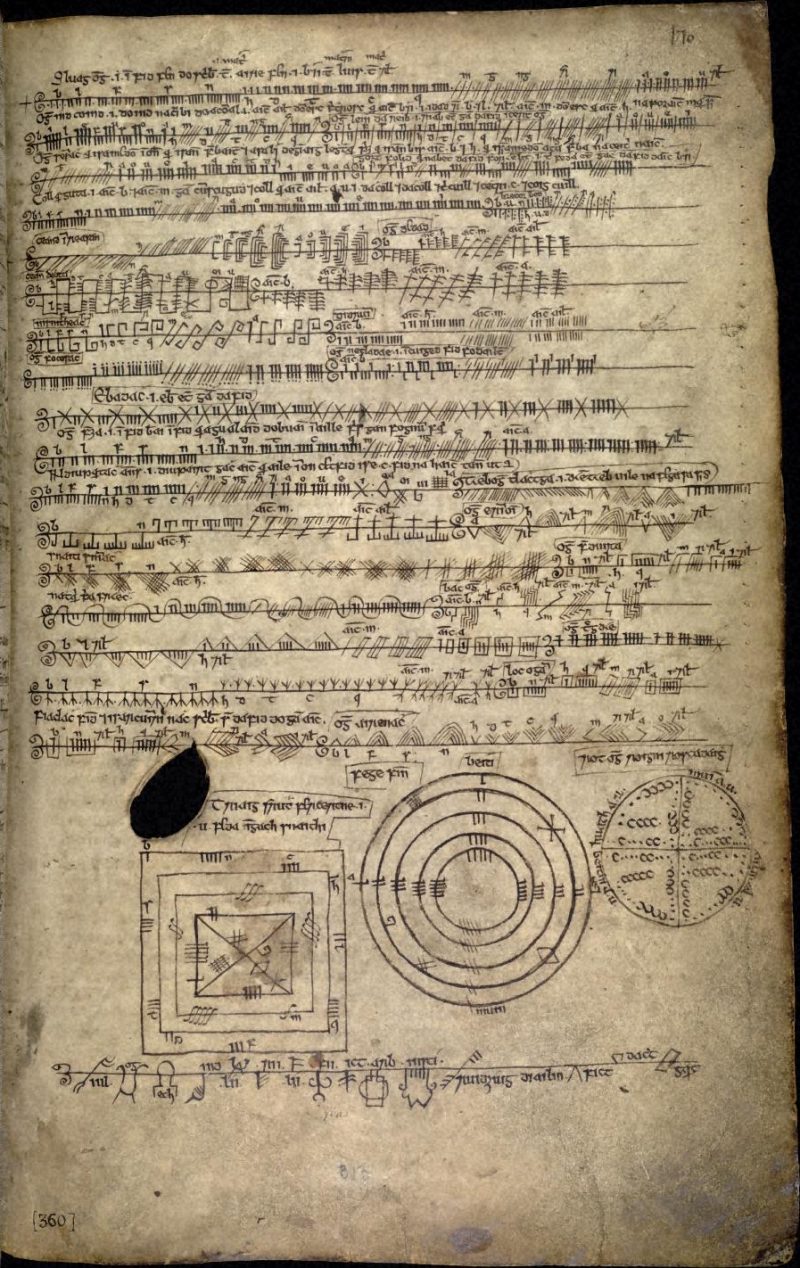
Ogham is an Early Medieval writing system developed in Ireland to record the Primitive and Old Irish languages. It consists of roughly 400 surviving stone inscriptions featuring personal names and genealogical formulas. The script was also applied occasionally to the Pictish language in Scotland.
- Roughly 400 stone inscriptions survive from the early medieval period.
- Most stones are located in the Irish province of Munster.
- The script records Primitive Irish and Old Irish personal names.
- Medieval manuscripts associate letters with trees and plants.
- Supplementary letters were added to the original twenty-character set.
What it is
Ogham serves as an early medieval alphabet designed primarily for the early Irish language. Surviving examples appear as carved marks on standing stones across Ireland and western Britain. Most texts contain personal names arranged in standard formulas. The script later recorded Old Irish and occasionally the Pictish language. Scholars classify it as a unicase system with linear strokes. Its structure relies on groups of lines extending from a central axis. The name derives from the first letters of its traditional sequence.
Where it comes from
The earliest stone inscriptions date to the fourth century AD. Linguistic evidence suggests the system existed earlier, likely on perishable materials like wood. Scholars debate whether the script emerged from Latin influence or served as a secret cipher against Roman authorities. Some theories propose Christian communities created it to transcribe sounds difficult for Latin. Other accounts link it to ancient druidic finger signals or tally marks. Legendary texts attribute the invention to Fenius Farsa or the god Ogma.
How it is done
The script uses straight lines and notches carved into stone or wood. Marks extend from a central stem line in four directions. Each position represents a specific sound. The original set contained twenty letters divided into families. Later manuscripts added five supplementary characters. Inscriptions typically follow a rigid formula listing a person's name and their lineage. The text usually reads from bottom to top along the edge of the stone.
Tools and materials
Carved stone monuments serve as the primary medium for surviving records. Wood may have been used for earlier, unwritten drafts. The letters are formed by single or multiple strokes. Manuscripts later preserved the system using ink. These texts attached plant names to each character. Many of these botanical associations remain uncertain to modern readers.
Ogham, drawn and placed
- Living
- Revived
- Fading
- Historical
- Legendary
- Performed
- Lineage
- Early Medieval Irish writing systems
- Timing
- 4th to 10th centuries AD
What it is for
The inscriptions functioned as markers of identity and land ownership. They recorded family lines and tribal connections. The script allowed speakers to write their native tongue without relying on Latin. It provided a distinct cultural marker during periods of political tension. The system facilitated communication among Irish-speaking communities.
Who does it
No living practitioners perform rituals with ogham today. Modern study focuses on historical analysis and linguistic reconstruction. Neopagan groups sometimes adopt the letter names for spiritual purposes. This usage stems from nineteenth-century literary interpretations rather than ancient tradition. Academic scholars examine the stones to understand early Irish phonology.
Peoples and places
The script belongs to the Irish cultural sphere. Most stones cluster in the southern province of Munster. Counties Cork and Kerry hold the majority of finds. Smaller numbers appear in Wales and Scotland. The Welsh stones often show bilingual features. This distribution reflects migration and contact between Irish settlers and local Britons.
At a glance: who, where and when
Who does it


What people believe
Medieval manuscripts linked each letter to a specific tree or plant. This association popularized the idea of a Celtic tree alphabet. Robert Graves promoted this view in twentieth-century literature. Scholars now consider the botanical links largely symbolic or mnemonic. The original purpose of the script was practical recording rather than magical symbolism.
When it is done
The script was active from the fourth through the tenth centuries. Usage peaked during the fifth and sixth centuries. It declined as the Latin alphabet became dominant for Irish writing. The transition coincided with the spread of Christianity in Ireland.
How scholars and sceptics see it
Researchers analyze the script to trace changes in the Irish language. They note archaic sounds preserved in the carving system. Debates continue regarding its exact origin and motivation. Some view it as a defensive measure against Roman rule. Others see it as a tool for early Christian missionaries. The theory of druidic finger signals has been largely rejected.
Cautions and what is closed
Modern neopagan practices often misinterpret the letter meanings. The tree associations found in manuscripts are frequently misunderstood as magical correspondences. Historical accuracy requires distinguishing between medieval scholarly glosses and actual ancient usage. Commercial products sometimes exploit these misconceptions.
Compare and confuse
Ogham differs from the Latin alphabet in its linear stroke structure. It shares some structural similarities with Germanic runes. The tree-letter concept resembles other alphabetic mysticism traditions. However, the botanical links are unique to Irish manuscript commentary.
Questions people ask about Ogham
What is Ogham?
Ogham is an early medieval alphabet used to write the Irish language. It consists of lines and notches carved into stone monuments. The script appears mainly in Ireland and parts of Britain.
Where did Ogham originate?
Scholars believe Ogham originated in Ireland between the fourth and sixth centuries. It was likely created to write Irish sounds that Latin could not easily capture. Some theories suggest it served as a secret code.
What do the letters represent?
The letters represent sounds in the Irish language. Medieval texts later assigned tree names to each character. These botanical links are part of scholarly commentary rather than the original script's design.
Is Ogham a magical tree alphabet?
The idea of a tree alphabet comes from medieval manuscripts and later literary works. Ancient users likely employed the script for practical naming and genealogy. The magical associations are modern interpretations.
Good reading and sources
- Encyclopaedia BritannicaArticle
- Teacher finds stone with ancient ogham writing from Ireland in Coventry gardenThe Guardian, Article
- Ogham on WikipediaEncyclopedia
- More photos on Wikimedia CommonsPhotos and video
- Wikidata recordOpen data
The facts on this page come from the Wikipedia article "Ogham", written by its contributors and used under the CC BY-SA 4.0 licence, and from its Wikidata record (CC0). EveryJaadu rewrote the text in its own words, with AI assistance, and compares every page with the article to make sure no passage is copied. It may be reused under the same CC BY-SA 4.0 licence with a link back.
It may contain mistakes. Names and customs differ from one community to the next, and some knowledge is closed to outsiders and left out here. This page describes belief and practice. It does not say that any of it works, it is not a how-to, and it is not medical advice. If something is wrong, tell us. Last refreshed 2026-10-05.
More from Ireland
All the entries from Ireland 🇬🇧 United Kingdom and 2 moreWitchcraft Acts
A series of British laws that shifted from punishing witchcraft to punishing those who claimed to practice it.Text · Cursing and harm Historical
🇮🇪 IrelandLorica
A Hiberno-Scottish monastic prayer for protection against evilText · Protection Historical
🇬🇧 United Kingdom and 1 moreThirteen Treasures of the Island of BritainTri Thlws ar Ddeg Ynys Prydain
A collection of magical objects from late-medieval Welsh legendText · Wonder and entertainment Historical
🇬🇧 United Kingdom and 2 moreWitchcraft Acts
A series of British laws that shifted from punishing witchcraft to punishing those who claimed to practice it.Text · Cursing and harm Historical
🇮🇪 IrelandLorica
A Hiberno-Scottish monastic prayer for protection against evilText · Protection Historical
🇬🇧 United Kingdom and 1 moreThirteen Treasures of the Island of BritainTri Thlws ar Ddeg Ynys Prydain
A collection of magical objects from late-medieval Welsh legendText · Wonder and entertainment Historical
 🇬🇧 United Kingdom and 2 moreKing ArthurBrenin Arthur
A legendary British king and folk hero of medieval literature and Welsh mythologyFigure · Power and authority · Wonder and entertainment Legendary
🇬🇧 United Kingdom and 2 moreKing ArthurBrenin Arthur
A legendary British king and folk hero of medieval literature and Welsh mythologyFigure · Power and authority · Wonder and entertainment Legendary
Related elsewhere
All text 🇩🇿 Algeria and 1 moreAhmad al-Buniأحمد البوني المالكي
A medieval Sufi scholar known for works on letter mysticism and talismansText · Power and authority · Seeing and foretelling Historical
🇩🇿 Algeria and 1 moreAhmad al-Buniأحمد البوني المالكي
A medieval Sufi scholar known for works on letter mysticism and talismansText · Power and authority · Seeing and foretelling Historical
 🇯🇵 JapanGazu Hyakki Yagyō画図百鬼夜行
A 1776 Japanese woodblock book of yōkai illustrations by Toriyama SekienText · Wonder and entertainment Historical
🇯🇵 JapanGazu Hyakki Yagyō画図百鬼夜行
A 1776 Japanese woodblock book of yōkai illustrations by Toriyama SekienText · Wonder and entertainment Historical
 🇮🇳 India and 1 moreMantraमन्त्रम्
A sacred sound or phrase repeated to focus the mind and invoke spiritual powerText · Speaking with spirits and the dead · Power and authority Living
🇮🇳 India and 1 moreMantraमन्त्रम्
A sacred sound or phrase repeated to focus the mind and invoke spiritual powerText · Speaking with spirits and the dead · Power and authority Living