
Excalibur
from Welsh Caledfwlch, meaning 'hard breach', or Latin Caliburnus
The mythical sword of King Arthur, symbolizing rightful sovereignty and magical power.
Excalibur is the legendary sword of King Arthur, purported to possess magical powers and serve as proof of his divine right to rule Britain. First appearing in Geoffrey of Monmouth's Historia Regum Britanniae, the weapon features in various forms across Welsh, French, and English literary traditions.
- First appears in Geoffrey of Monmouth's Historia Regum Britanniae.
- Name derives from Welsh Caledfwlch, meaning 'hard breach'.
- Sword in the stone tests Arthur's right to rule.
- Scabbard prevents wearer from bleeding to death.
- Returned to a lake by a knight at Arthur's death.
What it is
Excalibur stands as the most famous mythical sword in Western literature, belonging to King Arthur. It is widely regarded as a magic weapon that validates the wearer's claim to the British throne. The blade represents more than martial strength; it embodies the concept of legitimate sovereignty. Different texts describe its origin and nature with varying details, yet all agree on its central role in Arthur’s rise and fall. The sword appears in numerous versions of the Arthurian cycle, sometimes as a single entity and other times as two distinct weapons sharing the same name.
Where it comes from
The earliest reliable mention of the sword comes from Geoffrey of Monmouth’s twelfth-century chronicle, where he calls it Caliburnus. This name likely derives from the earlier Welsh term Caledfwlch, found in tales like Culhwch and Olwen. The etymology suggests a compound meaning 'hard cleft' or 'hard breach'. Some scholars link it to the Irish sword Caladbolg, though others argue both names may have arisen independently from early generic terms for swords. The name evolved through various spellings in French and Middle English before settling into Excalibur.
How it is done
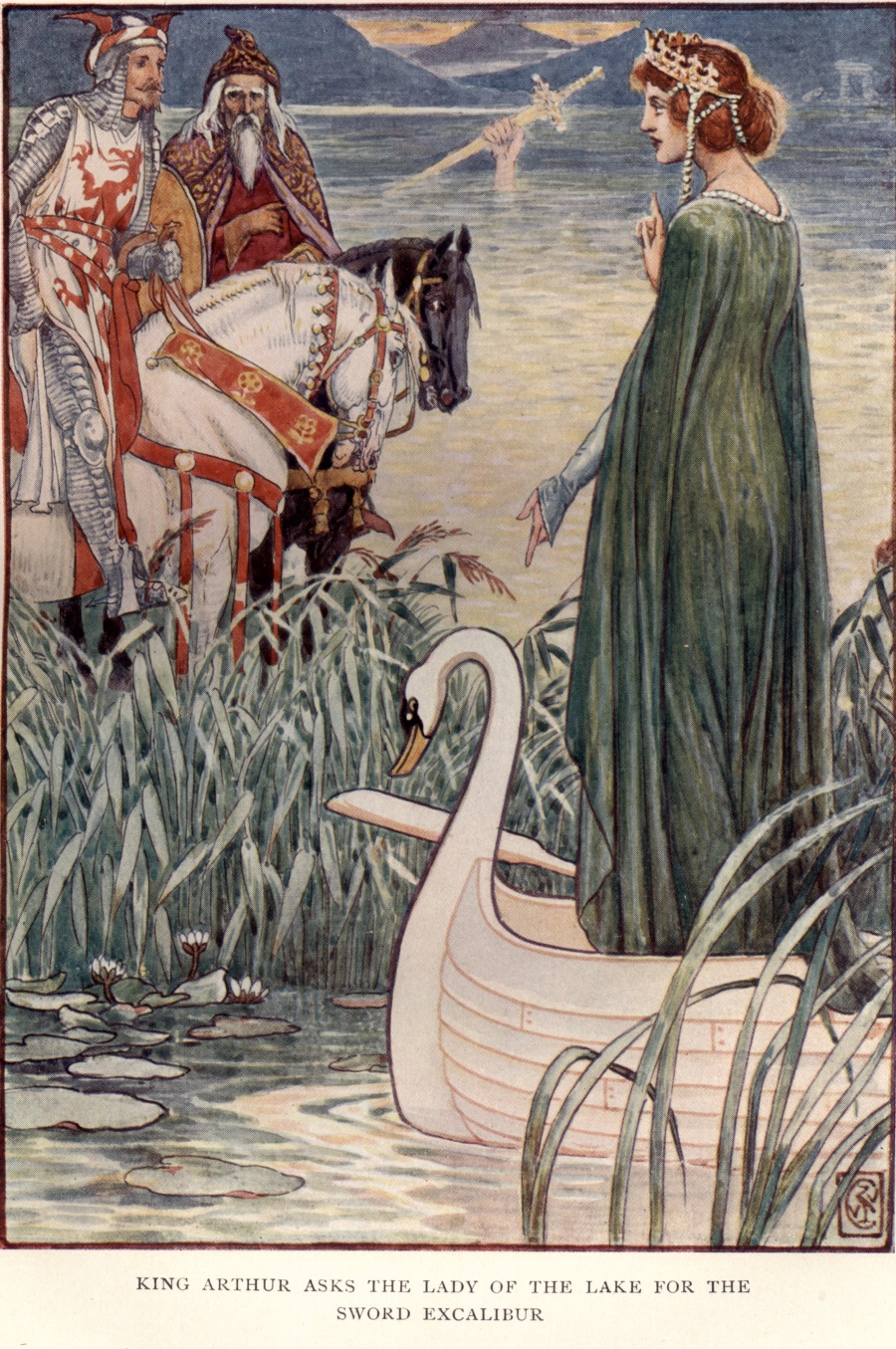
One prominent legend describes the sword embedded in a stone with an anvil upon it. Only the true heir of Uther Pendragon could pull it free, a feat accomplished by Arthur when he was still unaware of his royal lineage. Another tradition tells of a Lady of the Lake presenting the sword to Arthur after he broke his first weapon. In some accounts, the sword is returned to the lake by a knight at Arthur’s deathbed, caught by a hand emerging from the water. These narratives serve as ritualistic tests of kingship rather than practical methods of acquisition.
Tools and materials
The sword itself is often described with golden hilts featuring chimeras that emit flame-like light when drawn. Its scabbard is equally significant, said to prevent the wearer from bleeding to death. The stone and anvil serve as the testing ground for legitimacy. Morgan le Fay is associated with stealing the scabbard, highlighting the importance of these accessories in the lore.
Excalibur, drawn and placed
- Living
- Revived
- Fading
- Historical
- Legendary
- Performed
- Lineage
- Arthurian legend
What it is for
Excalibur functions primarily as a symbol of divine right and political authority. It proves Arthur’s lineage and justifies his rule over Britain. In combat, it is depicted as capable of slicing through iron as easily as wood. The scabbard offers protection, ensuring survival in battle. The sword also plays a role in Arthur’s death, as its return to the lake marks the end of his reign. It serves as a narrative device to explore themes of power, fate, and mortality.
Who does it
The sword is wielded by King Arthur, but also appears in the hands of Gawain, Griflet, and Bedivere in various texts. Merlin guides Arthur toward the sword and warns him about the value of its scabbard. Morgan le Fay interacts with the weapon through theft and duplication. Scholars study these texts to understand the evolution of Arthurian legend and the cultural significance of magical artifacts in medieval literature.
Peoples and places
The sword originates in Welsh mythology as Caledfwlch, appearing in early prose tales. Geoffrey of Monmouth introduced it to Latin chronicles, spreading the story across Europe. French romances like those by Chrétien de Troyes and the Vulgate Cycle expanded its lore. Thomas Malory compiled these traditions in Le Morte d’Arthur, cementing Excalibur’s place in English literature. Irish mythology offers parallels with Caladbolg, suggesting shared Celtic roots.
At a glance: who, where and when



What people believe
It is tied to the concept of divine appointment, where only the rightful king can wield it. The scabbard’s protective magic reflects beliefs in supernatural safeguards against death. The return of the sword to the lake signifies a cyclical view of power and destiny. These elements combine to create a mythos where magic and monarchy are inextricably linked.
When it is done
The sword in the stone contest occurs on Christmas Eve, marking a significant moment in Arthur’s youth. The final return of the sword happens during Arthur’s dying moments, often associated with the Battle of Camlann. These events anchor the sword’s narrative within specific temporal markers, emphasizing its role in key life transitions.
How scholars and sceptics see it
Researchers analyze the etymology of Caledfwlch and Caliburnus to trace linguistic shifts. Literary critics examine how different authors adapted the sword’s story to suit their themes. Historians consider the sword’s role in reinforcing ideas of legitimate rule. Some debate the connection between Welsh and Irish sword myths, while others focus on the symbolic weight of the scabbard versus the blade.
Cautions and what is closed
The sword is a fictional artifact with no real-world existence. It appears in literature and art, inspiring countless adaptations. No actual magical properties are associated with it outside of storytelling. Readers should approach it as a cultural symbol rather than a historical object.
Compare and confuse
Excalibur is often compared to other legendary weapons like Durandal or Joyeuse. It shares motifs with the Irish Caladbolg, such as magical cutting ability. The sword in the stone trope appears in various folktales globally. Unlike religious relics, Excalibur is tied to secular kingship rather than divine worship.
Questions people ask about Excalibur
What is Excalibur?
Excalibur is the mythical sword of King Arthur, said to possess magical powers and prove his right to rule Britain. It appears in many versions of the Arthurian legend, often as a symbol of sovereignty.
Where does the name come from?
The name likely comes from the Welsh Caledfwlch, meaning 'hard breach'. Geoffrey of Monmouth Latinized it as Caliburnus, which evolved into Excalibur through various French and English spellings.
How did Arthur get the sword?
In one version, Arthur pulls it from a stone with an anvil, proving his lineage. In another, a Lady of the Lake gives it to him after he breaks his first sword. Both stories highlight its magical nature.
Does the sword have special powers?
Yes, it is said to cut through iron like wood and shine brightly in battle. Its scabbard is also magical, preventing the wearer from bleeding to death, making it a crucial asset in combat.
Good reading and sources
- Excalibur on WikipediaEncyclopedia
- More photos on Wikimedia CommonsPhotos and video
- Wikidata recordOpen data
The facts on this page come from the Wikipedia article "Excalibur", written by its contributors and used under the CC BY-SA 4.0 licence, and from its Wikidata record (CC0). EveryJaadu rewrote the text in its own words, with AI assistance, and compares every page with the article to make sure no passage is copied. It may be reused under the same CC BY-SA 4.0 licence with a link back.
It may contain mistakes. Names and customs differ from one community to the next, and some knowledge is closed to outsiders and left out here. This page describes belief and practice. It does not say that any of it works, it is not a how-to, and it is not medical advice. If something is wrong, tell us. Last refreshed 2026-10-05.
More from the United Kingdom
All the entries from the United Kingdom 🇬🇧 United Kingdom and 2 moreKing ArthurBrenin Arthur
A legendary British king and folk hero of medieval literature and Welsh mythologyFigure · Power and authority · Wonder and entertainment Legendary
🇬🇧 United Kingdom and 1 moreBugbear
A medieval English creature used to frighten children into obedienceFigure · Cursing and harm Legendary
🇬🇧 United KingdomGreen Children of Woolpit
A medieval English legend about two green-skinned siblings who appeared in a Suffolk village.Figure · Wonder and entertainment Legendary
🇬🇧 United Kingdom and 2 moreKing ArthurBrenin Arthur
A legendary British king and folk hero of medieval literature and Welsh mythologyFigure · Power and authority · Wonder and entertainment Legendary
🇬🇧 United Kingdom and 1 moreBugbear
A medieval English creature used to frighten children into obedienceFigure · Cursing and harm Legendary
🇬🇧 United KingdomGreen Children of Woolpit
A medieval English legend about two green-skinned siblings who appeared in a Suffolk village.Figure · Wonder and entertainment Legendary
 🇬🇧 United KingdomMatthew Hopkins
The English witch-hunter who led the deadliest wave of executions in Britain.Figure · Cursing and harm Historical
🇬🇧 United KingdomMatthew Hopkins
The English witch-hunter who led the deadliest wave of executions in Britain.Figure · Cursing and harm Historical
Related elsewhere
All figure 🇮🇳 India and 5 moreAstrology
A divinatory practice that reads human fate through the positions of celestial bodies.Belief · Seeing and foretelling · Luck and prosperity Living
🇮🇳 India and 5 moreAstrology
A divinatory practice that reads human fate through the positions of celestial bodies.Belief · Seeing and foretelling · Luck and prosperity Living
 🇮🇳 India and 2 morePalmistry
A divination method that interprets the lines and shapes of the hand to predict fate or reveal character.Oracle · Seeing and foretelling · Power and authority Living
🇮🇳 India and 2 morePalmistry
A divination method that interprets the lines and shapes of the hand to predict fate or reveal character.Oracle · Seeing and foretelling · Power and authority Living
 🇨🇳 China and 3 moreChinese dragon龍
A legendary water deity and imperial symbol in East Asian cultureBeing · Protection · Luck and prosperity Historical
🇨🇳 China and 3 moreChinese dragon龍
A legendary water deity and imperial symbol in East Asian cultureBeing · Protection · Luck and prosperity Historical
 🇮🇳 India and 1 moreGarba
A Gujarati circle dance performed around a central symbol during NavaratriIllusion · Power and authority · Luck and prosperity Living
🇮🇳 India and 1 moreGarba
A Gujarati circle dance performed around a central symbol during NavaratriIllusion · Power and authority · Luck and prosperity Living